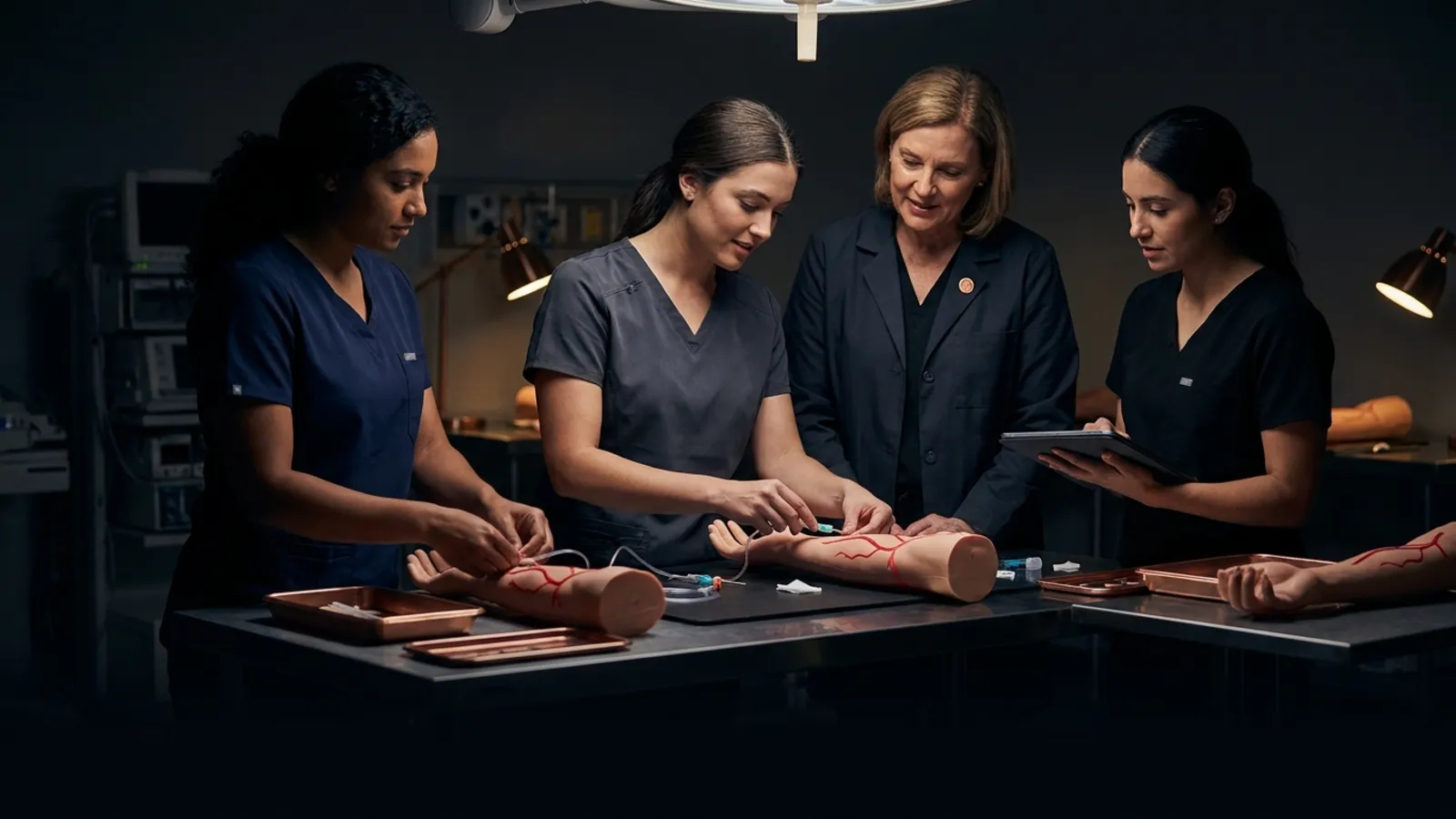
Peripheral IV placement training for nurses is hands-on education in starting a peripheral intravenous catheter, covering vein assessment, insertion mechanics, flash recognition, securement, and complication basics through supervised practice. Strong programs also train the mental side of placement so your hands stay usable when a patient, preceptor, or charge nurse is watching.
If you searched for peripheral IV placement training for nurses, you are usually past the awareness stage. You already know the skill matters. You want a course that treats PIV placement as mastery practice, not a checkbox you clear once in orientation and hope sticks for the rest of your career.
This guide owns the placement curriculum question: what peripheral IV placement training should teach, which formats actually build first-attempt skill, who needs it now, and how to choose a program that develops competence under observation. For the broader insertion-language landscape, see IV insertion training for nurses. For a first-year practice plan, use our IV training for new nurses roadmap.
What peripheral IV placement means at the bedside
Peripheral IV placement is the act of inserting a short catheter into a peripheral vein so fluids, medications, or blood products can run through a continuous line. Nurses also call it an IV start, PIV insertion, or cannulation. Educators and infusion standards lean toward cannulation. Unit language leans toward placement and insertion. The skill is the same.
What changes is the judgment wrapped around the stick: site selection, gauge choice, when to stop, when to escalate, and how you regulate your nervous system between tourniquet and flash. Placement training that only drills the puncture sequence leaves the hardest part untrained.
According to a 2015 review in the Journal of Infusion Nursing, roughly half of peripheral IV catheters fail before therapy is complete. Placement technique, site choice, and securement all feed that failure rate. Training that ignores those pieces produces nurses who can get flash and still lose the line an hour later.
What peripheral IV placement training for nurses should cover
A placement curriculum worth your money builds skill in a deliberate order. Skip the early pieces and later "tips" do not stick.
- CNS readiness before the stick. Placement collapses when your heart rate spikes and your fine motor control disappears. Psychology-first training teaches breathing, grounding, and a short pre-stick routine before you chase angles. See the psychology of IV insertion.
- Vein assessment and site hierarchy. Inspection, palpation, and knowing when a pretty vein is the wrong vein for the therapy planned.
- Device and gauge selection. Matching catheter size to vein caliber and intended use. Our IV catheter size selection guide covers the clinical logic.
- Placement mechanics. Skin traction, approach angle, depth, flash recognition, catheter advance, and blood-control handling until the motion is muscle memory.
- Securement and dressing. A placed line that migrates is a delayed miss. Securement is part of placement, not an afterthought.
- Complication literacy. Early infiltration, blown veins, and when to pull and restart. See IV infiltration signs and treatment and blown veins: causes and prevention.
- Supervised live sticks with feedback. Observed placements on real veins. Simulation prepares you. Live sticks finish the job.
According to the Infusion Nurses Society (INS) Standards of Practice, documented training plus supervised performance is the baseline for IV competence. A placement course that cannot describe its observation model is selling attendance, not skill.
Landmark-based placement vs ultrasound-guided PIV
Most nurses searching for peripheral IV placement training for nurses need landmark-based skill first: palpation, visualization, and placement without a probe. Ultrasound-guided peripheral IV (UGPIV) is a second layer for difficult access, not a substitute for foundational placement.
| Training layer | Focus | When it fits | Typical cost |
|---|---|---|---|
| Landmark-based PIV placement | Palpation, angle, flash, securement | New grads, floor nurses rebuilding basics, mobile IV providers | $199-$450 |
| Hybrid placement + simulation | Sequence practice on arms or pads | Early exposure; weak alone for bedside confidence | $125-$350 |
| Ultrasound-guided PIV | Probe handling, vessel mapping, needle visualization | After landmark competence; DIVA, critical care, flight | $350-$500+ |
Bottom line: If you still hesitate on average arms, buy landmark-based peripheral IV placement training first. Ultrasound will not fix shaky basics. When you are ready for the probe layer, read ultrasound-guided IV training and when to use ultrasound for IV access.
Placement training formats compared
Not every course that mentions "PIV" gives you enough coached placements to change your next shift.
| Format | What you get | Supervised live placements | Best fit |
|---|---|---|---|
| Unit orientation / precepting | Policy, pumps, whatever volume your assignment supplies | Highly variable | Employed nurses with strong preceptors |
| Online PIV module | Theory, quiz, certificate of completion | None | Knowledge refresh only |
| Weekend workshop | Group lecture plus rubber-arm practice | Limited or none | Exposure, not mastery |
| Hands-on placement intensive | Small group, individual coaching, live sticks | High | Nurses who need real first-stick skill |
| Multi-day certification track | Didactic hours plus clinical documentation | Moderate to high | Nurses needing formal credential paperwork |
Bottom line: Ask one question before you enroll: how many supervised peripheral IV placements will I perform on real veins, with feedback? If the answer is vague, keep looking. Format math is covered in more depth in online vs hands-on IV training and IV training programs compared.
Who needs peripheral IV placement training
New graduate nurses. School labs rarely supply enough live placements. Your first real sticks often happen on the floor with an audience. Structured placement training early prevents years of avoidance. Pair a course with the new grad IV confidence guide.
Experienced RNs who avoid hard sticks. You can place most easy IVs and still quietly route difficult arms to someone else. That is a placement training gap, not a personality flaw.
LPNs and LVNs expanding scope. Many states require a board-approved IV course before placement is within scope. Start with the LPN IV certification guide and confirm your board rules.
Mobile IV and infusion nurses. Failed placement in a client's home or chair is a reputation problem. Placement skill is the product.
Nurses preparing for ER, ICU, or flight. Specialty units assume you can place under pressure. Foundational placement training is the entry ticket; advanced access comes later.
How to evaluate a PIV placement course
Use this checklist before you pay.
- Live sticks, not simulation only. Arms teach sequence. Patients teach judgment.
- Low student-to-instructor ratio. Individual coaching beats lecture-hall observation.
- Psychology included. If nobody names the stress response, your hands will still shake on hard days.
- Mastery-based progression. You advance when you demonstrate competence, not when the agenda says lunch.
- Transparent pricing and schedule. Know the cost, duration, and what supplies are included.
- Clear scope honesty. A course certificate of completion is not the same as national specialty certification. See what is IV certification if credential language is fuzzy.
- A path after class day. Stick Lab style practice or a defined next skill layer keeps placement from decaying.
VeinCraft Academy Level 1: The Method was built against that checklist. Credentialed clinicians with active field experience teach an 8-hour intensive that pairs psychology-first instruction with simulation and live sticks at a 10:1 student-to-instructor ratio. Students advance when they demonstrate competence. Level 1 starts at $199. Level 2: The Craft at $299 extends into hard sticks, special populations, and ultrasound-guided access once your placement foundation holds.
What a strong placement day looks like
A useful peripheral IV placement training day is not eight hours of slides with a late-afternoon lab.
Morning: CNS management, vein assessment, gauge logic, and placement mechanics broken into coached micro-skills.
Midday: High-repetition simulation so the catheter motion stops feeling novel.
Afternoon: Supervised live sticks with real-time correction. You place, you get feedback, you place again.
Close: Personal coaching notes, complication review, and a practice plan for your next two weeks on the unit.
That sequence compresses what orientation often spreads thinly across months. It is also why class size caps matter. Ten students with one instructor can get individual coaching. Twenty cannot.
Common mistakes when choosing placement training
- Buying the cheapest online module and calling it placement training. Video cannot teach tactile flash or composure under observation.
- Jumping straight to ultrasound. Probe skills on top of weak landmark placement create expensive false confidence.
- Treating orientation sign-off as mastery. A checked competency form means you met a minimum once.
- Ignoring the mental game. Technique without CNS control fails the first time the vein rolls in front of family.
- Skipping practice after class. Placement skill decays without deliberate reps. Home drills and drop-in practice keep the sequence warm. See IV practice at home tips.
Ready to train placement like it matters
Peripheral IV placement is the skill your colleagues notice first. Misses are public. Clean placements build the quiet reputation that opens ER, ICU, flight, and infusion doors.
If you want peripheral IV placement training for nurses that prioritizes live sticks, psychology, and mastery-based coaching, start with VeinCraft Academy Level 1 at $199. When you are ready for hard sticks and ultrasound-guided access, move into Level 2 at $299, or take the Master the Craft bundle at $449.
Become the nurse everyone calls when the arm looks difficult. That identity starts with placement training that demands competence, not attendance.
What is peripheral IV placement training for nurses?
Peripheral IV placement training for nurses is supervised education in starting a short peripheral IV catheter, including assessment, insertion mechanics, securement, complication recognition, and coached practice. The goal is bedside competence on real veins, not a quiz score from an online module.
How is PIV placement training different from IV certification?
Placement training builds the psychomotor skill through practice and feedback. IV certification usually means a credential pathway such as CRNI, VA-BC, state LPN authorization, or a course completion certificate. You may need training, a credential, and employer competency validation at different points. Our IV certification course guide maps those layers.
How many supervised placements should a course include?
Look for programs that can describe observed stick volume and feedback quality, not just seat time. Foundational competence often clusters around 25 supervised attempts across real patients, with broader proficiency closer to 100 varied sticks. Details are in how many IV sticks to become proficient.
Can new nurses take peripheral IV placement training during orientation?
Yes. Many new grads take a focused placement intensive during or right after orientation because unit precepting alone is inconsistent. Earlier structured practice reduces the chance that avoidance becomes your default by month three.
Does VeinCraft Academy teach landmark-based peripheral IV placement?
Yes. Level 1: The Method is landmark-based peripheral IV placement training with psychology, technique, simulation, and live sticks. Ultrasound-guided placement belongs in Level 2 after your foundation is solid. All courses are taught by credentialed clinicians with active field experience under a standardized, mastery-based curriculum. VeinCraft Academy is a RevivaGo Company.
How much does peripheral IV placement training for nurses cost?
Hands-on intensives typically run $199 to $450. Online theory courses cost less but do not include live placements. Ultrasound-focused courses often run $350 to $500+. VeinCraft Academy Level 1 starts at $199 for an 8-hour placement intensive with individual coaching.
VeinCraft Academy is a mastery-focused IV cannulation training program for healthcare professionals. All instruction is delivered by credentialed clinicians with active field experience. VeinCraft Academy is a RevivaGo Company.