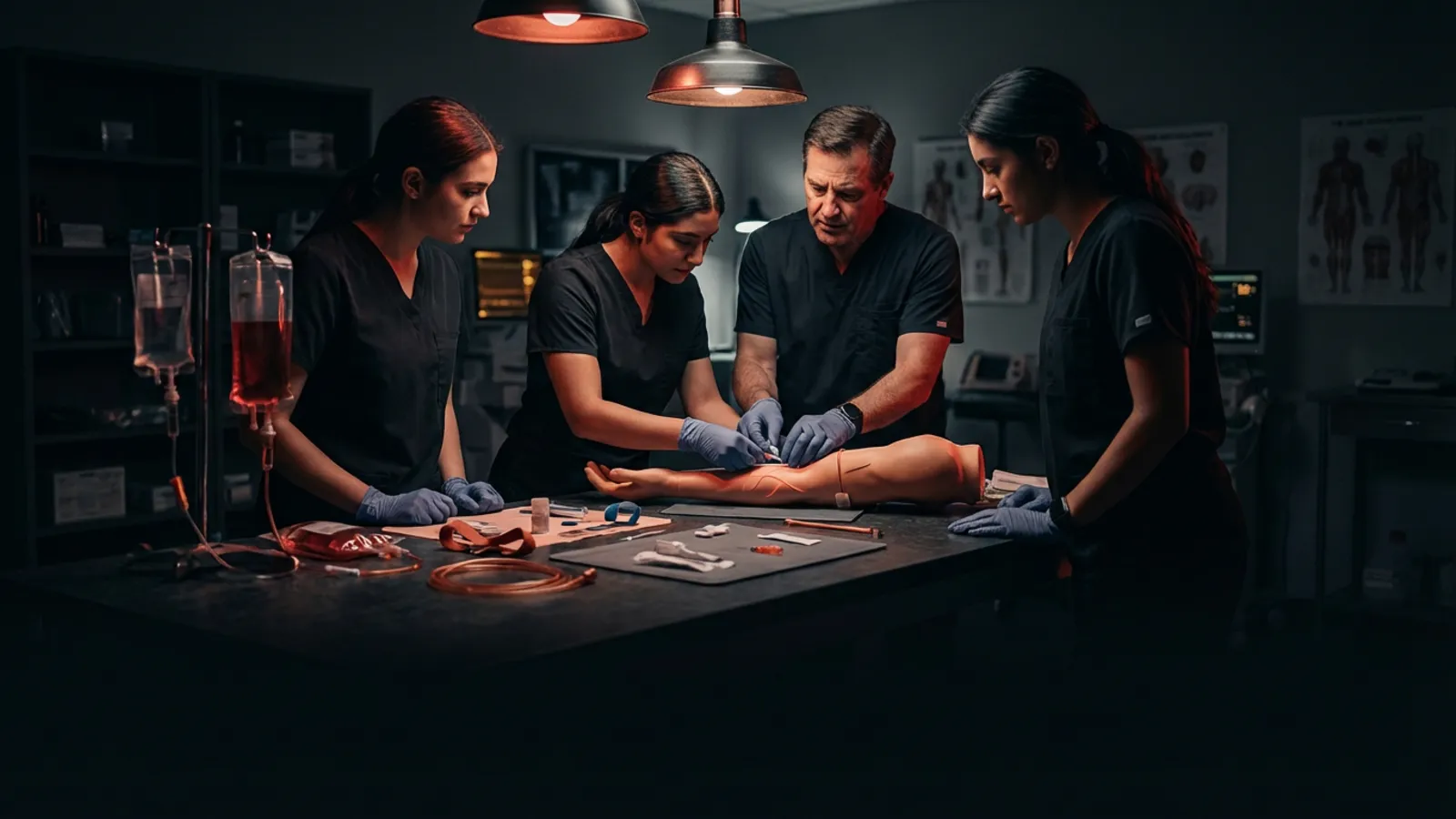
The right IV training program depends on three variables: how much hands-on practice you need, how much you can spend, and whether you require accredited continuing education credit. Most healthcare professionals choose between hospital in-service training (free, inconsistent), online-only courses ($150-$350, no live practice), weekend workshops ($250-$300, mostly rubber arms), specialty hands-on intensives ($199-$500, real patients), and multi-day classroom programs ($300-$500, supervised clinical hours). This guide compares each format on the variables that actually predict skill outcomes.
If you have searched "IV training programs near me," you are looking for a real answer to "which one is worth my money." This is a buyer's guide, not a sales page. Some programs solve some problems. The wrong program for your situation is expensive even when it is cheap.
How to evaluate any IV training program
Before reading the format-by-format comparison, decide which of these criteria matter most for your situation:
- Hands-on time with real patients. Cannulation skill is built through supervised live sticks, not videos. The best predictor of skill is the number of supervised attempts on real human anatomy.
- Instructor-to-student ratio. A class of 50 with one instructor is a lecture. A class of 10 with one instructor is a coaching session. The ratio determines how much individual technique correction you receive.
- Curriculum scope. Some programs cover only basic peripheral cannulation. Others include hard sticks, special populations, and ultrasound-guided access. Match scope to the patients you will actually encounter.
- Psychology component. Few programs teach the mental game (CNS management, calm under pressure, recovery from missed attempts). The ones that do produce more confident graduates.
- Accreditation. If your employer or state board requires CEUs, accreditation matters. If skill is the priority and CEUs are a future bonus, it matters less.
- Schedule and location. A great course you cannot attend is worthless. Mobile/on-site programs that travel to local venues solve the geography problem for many providers.
- Total cost (including travel). A "free" hospital in-service may cost less in dollars but more in inconsistent quality. A $199 intensive day with full hands-on may be cheaper than a $250 weekend workshop with limited live sticks.
The same program is the right answer for one provider and the wrong one for another. The variables above are how you tell which.
Format-by-format comparison
Hospital in-service IV training
What it is: On-the-job training as part of orientation or unit competency, typically 4 to 16 hours combining classroom and preceptor-supervised attempts.
Pros: Free to the employee, accepted as competency documentation by the hiring institution, integrates with the workflow you actually do.
Cons: Quality varies enormously by preceptor and unit volume. Some new nurses get 30 supervised sticks in their first month. Others get 3. The mental game (psychology, CNS management) is rarely covered. There is no standardized curriculum.
Best for: New hires whose hospital has a strong, structured IV training program with consistent preceptor coverage. If your unit's IV training is hit-or-miss, it is not the right primary training source.
Online-only IV courses
What it is: Video-based modules with quizzes and a certificate of completion, often $150 to $350 for 4 to 8 hours of theory.
Pros: Scheduling flexibility, often CEU-bearing, reasonable price for theory, useful as supplemental education.
Cons: Cannot build cannulation muscle memory. Watching a video of a stick is not the same as performing one with feedback. Studies of skill acquisition consistently show that hands-on repetition under coaching produces materially better outcomes than passive viewing. Our deeper analysis on online vs hands-on IV training explains why.
Best for: Theory refreshers, CEU credit when you cannot leave home, or as a supplement to hands-on training. Not as a primary training source.
Weekend workshops (rubber arm only)
What it is: 4 to 8 hour group classes using simulation arms or pads. Class sizes often 15 to 30 students. $250 to $300.
Pros: Some hands-on practice in a safe environment, often CEU-bearing, lower cost than multi-day programs.
Cons: Rubber arms do not roll, do not blow, and do not bleed when you blow them. Skill transfer to real patients is limited. Group settings limit individual feedback. Many graduates report walking out feeling more confident but freezing on their first real-patient stick. Our piece on why IV training programs fail covers this in depth.
Best for: Awareness of the procedure for non-clinical adjacents, or as a primer before a hands-on intensive.
Hands-on intensives with live sticks
What it is: 1 to 2 day intensives that combine psychology, anatomy, technique, and supervised cannulation on real patients. $199 to $500. Class sizes typically 10 or fewer.
Pros: The strongest predictor of skill. Real patients, real feedback, real recovery from missed attempts. Smaller class sizes allow individual coaching. Often includes the psychology component that other programs skip.
Cons: Schedule-dependent (you have to attend on specific dates). Quality varies by instructor and curriculum. Few programs are accredited for CEUs at the time of writing.
Best for: Working professionals who want a meaningful skill upgrade in a short timeframe. Mobile IV providers, new ICU/ER nurses, paramedics adding scope, and anyone who has hit a plateau on their current first-stick rate.
Multi-day classroom + clinical programs
What it is: 3 to 5 day programs combining classroom theory with supervised clinical practice in a partner hospital or clinic setting. $300 to $500. Often accredited for substantial CEU credit.
Pros: Comprehensive curriculum, accredited credit, structured progression, typically 20 to 40 supervised live sticks across the program duration.
Cons: Significant time commitment that working professionals struggle to schedule. Higher total cost when factoring travel, lodging, and lost shifts. Often over-engineered for someone who just needs a focused skill upgrade.
Best for: Career-change nurses entering critical care, paramedics moving to flight medicine, or institutions sending entire cohorts for standardized training.
Specialty courses (UGPIV, INS-style certificates)
What it is: Narrowly focused courses on specific subspecialties, most commonly ultrasound-guided peripheral IV access (UGPIV). $350 to $500 for a 1 to 2 day intensive.
Pros: Deep skill development in the specific subspecialty. Often accredited. Strong fit for clinicians who already have a peripheral IV foundation and need the next-level skill.
Cons: Limited scope. Does not address foundational technique gaps. A clinician who blows veins on standard peripheral access will not be helped by an UGPIV course alone. Our when to use ultrasound for IV access decision guide covers when UGPIV training is the right next step.
Best for: ER, ICU, flight, and critical care providers with solid peripheral cannulation foundation who need to add ultrasound-guided technique.
Side-by-side comparison
| Format | Hands-on with real patients? | Class size | Typical cost | CEU bearing? | Time commitment |
|---|---|---|---|---|---|
| Hospital in-service | Yes (variable) | 1:1 with preceptor | Free | Sometimes | 4-16 hrs over orientation |
| Online-only | No | N/A | $150-$350 | Often | 4-8 hrs self-paced |
| Weekend workshop (rubber arm) | Limited | 15-30 | $250-$300 | Usually | 1-2 days |
| Multi-day classroom + clinical | Yes (supervised) | 10-20 | $300-$500 | Yes | 3-5 days |
| Specialty courses (UGPIV) | Yes (narrow) | 6-12 | $350-$500 | Yes | 1-2 days |
| VeinCraft Academy Level 1 | Yes (live sticks) | Up to 10 | $199 | Pending accreditation | 1 day (8 hrs) |
| VeinCraft Academy Level 2 | Yes (hard sticks + UGPIV) | Up to 10 | $299 | Pending accreditation | 1-2 days |
| VeinCraft Bundle (Master the Craft) | Yes (full progression) | Up to 10 | $449 | Pending accreditation | 2-3 days |
Bottom line: The right program is the one that matches your skill gap, schedule, budget, and credit requirements. For most working professionals who want a meaningful skill upgrade without a multi-week commitment, hands-on intensives with live sticks deliver the strongest skill-to-time-to-money ratio.
Key questions to ask before you enroll
When you are evaluating any IV training program, ask the program directly:
- How many supervised live sticks will I perform during the course? A specific number is the answer you want. Vague language about "ample practice" is the answer to avoid.
- What is the student-to-instructor ratio? Anything beyond 10:1 limits how much individual feedback you receive on technique.
- What does the curriculum cover beyond basic peripheral access? Hard sticks, special populations, ultrasound-guided technique, and the psychology of the stick are the elements that separate proficiency from competence.
- Who teaches it, and what are their credentials? Look for active clinical practice, not just teaching tenure.
- Is the certificate accepted by my state board or employer? If credit matters to you, verify before enrolling.
- What is the refund or reschedule policy? Schedule conflicts happen. The good programs accommodate them.
- What happens after the course? Practice opportunities, alumni community, and ongoing skill maintenance separate one-and-done courses from professional development partners.
If a program cannot answer these questions clearly, the lack of clarity is the answer.
Why VeinCraft Academy fits a specific niche
VeinCraft Academy is a hands-on intensive built specifically for working healthcare professionals who want a meaningful skill upgrade without a multi-week commitment.
What we do well:
- Live sticks on real patients at a 10:1 student-to-instructor ratio, with credentialed clinical instructors actively practicing in the field.
- Psychology-first curriculum that addresses the mental game most programs skip (why your hands shake, why you freeze, how to manage your CNS under clinical pressure).
- Mastery-based progression where students advance when they demonstrate competence, not when the clock runs out.
- Affordable pricing at $199 for Level 1: The Method and $299 for Level 2: The Craft, well below comparable accredited courses.
- Mobile delivery model so we can travel to partner venues across the Phoenix metro and (with the right venue partner) any market with a qualified instructor.
What we do not do:
- CEU accreditation (yet). We are on an active accreditation path. If your employer requires accredited continuing education for reimbursement, an alternative may be the better fit until our accreditation lands.
- Online-only theory courses. We are exclusively hands-on. If you need video-only theory, look elsewhere.
- Multi-week certification programs. We are an intensive skill-builder, not a career-credentialing program.
If your situation matches what we do, we are likely the right answer. If your situation calls for one of the other formats, the comparison table above points you in the right direction.
How do I find IV training programs near me?
Start by searching for "IV training [your city]" or "IV cannulation course [your state]" on Google. Filter by hands-on programs that include live patient practice, not just rubber-arm simulation. Many strong programs operate on a mobile/on-site model, which means availability depends more on whether they have a venue partner in your area than on a permanent campus. VeinCraft Academy operates in the Phoenix metro and expands to new markets when a qualified instructor and venue partner are in place.
What is the best IV training course for nurses?
The best IV training course for a nurse depends on the skill gap, the budget, and whether CEUs are required. New grads benefit most from hands-on intensives with live patient practice and a psychology component to address first-stick anxiety. Experienced nurses moving into ICU, ER, or critical care benefit from intensive courses that include hard sticks, special populations, and ultrasound-guided technique. Online-only courses work as supplements but rarely as primary training.
How much do IV training programs cost?
IV training programs range from free (hospital in-service) to $500 (multi-day accredited intensives). Online-only courses typically run $150 to $350. Weekend workshops with limited hands-on practice run $250 to $300. Hands-on intensives with live patient practice run $199 to $500. Specialty UGPIV courses run $350 to $500. The cheapest option is rarely the right answer if it does not deliver the skill outcome you need.
Can I take an IV training course as a non-nurse?
Most IV training programs accept paramedics, EMTs, mobile IV business operators, nursing students entering clinical rotations, and other healthcare professionals whose scope of practice includes vascular access. Programs typically require an active healthcare credential as enrollment evidence. Non-clinical workers without a path to using IV skills on patients are usually not the right fit, regardless of the program.
Are weekend IV workshops worth it?
Weekend IV workshops are worth it for awareness of the procedure, but rarely for skill mastery. The combination of short duration, group settings, and rubber-arm practice limits how much skill transfers to real patients. Workshops can be a useful primer before a hands-on intensive with live sticks, or as a CEU-bearing refresher. They are not a substitute for supervised practice on real anatomy when you need to build first-stick confidence.
Ready to choose?
If you have read this far, you have a clearer picture of which format fits your situation. If that picture points to a hands-on intensive with live sticks, an affordable price, a small class size, and a psychology-first curriculum, VeinCraft Academy is built for exactly that profile. Level 1: The Method is $199. Level 2: The Craft is $299. The bundle saves $49 and includes a free practice kit.
Enroll now or come to the next class with questions. Either way, the goal is the same: a real skill upgrade that shows on your next shift.
VeinCraft Academy is a mastery-focused IV cannulation training program for healthcare professionals. All instruction is delivered by credentialed clinicians with active field experience. VeinCraft Academy is a RevivaGo Company.