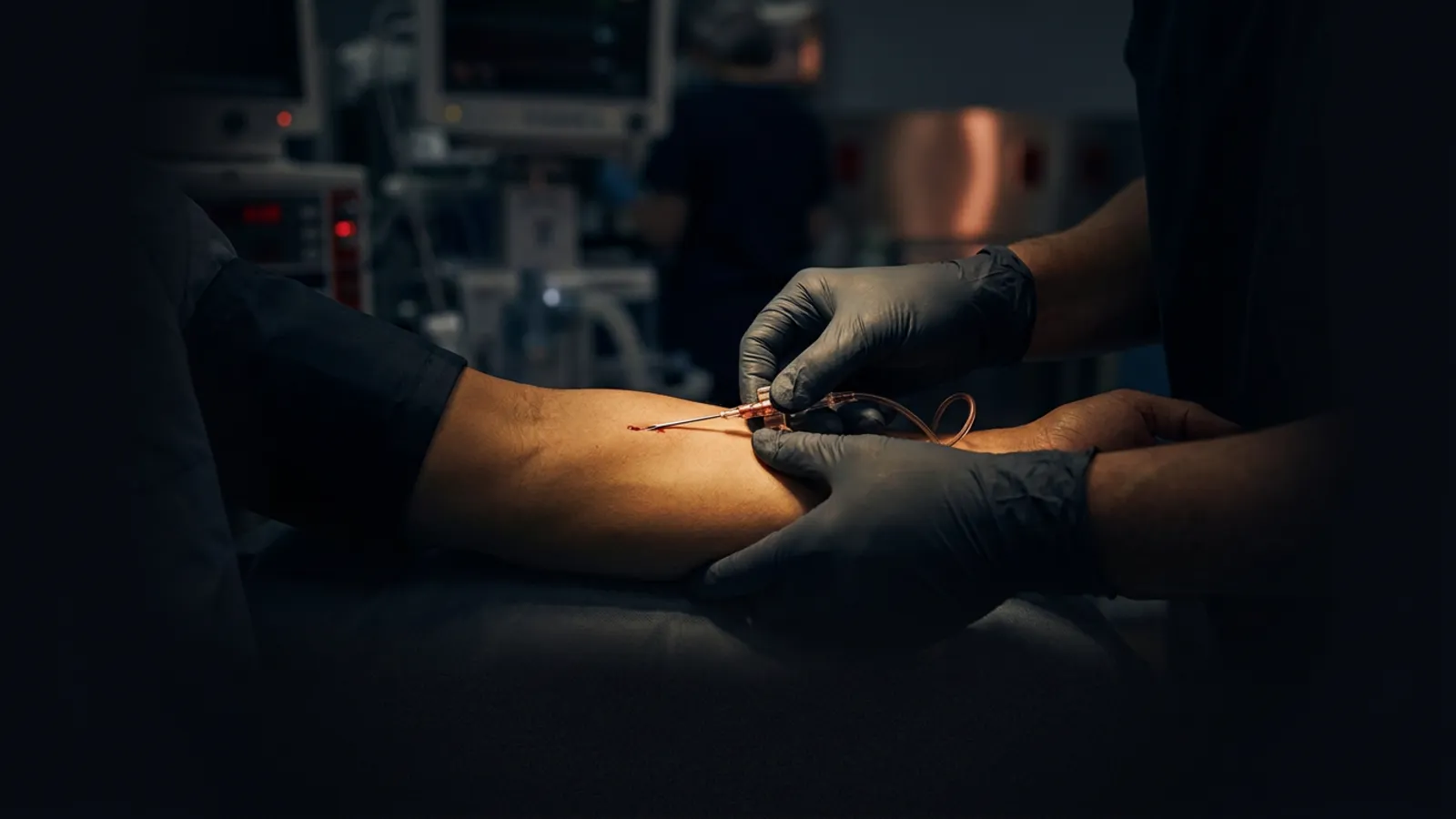
IV insertion training for nurses is supervised education in peripheral IV catheter placement, covering vein assessment, insertion technique, flash recognition, line securing, and complication basics through hands-on practice on real veins. Effective programs pair procedural instruction with performance psychology so nurses build bedside confidence, not just procedural awareness from a lecture or video module.
Most nurses search "IV insertion training" because that is the language they use at the bedside: "I need to start an IV," "can you help with this insertion," "my insertion technique falls apart on hard veins." Clinical educators and specialty programs often use "cannulation" for the same skill. The procedure is the same. The search terms differ. This guide uses both deliberately: it explains what hands-on insertion programs actually deliver, how they compare to cannulation-focused courses, what to look for before you enroll, and how to choose a format that builds skill you trust on your next shift.
IV insertion vs. cannulation: same skill, different search language
In clinical practice, IV insertion and IV cannulation describe the same procedure: placing a peripheral catheter into a vein for intravenous access. Nurses, preceptors, and floor staff usually say "insertion" or "IV start." Textbooks, infusion standards, and specialty training programs often say "cannulation."
Neither term is wrong. Cannulation is the precise clinical term for introducing a cannula (catheter) into a vein. Insertion is the procedural language nurses use when describing the act at the bedside. If you searched for IV insertion training for nurses, you are looking for the same hands-on skill development covered in a cannulation course for nurses. VeinCraft Academy teaches cannulation in our curriculum because precision matters in clinical documentation and specialty practice. We also recognize that many nurses find training through insertion-language searches, and both paths should lead to the same outcome: competent, confident vascular access.
For the patient communication side of insertion (word choice that affects vein caliber and cooperation), see how to talk to patients during IV insertion. For the provider anxiety side, read IV insertion anxiety in nurses.
What IV insertion training for nurses should cover
A program worth your time develops four competencies, not just the mechanical sequence.
Vein assessment and site selection. Palpating depth, diameter, and direction; matching catheter gauge to vein caliber; knowing when to move to a different site. See vein anatomy for IV cannulation for the anatomical foundation.
Insertion mechanics. Skin traction, approach angle, flash recognition, catheter advancement, and securing the line. The goal is repeatable motion under observation, not a checklist you recite while your hands shake.
Complication recognition. Infiltration, blown veins, extravasation risk, and when to stop and escalate. Nurses look these up during shifts; training should prepare you before the moment arrives.
Performance psychology. Managing your stress response when a patient watches, a colleague waits, or the vein rolls mid-stick. Programs that skip this produce nurses who perform on simulation arms but hesitate on live patients. The psychology of IV insertion explains why the mental game carries as much weight as technique.
According to the Infusion Nurses Society (INS) Standards of Practice, IV competence requires documented training plus supervised performance. IV insertion training that meets that standard gives you observed sticks, instructor feedback, and a record of what you demonstrated.
Types of IV insertion training programs compared
Not every course labeled "IV therapy" delivers meaningful insertion practice. Use this table to compare formats.
| Program type | Format | Typical cost | Supervised insertion reps | Best for |
|---|---|---|---|---|
| Hospital orientation | Preceptor-led on unit | Free (employer) | Variable; depends on patient volume | Employed nurses; quality varies by preceptor |
| Online IV course | Video plus quiz | $50-$250 | None | Theory refresh; not insertion training |
| Hybrid workshop | Online didactic plus sim lab | $250-$400 | Limited; often simulation arms only | Exposure, not mastery |
| Hands-on insertion intensive | Small group, live patient practice | $199-$450 | High; coached sticks on real veins | RNs, LPNs, paramedics building real skill |
| Multi-day certification program | Didactic plus clinical hours | $300-$640+ | Moderate to high; varies widely | Nurses needing documented hours plus certificate |
Bottom line: Hands-on insertion training requires supervised practice on real veins. If a program cannot tell you how many observed insertions each student performs, you are buying awareness, not competence. For a detailed format comparison, read online vs hands-on IV training.
IV insertion training vs. certification vs. competency
Three terms get conflated in nursing searches. They answer different questions.
IV insertion training builds the psychomotor skill: coached practice, instructor feedback, muscle memory on real anatomy. Output: improved technique and documented training hours.
IV certification refers to credentials: CRNI, VA-BC, state LPN/LVN authorization, or a course completion certificate filed with your employer. Output: a credential that satisfies hiring or scope requirements. See our IV certification course guide for nurses.
IV competency is what your employer validates annually: observed performance against a skills checklist, often without an external exam. Output: permission to practice IV therapy on that unit. See IV competency for nurses.
You may need all three layers at different career stages. Insertion training builds the skill. Certification documents it for boards or specialty roles. Competency validation keeps it current with your employer. For the full training landscape, start with IV training for nurses.
What to look for in IV insertion training
Evaluate any program against these criteria before you pay.
Live sticks on real patients or volunteers. Simulation teaches the visual sequence. Real veins teach rolling, fragile skin, vasoconstriction from anxiety, and the social pressure of performing under observation. Ask: how many supervised insertions does each student perform?
A low student-to-instructor ratio. Individual coaching is where angle, depth, and flash recognition get corrected. Look for 10:1 or better. Meet our instructors, credentialed clinicians with active field experience.
Psychology in the curriculum. Technique without nervous-system training leaves you competent on easy veins and hesitant on hard ones. Programs that address CNS management produce nurses who perform when observed, not just in a quiet skills lab.
Mastery-based progression. Clock-hour programs advance everyone on schedule regardless of demonstrated skill. Mastery-based programs advance you when an instructor observes competence. That aligns with how hospitals validate IV competency.
A path to keep practicing. One intensive day builds a foundation; skill decays without repetition. Programs with post-course practice access help you hold what you built. See IV practice at home tips and how to maintain IV competence.
For why many programs fail these criteria, read why IV training programs fail.
How much does IV insertion training for nurses cost?
Pricing reflects format and depth more than marketing language.
- Online-only courses: $50-$250. Useful for theory. Not insertion training in the hands-on sense.
- Hybrid workshops: $250-$400. Confirm live stick count and instructor ratio before booking. Many allocate most hours to didactic content and simulation.
- Hands-on intensives: $199-$450. VeinCraft Academy Level 1: The Method runs $199 for an 8-hour intensive with psychology, anatomy, technique, simulation drills, and live cannulation on real patients with individual coaching at a 10:1 ratio. Level 2: The Craft at $299 extends into hard sticks, special populations, and ultrasound-guided peripheral IV access.
- Multi-day programs: $300-$640+. More hours do not automatically mean more supervised insertions. Ask how clinical time is allocated.
Research published in the Journal of the Association for Vascular Access notes that first-attempt peripheral IV insertion fails in a meaningful share of adult patients, with difficult venous access common across hospital populations. Insertion training that lowers your miss rate pays for itself in patient trust, colleague confidence, and (for mobile IV providers) client retention.
Who needs IV insertion training?
The right program depends on where you are in your career.
New graduates and nursing students. Limited school practice leaves a gap before the first real patient stick. Early structured training prevents years of avoidance. Start with new grad IV confidence and IV cannulation training before your first stick.
Experienced RNs who route hard sticks to someone else. Competent on easy veins, hesitant on dehydrated, rolling, or pediatric access? That is a training gap. Insertion training focused on difficult access closes it.
LPNs and LVNs in states with IV scope requirements. Many states require board-approved IV training before LPNs perform insertion independently. Verify your state rules first. See our LPN IV certification guide.
Paramedics, EMTs, and mobile IV providers. Field conditions and client homes demand first-attempt confidence. Failed insertions in front of a patient or a paying client carry real cost.
How VeinCraft Academy delivers IV insertion training for nurses
VeinCraft Academy teaches IV cannulation using clinical precision in our curriculum, but the skill we build is the same one nurses describe as IV insertion: supervised catheter placement on real anatomy, preceded by training your nervous system to stay calm under observation.
Our curriculum starts with psychology, not catheter gauge. Before insertion mechanics, we address how performance pressure affects hand steadiness and decision-making. Level 1: The Method covers anatomy, site selection, flash technique, complication basics, simulation drills, and live insertion practice on real patients with credentialed clinical instructors who maintain active field practice.
Progression is mastery-based. You advance when instructors observe competence, not when the clock runs out. Class sizes cap at 10 students so every person gets individual coaching. At $199, Level 1 sits below most hybrid IV programs ($250-$400) while delivering more supervised stick time than typical simulation-only workshops.
Level 2: The Craft extends insertion training into hard sticks, special populations, and ultrasound-guided peripheral IV access for nurses ready to become the go-to person on their unit.
Ready to move from knowing the steps to trusting your hands? Explore enrollment or compare Level 1 and Level 2.
What is IV insertion training for nurses?
IV insertion training for nurses is hands-on education in peripheral IV catheter placement that includes vein assessment, insertion technique, flash recognition, line securing, and complication basics, with supervised practice on real veins. It differs from online IV theory courses because it builds muscle memory and bedside confidence through observed insertion reps, not video completion alone.
Is IV insertion training the same as cannulation training?
Yes, for peripheral IV access. Insertion is the procedural language nurses use at the bedside; cannulation is the clinical term for placing a catheter into a vein. Both describe the same skill. Programs may use either term in their marketing; what matters is how many supervised sticks on real veins the course includes.
Can I learn IV insertion online?
Partially. Online modules work for anatomy, policy, and procedural theory. The insertion skill itself requires hands-on practice with instructor feedback on real veins. Treat online-only programs as supplements, not replacements for supervised insertion training.
How many IV insertions should training include?
Research on clinical skill acquisition suggests 25 to 50 successful insertions before the skill becomes reliably automatic. Ask any program how many supervised sticks each student performs. If the answer is "we watch a demo" or "one stick per person in a large group," keep looking.
How much does IV insertion training for nurses cost in 2026?
Hands-on insertion training typically runs $199 to $450 for single-day or multi-session intensives. Online theory courses run $50 to $250 but do not include live practice. Multi-day certification-track programs run $300 to $640+. VeinCraft Academy Level 1 starts at $199 for an 8-hour intensive with live insertion practice and individual coaching.
Do RNs need IV insertion training to start IVs?
RNs can legally perform peripheral IV insertion under their license in every U.S. state without a separate certification. Many RNs still pursue insertion training to build confidence, satisfy employer competency documentation, or prepare for specialty roles. LPNs and LVNs may need state-approved IV training depending on where they practice.
Insertion training is how you close the gap between knowing the procedure and performing it when the vein is difficult and someone is watching. Choose a program with live sticks, low instructor ratios, psychology in the curriculum, and credentialed clinicians who still practice at the bedside. Whether you call it insertion or cannulation, the skill behind the words is what defines your reputation. Ready to build it? Enroll at VeinCraft Academy and become the nurse your unit calls for the hard stick.
This article is educational and is not legal or career advice. Verify current scope of practice and training requirements with your state board of nursing before enrolling.
VeinCraft Academy is a mastery-focused IV cannulation training program for healthcare professionals. All instruction is delivered by credentialed clinicians with active field experience. VeinCraft Academy is a RevivaGo Company.