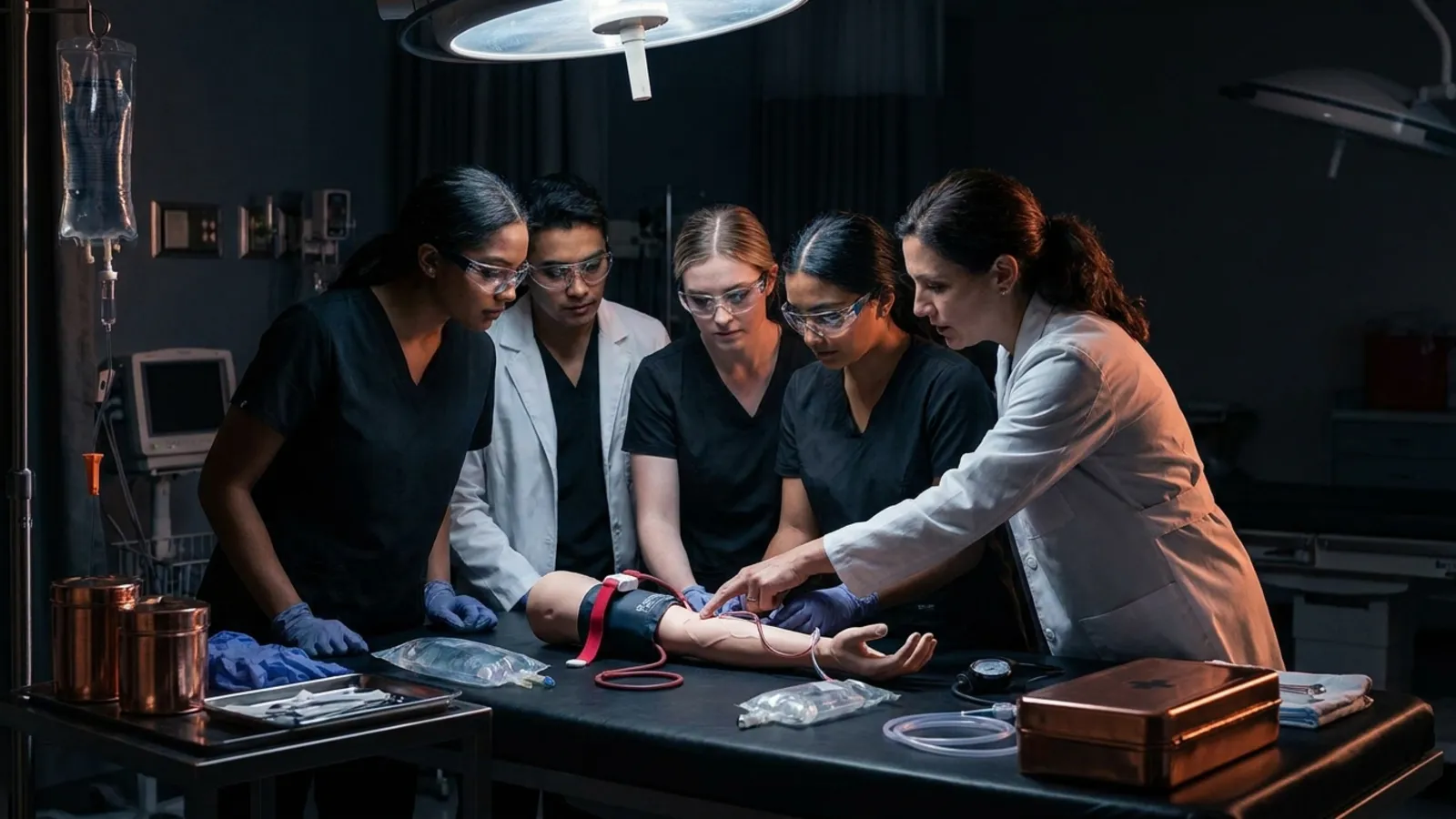
IV training for nurses is structured education that develops the skill to perform intravenous cannulation and infusion therapy safely, covering vein anatomy, insertion technique, complication management, and the psychology of performing under pressure. It ranges from a few hours of hospital orientation to multi-day hands-on intensives with live patient practice. The format you choose determines whether you walk away with a certificate or with the confidence to start a difficult line on your next shift.
If you have searched for IV training for nurses, you have probably noticed the same problem most nurses run into: the phrase covers everything from a free in-service on your unit to a $600 online course to a weekend workshop on rubber arms. They are not the same, and they do not produce the same result. This guide maps the full landscape. It explains what IV training actually covers, the program types and what each one delivers, what to look for before you pay, how much it costs, and how to choose the path that fits where you are in your nursing career.
What IV training for nurses actually covers
Good IV training for nurses develops four distinct competencies, not just one. Programs that cover only the first two leave you with a certificate but not the ability to perform when the vein is difficult and the patient is watching your hands.
- Anatomy and site selection. Reading the venous map by palpation, choosing the right site for the therapy, and knowing which veins to protect for later use.
- Insertion technique. Angle, advancement, flash recognition, threading the catheter, and securing the line, repeated until the motion is muscle memory rather than a sequence you have to think through.
- Complication management. Recognizing and responding to infiltration, extravasation, blown veins, and phlebitis, plus knowing when to stop and escalate.
- The psychology of the stick. Managing your own stress response so your hands stay steady on a hard access in front of an audience. This is the piece most programs skip entirely, and it is the reason competent nurses still freeze on difficult veins.
The first two get you a passing score in a skills lab. All four get you to the point where colleagues start escalating their hard sticks to you instead of the other way around. For a closer look at why the mental side carries so much weight, read the psychology of IV insertion.
The types of IV training programs for nurses
Nurses encounter IV training in five common formats. Each delivers something different, and the gap between them is mostly about how much live, supervised practice you get.
| Program type | Format | Typical cost | What it delivers |
|---|---|---|---|
| Hospital in-service / orientation | On-unit, preceptor-led | Free (employer-provided) | Inconsistent. Depends entirely on who precepts you and how busy the floor is. |
| Online IV course | Video lectures plus quiz | $50-$250 | Theory and a certificate. No hands-on skill, no muscle memory. |
| Weekend workshop | Group session, simulation arms | $250-$300 | Foundational exposure, but limited live sticks and high student-to-instructor ratios. |
| Hands-on intensive | Small-group, live patient practice | $199-$450 | Real cannulation reps with coaching. Builds skill, not just awareness. |
| Certification-track program | Multi-day didactic plus clinical | $300-$525 | Credential plus training, often heavy on theory you already know. |
Bottom line: The single best predictor of whether a program builds real competence is how many supervised sticks you perform on actual veins. Online and lecture-only formats produce the dangerous combination of a certificate and false confidence. Hands-on intensives and strong certification-track programs produce the skill. For a deeper side-by-side, read our breakdown of online versus hands-on IV training and our buyer's guide to IV training programs compared.
Who needs IV training, and when
IV training is not a single course you take once. The right program depends on where you are in your career.
Nursing students and new graduates. Most nursing programs offer limited live IV practice before graduation, and the first real stick on a patient often happens on the floor with an audience. Early structured training closes that gap before it becomes a long-term avoidance pattern. If you are in your first year, start with building new grad IV confidence and your first stick fundamentals.
Experienced RNs who avoid hard sticks. Plenty of competent nurses can start an easy IV but quietly route the difficult ones to someone else. That is a training gap, not a character flaw, and it responds to deliberate practice on difficult access. See our guide to difficult and rolling veins.
LPNs and LVNs. IV therapy scope for LPNs and LVNs is state-specific, and many states require a board-approved IV course before you can legally perform IV therapy. Start with the LPN IV certification guide and verify the rules where you practice.
Nurses moving into specialty or independent practice. ICU, ER, flight, infusion, and mobile IV roles all raise the skill bar. Specialty-bound nurses benefit from advanced training in ultrasound-guided access and special populations. See how to become an IV therapy nurse and nurse career advancement through IV skills.
What to look for in an IV training program
Not all IV training for nurses is built the same. Before you pay, check the program against this list.
- Live sticks on real veins. Rubber arms do not roll, blow, or react. Ask directly how many supervised cannulations on real patients or volunteers the course includes. If the answer is zero, you are buying theory.
- A low student-to-instructor ratio. Individual coaching is where technique actually gets corrected. A 30-person lecture cannot do that. Look for small-group instruction, ideally 10 students or fewer per instructor.
- Credentialed clinical instructors. Verify the instructors are clinicians with active field experience, not video presenters reading a script.
- Coverage of the mental game. A program that never addresses stress response under pressure is teaching half the skill. The hands fail because the nervous system does first.
- A path to keep practicing. Skill decays without repetition. Programs that offer ongoing practice access help you hold what you built. See how to maintain IV competence and fight skill decay.
According to the Infusion Nurses Society (INS) Standards of Practice, IV competence is established through documented training plus supervised performance, not through a written test alone. A program that skips the supervised performance is skipping the part the standards actually require. For employer expectations on documented competency, see our guide to IV competency for nurses.
How much does IV training for nurses cost?
The cost generally runs from free to roughly $640, depending on format and depth. Employer-provided orientation costs nothing but varies widely in quality. Online courses typically run $50 to $250 and deliver a certificate with little hands-on time. Hands-on intensives and certification-track programs typically run $199 to $525, with the higher end reflecting multi-day clinical hours.
Two points matter more than the sticker price. First, the cost of a missed stick is real: lost patient trust, repeated attempts, and in mobile IV practice, a lost client and the referrals that client would have sent. Research published in the Journal of the Association for Vascular Access reports that first-attempt peripheral IV insertion fails in a meaningful share of adult patients, with difficult venous access common across hospital populations. Training that lowers your miss rate pays for itself quickly. Second, the cheapest program is not the one with the lowest price. It is the one that actually builds the skill, because a $50 certificate that leaves you freezing on hard veins cost you more than the money.
For the certification side of the cost question, see our guide to IV certification courses for nurses.
IV training vs. IV certification
These two terms get used interchangeably, but they are different things, and the difference affects where you spend your money.
IV training is the educational process that builds the skill: the practice reps, the coaching, the live sticks. IV certification is the documentation that the training was completed: a course certificate, a state authorization, or a specialty board credential.
The two often come bundled, but not always. Some online certification programs produce a certificate with minimal real training behind it. Some excellent training experiences produce real skill but no portable credential. The honest framing for any nurse: the certification makes your training visible to employers, and the training makes the work possible at the bedside. Choose programs that produce both. For a full breakdown of the credential side, read what is IV certification and the state-by-state IV therapy certification requirements.
How to get IV training as a nurse: a step-by-step path
- Confirm your scope. Verify what IV therapy your license permits in your state. RNs hold IV cannulation in scope from licensure. LPNs and LVNs often need a state-approved course first.
- Match the program to your goal. A new grad building confidence, an experienced nurse tackling hard sticks, and a nurse heading into infusion specialty practice each need a different starting point.
- Prioritize hands-on reps. Choose the format that gives you the most supervised live practice your budget allows. Hands-on time is the variable that moves competence.
- Verify it counts. If you need the training for employer credentialing or state authorization, confirm the program satisfies those requirements before you enroll.
- Build in ongoing practice. Schedule deliberate practice after the course so the skill holds. See IV practice at home tips and how many sticks it takes to become proficient.
How VeinCraft Academy fits into IV training for nurses
VeinCraft Academy is a mastery-focused IV cannulation training program for healthcare professionals. We are not a specialty board certification body, and we do not currently hold CE provider accreditation. What we offer is the part of IV training most programs underbuild: the hands-on skill and the mental game behind it.
Our curriculum starts with psychology, not technique. Before catheter gauge or insertion angle, we address how your nervous system behaves under performance pressure and how to build the calm, repeatable focus real cannulation demands. From there, progression is mastery-based. You advance when credentialed clinical instructors with active field experience observe you demonstrating competence on real patients, not when the course clock runs out.
Level 1: The Method is an 8-hour intensive at $199 covering psychology, anatomy, technique, simulation drills, and live cannulation on real patients, with individual coaching at a 10:1 student-to-instructor ratio. It is the right starting point for nurses building the cannulation foundation every IV training and certification path assumes you already have.
Level 2: The Craft at $299 extends into hard sticks, special populations, and ultrasound-guided peripheral IV access, the difficult-access skill set that specialty infusion work depends on. The Master the Craft bundle pairs both levels.
Most nurses get the most from pairing skill-focused training like VeinCraft with whatever credential maps to their state and role. The credential satisfies the employer. The skill carries you through the work. Explore enrollment or compare Level 1: The Method and Level 2: The Craft to find the right starting point.
How long does IV training for nurses take?
It depends on the format. Online courses can be finished in a few hours. Hands-on intensives like an 8-hour foundation course run a single day. State-required LPN/LVN IV authorization courses typically run 16 to 60 hours of combined didactic and clinical time over one to several weeks. Specialty board paths for RNs require accumulating documented clinical experience over one to two years before sitting for an exam. The time that builds actual skill is the supervised hands-on portion, so a focused one-day intensive with many live sticks often develops more competence than weeks of online lectures.
Can nurses get IV training online?
Partly. The theory portion of IV training, including anatomy, complications, and infection control, translates well to online formats. The hands-on skill does not. You cannot build cannulation muscle memory by watching video, because the tactile feedback of a vein, the angle correction mid-insertion, and the stress of a real patient cannot be simulated on screen. Many strong programs use a hybrid model: online didactic plus an in-person clinical day. Treat online-only courses as a supplement to supervised practice, not a substitute for it.
Do new grad nurses need IV training beyond nursing school?
Most do. Nursing programs vary widely in how much live IV practice they provide, and many graduates report only a handful of supervised sticks before licensure. That is rarely enough to build durable confidence. Structured training early in the first year closes the gap before avoidance patterns set in. New grads benefit most from hands-on programs with live practice and individual coaching rather than online refreshers.
What is the best IV training for nurses?
The best IV training is the program that gives you the most supervised practice on real veins for your budget and matches your career goal. For foundational confidence, that means a hands-on intensive with live sticks and a low student-to-instructor ratio. For specialty or independent practice, it means advanced training in difficult access and ultrasound-guided technique. The worst value, regardless of price, is any program that hands you a certificate without putting a catheter in a real vein under observation.
IV training for nurses comes in many formats, but only one variable consistently separates the programs that build competence from the ones that hand out paper: how much supervised practice you get on real veins. Choose the training that builds the skill, and pair it with the credential your role requires. Ready to build cannulation confidence that holds up under pressure? Enroll at VeinCraft Academy and become the provider the team trusts with the hard stick.
This article is educational and is not legal or career advice. Verify current scope of practice and credentialing requirements directly with your state board of nursing before relying on any summary.
VeinCraft Academy is a mastery-focused IV cannulation training program for healthcare professionals. All instruction is delivered by credentialed clinicians with active field experience. VeinCraft Academy is a RevivaGo Company.