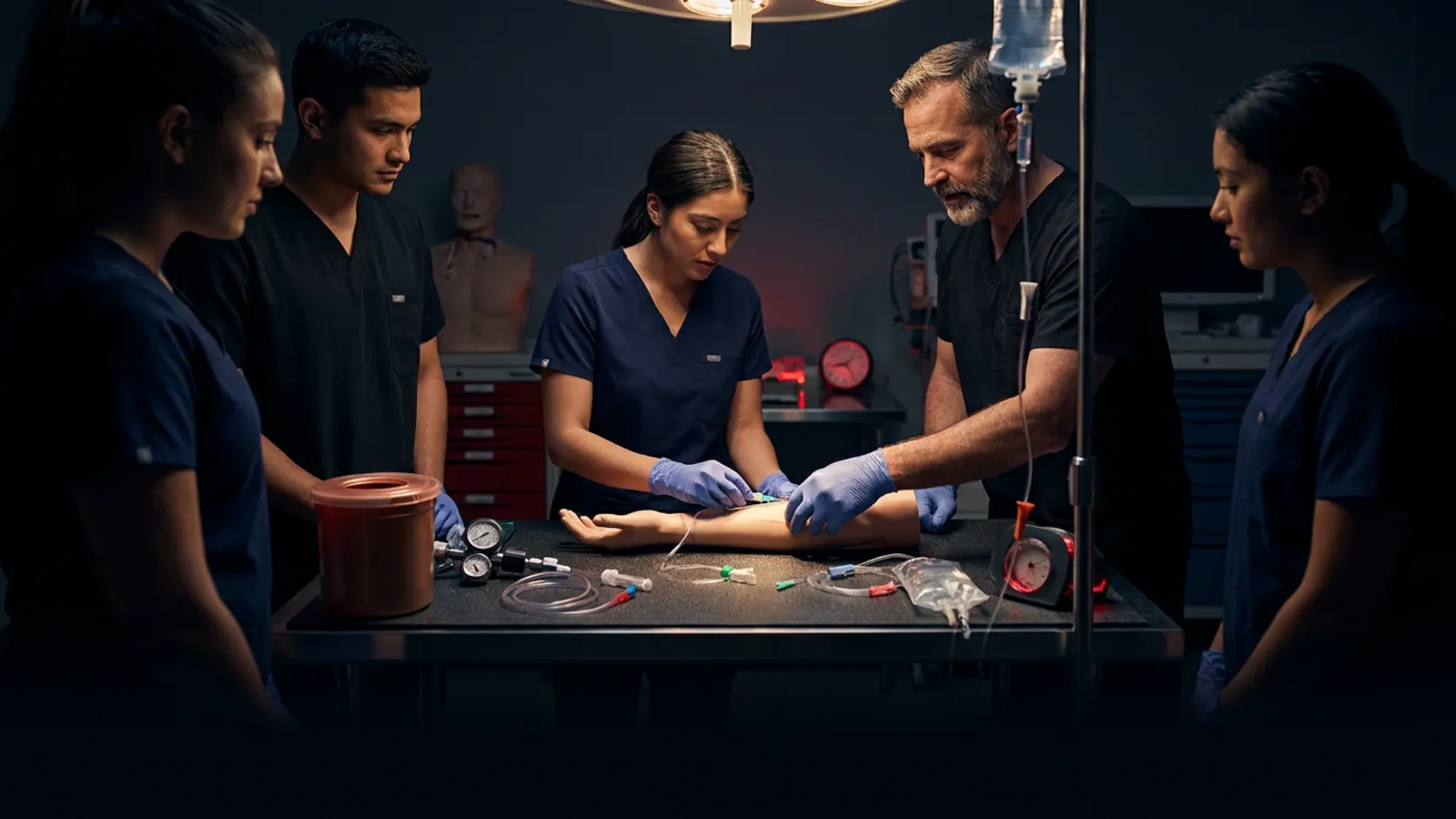
IV therapy certification requirements in the United States are set state by state, not nationally, and the rules differ sharply by license type. Registered nurses generally have IV cannulation in their scope of practice from the day they pass the NCLEX-RN. Licensed practical and vocational nurses (LPN/LVN) face state-specific training hour minimums, board-approved course mandates, and central-line restrictions that vary widely. Paramedics fall under a separate state EMS authority that operates independently from the board of nursing.
If you have ever tried to figure out whether your state requires a course before you can hang an IV, you already know how scattered the answers are. State boards publish the rules in different formats, employers add their own competency requirements on top, and the language switches between "certification," "authorization," and "approval" depending on who is writing the policy. This guide consolidates the regulatory picture for 2026 so you can verify what applies to you, document the right training, and stop second-guessing whether your scope covers what you are about to do.
What "IV therapy certification" actually means
IV therapy certification refers to a state-recognized credential or completed training that authorizes a healthcare professional to perform intravenous cannulation, infusion, and related vascular access tasks within the scope of their license. It is not a single national credential. The phrase covers four distinct things: state-issued LPN/LVN authorization to practice IV therapy, board certifications for specialty RNs (such as CRNI and VA-BC), course completion certificates from training programs, and employer-recognized competency documentation.
Each of these matters in different ways. State LPN authorization is a legal requirement to perform IV therapy in some states. Board certifications signal specialty expertise and can affect pay grade. Course completion certificates document recent hands-on training and matter for travel nursing applications, hospital orientation, and mobile IV practice operators. Employer competency files satisfy hospital and agency policies regardless of what the state requires.
For a deeper breakdown of these credential types and how to choose between them, see our complete guide to IV certification courses for nurses.
How state requirements differ by license type
State IV therapy rules concentrate in different places depending on the license you hold.
Registered nurses (RN, BSN). IV cannulation is part of the RN scope of practice in every U.S. state. No additional state certification is required to start a peripheral IV. Some states and employers require documented competency for advanced procedures such as central line management, midline insertion, or ultrasound-guided peripheral access. Specialty board credentials (CRNI, VA-BC) are voluntary and are awarded by professional organizations, not state boards.
Licensed practical and vocational nurses (LPN/LVN). This is where state rules concentrate. Some states grant IV authorization automatically upon graduation from an approved nursing program. Others require a board-approved course of a specified length before an LPN can perform IV therapy. Most states restrict LPNs from advanced procedures such as central line infusion, IV push medications, blood product administration, and titrated medication management.
Paramedics and AEMTs. IV therapy is regulated by each state's Emergency Medical Services authority, which operates independently from the board of nursing. The 2019 National EMS Scope of Practice Model includes peripheral IV therapy in the AEMT and Paramedic scope, but each state can expand or restrict that scope. Verification happens through the state EMS office, not the board of nursing.
Advanced practice registered nurses (APRN). Nurse practitioners, certified nurse midwives, and certified registered nurse anesthetists hold IV therapy authority through their advanced license. State APRN scope rules govern prescribing, ordering, and supervision rather than the cannulation skill itself.
IV therapy certification requirements by state (2026 table)
The table below summarizes regulatory categories for LPN/LVN IV therapy practice as of early 2026. RNs are not covered in the table because IV cannulation is in the RN scope nationwide. Verify with your state board before relying on any summary.
| State | LPN IV Therapy Status | Notable Requirement |
|---|---|---|
| Alabama | Permitted with training | Employer-documented competency |
| Alaska | Permitted with training | Board guidance on scope |
| Arizona | Permitted with restrictions | LPNs cannot directly access central lines (basic vs. advanced training tiers) |
| Arkansas | Permitted with training | Approved course required |
| California | Board-approved course required | 24 hours theory + 6 hours clinical; online-only not accepted |
| Colorado | Board-approved course required | 60 hours, in-person required |
| Connecticut | Permitted with restrictions | LPNs cannot infuse through central lines |
| Delaware | Permitted with training | Approved course required |
| District of Columbia | Board-approved course required | LPNs cannot infuse through central lines |
| Florida | Course required | 30 hours minimum, skills practicum recommended |
| Georgia | Permitted with training | Employer-documented competency |
| Hawaii | Permitted with training | Approved course required |
| Idaho | Permitted with training | Approved course required |
| Illinois | Permitted with restrictions | LPNs cannot infuse through central lines |
| Indiana | Permitted with training | Approved course required |
| Iowa | Board-approved course required | Documented competency |
| Kansas | Board-approved course required | 38 hours |
| Kentucky | Authorized on graduation | Automatic for LPNs from approved programs after specified date |
| Louisiana | Authorized on graduation | IV therapy is included in LPN nursing education |
| Maine | Permitted with training | Approved course required |
| Maryland | Permitted with training | Approved course required |
| Massachusetts | Permitted with training | Approved course and employer competency required |
| Michigan | Permitted with training | Approved course required |
| Minnesota | Permitted with training | Approved course required |
| Mississippi | Authorized on graduation (after specified date) | Board-approved course for older grads |
| Missouri | Authorized on graduation (after specified date) | Board-approved course for older grads |
| Montana | Permitted with training | Approved course required |
| Nebraska | Board-approved course required | Documented competency |
| Nevada | Board-approved course required | 20 hours classroom + 10 hours clinical |
| New Hampshire | Board-approved course required | 30 hours theory + lab practice |
| New Jersey | Permitted with training | Approved course required |
| New Mexico | Permitted with training | Approved course required |
| New York | Course required by employer setting | LPNs in hospitals, nursing homes, ASCs, dialysis, home care, and hospice must complete IV training; LPNs cannot infuse through central lines |
| North Carolina | Permitted with training | Approved course required |
| North Dakota | Board-approved course required | 30 hours theory + 4 hours supervised clinical + 3 successful sticks |
| Ohio | Permitted with restrictions | LPNs cannot infuse through central lines |
| Oklahoma | Permitted with training | Approved course required |
| Oregon | Permitted with training | Approved course required |
| Pennsylvania | Board-approved course required | Course must comply with PA Nursing Code §21.203(d)(8) |
| Rhode Island | Permitted with training | Approved course required |
| South Carolina | Permitted with training | Approved course required |
| South Dakota | Authorized on graduation | Automatic for LPNs from approved programs after specified date |
| Tennessee | Permitted with training | Approved course required |
| Texas | Board-approved course required | LVN IV certification course aligned to BON requirements |
| Utah | Permitted with training | Approved course required |
| Vermont | Permitted with training | Approved course required |
| Virginia | Permitted with training | Approved course required |
| Washington | Permitted with training | Approved course required |
| West Virginia | Permitted with training | Approved course required |
| Wisconsin | Permitted with training | Approved course required |
| Wyoming | Board-approved course required | 16 hours didactic + 16 hours clinical + 3 successful sticks |
Bottom line: Roughly a dozen states publish specific hour minimums and board-approval requirements for LPN IV therapy training. Five states grant IV authorization on graduation for newer grads. The remaining states permit IV therapy with course-based or employer-documented competency. Always verify directly with your state board, because boards update advisory opinions and scope guidance more often than these summaries can keep up with.
States with specific training-hour requirements
Eight states publish defined minimum hours for LPN IV therapy training. If you practice as an LPN in any of these states, your course needs to meet or exceed the published threshold and be on the board's approved provider list.
- California. 24 hours of theory plus 6 hours of clinical training. Online-only courses are not accepted. The California Board of Vocational Nursing and Psychiatric Technicians must approve the program.
- Colorado. 60 hours total, with in-person instruction required. Online preparation may supplement but cannot replace classroom and lab time.
- Florida. 30 hours of instruction at minimum, with a skills practicum recommended. Florida requires the training to be completed after graduation from an approved nursing program.
- Kansas. 38 hours, with a board-approved course provider.
- Nevada. 20 hours of classroom instruction plus 10 hours of supervised clinical practice. Board approval is required.
- New Hampshire. 30 hours minimum of theoretical content and laboratory practice.
- North Dakota. 30 hours of theory, 4 hours of supervised clinical practice, and three successful supervised IV sticks before sign-off.
- Wyoming. 16 hours didactic plus 16 hours clinical, with three successful supervised sticks documented.
Hour minimums are floors, not ceilings. Many board-approved programs run longer to add live-stick repetitions, ultrasound exposure, or special-population content.
States that grant IV authorization on graduation
Five states automatically grant LPN IV therapy authorization upon graduation from an approved nursing program, provided the LPN graduated after a specified date when the curriculum was updated to include IV content.
- Kentucky
- Louisiana
- Mississippi
- Missouri
- South Dakota
LPNs who graduated before the specified date in these states must complete a board-approved IV therapy course to gain authorization. The cutoff date varies by state, so confirm directly with your state board if you graduated more than a few years ago.
Central line restrictions for LPNs
Several states explicitly restrict LPNs from infusing medications through central venous catheters. Direct central line access by LPNs is prohibited or restricted in these states:
- Arizona (LPNs may access established implanted ports for medication and sampling but cannot insert or de-access central lines)
- Connecticut
- District of Columbia
- Illinois
- New York
- Ohio
Other states allow central line use by LPNs with documented advanced training, employer-specific competency validation, or RN supervision. If your role involves any central venous device, confirm what your state advisory opinion permits and what your facility policy requires before practicing.
How to verify your state's current requirements
Regulations change. State boards issue revised advisory opinions, expand LPN scope, or tighten central-line rules without major announcements. Use this verification sequence before relying on any summary, including this one.
1. Go to your state board's website. Every state nursing board publishes scope of practice documents, advisory opinions, and approved course provider lists. The phrase "advisory opinion" or "scope of practice statement" combined with "IV therapy" or "infusion therapy" usually finds the relevant document.
2. Check the board-approved provider list. If your state requires a board-approved course, it will publish a list of approved providers. A course that is not on the list will not satisfy the requirement, regardless of how good the curriculum is.
3. Confirm with your employer. Many hospitals, agencies, and mobile IV companies layer additional competency requirements on top of state rules. A signed competency checklist from your employer protects you in any post-incident review.
4. Document everything in your personnel file. Course completion certificates, CEU records, supervised stick logs, and employer competency sign-offs should live in your professional file. If your state requires three documented sticks before sign-off, keep the documentation.
5. Re-verify when you change states. Multistate compact licensure does not transfer state-specific IV authorization automatically. If you move from a self-graduation state like Louisiana to a hours-required state like California, you may need additional training before practicing IV therapy on your new license.
For nurses building a career on top of strong IV skills, see our guide on how IV competence accelerates nursing career advancement. For new graduates building foundational confidence on top of state requirements, see building IV confidence as a new grad nurse.
What this means if you operate a mobile IV business
State scope rules apply to mobile IV therapy practices the same way they apply to hospital staff, with one added layer: the state Board of Pharmacy or Department of Health may regulate the medications and the practice setting separately. Arizona, for example, requires a documented good-faith examination by a licensed provider before IV hydration is administered, regardless of where the IV is placed.
Mobile IV operators should confirm three regulatory inputs before opening:
- The board of nursing scope rules for the licensure level performing the cannulation (RN, LPN, paramedic)
- The board of pharmacy or department of health rules for the medications administered
- The medical director and supervising physician requirements for the practice model
For a deeper breakdown of the operational and clinical considerations, see our guide on how to start a mobile IV business.
Frequently asked questions
Do RNs need IV certification to start IVs?
RNs do not need a separate state IV certification to start peripheral IVs. IV cannulation is in the RN scope of practice in every U.S. state from the date of licensure. Voluntary specialty credentials such as CRNI (Certified Registered Nurse Infusion) and VA-BC (Vascular Access Board Certified) are available for RNs who want to formalize specialty-level expertise, but they are awarded by professional organizations, not state boards.
Does my IV certification transfer to another state?
Not automatically. State-issued LPN IV authorization is recognized only in the state that issued it. Multistate compact licensure (NLC) covers the underlying LPN license but does not extend state-specific IV authorization. If you move from a self-graduation state to a state with hour minimums, you may need additional training. RN-level IV practice transfers because IV cannulation is in the RN scope nationwide.
How long does IV therapy certification last?
Validity varies by state and program. Most state-issued LPN IV certifications are valid for 2 to 3 years and renew through continuing education, refresher courses, or competency reverification. Course completion certificates do not technically expire, but employers typically expect documented IV training within the past 12 to 24 months for hire and credentialing. CRNI and VA-BC board credentials require renewal every 3 years through continuing education and clinical practice documentation.
What if I work in multiple states as a travel nurse or mobile IV provider?
Verify each state separately. RN-level IV practice transfers under compact licensure, but advanced procedures (central lines, midlines, IV push medications) may have state-specific rules. LPN/LVN practitioners must hold valid IV authorization in each state where they perform IV therapy, even if their underlying license is recognized through compact agreement. Mobile IV operators crossing state lines should confirm scope rules with each state board before practicing.
What about CEUs for IV therapy?
CEUs for IV training are administered separately from state IV authorization. Most states require 20 to 30 CEU contact hours per renewal cycle for license renewal. A hands-on IV course can count toward those hours if the provider is accredited by the American Nurses Credentialing Center (ANCC), the state board, or a recognized specialty organization. For details on how CEU-bearing IV training works, see our guide on IV training CEU credits for nursing.
Build skill that meets every state's bar
Regulatory requirements set the floor for what you must complete. Real cannulation confidence is built on top of the floor, not at it. The nurses and paramedics who become the go-to person for difficult sticks all have something in common: they trained beyond the minimum, drilled the psychology of the stick alongside the technique, and put in repetitions on real patients with a credentialed instructor coaching every attempt.
VeinCraft Academy is an intensive, mastery-based IV cannulation training program designed for healthcare professionals who want to clear regulatory requirements and build durable clinical confidence in the same week. Our Level 1: The Method course covers psychology-first instruction, anatomy, technique, and live sticks on real patients in an 8-hour intensive. Level 2: The Craft extends into hard sticks, special populations, and ultrasound-guided access. Both meet or exceed the hour minimums published by every state listed in this guide.
We are pursuing CE provider accreditation with the Arizona Board of Nursing as our initial target and CAPCE for paramedic continuing education to follow. Until accreditation is finalized, our courses are continuing-education appropriate and recognized as professional development hours by many employers. Verify with your state board and employer before relying on any course for license renewal.
IV therapy certification requirements by state set the floor. Cannulation confidence is what carries you the rest of the way. Ready to build it on top of your state requirements? Explore VeinCraft Academy courses and enroll.
This article is educational and is not legal advice or a substitute for direct consultation with your state board of nursing or board of EMS. Regulations change. Confirm current requirements with the issuing authority before relying on any summary.
VeinCraft Academy is a mastery-focused IV cannulation training program for healthcare professionals. All instruction is delivered by credentialed clinicians with active field experience. VeinCraft Academy is a RevivaGo Company.