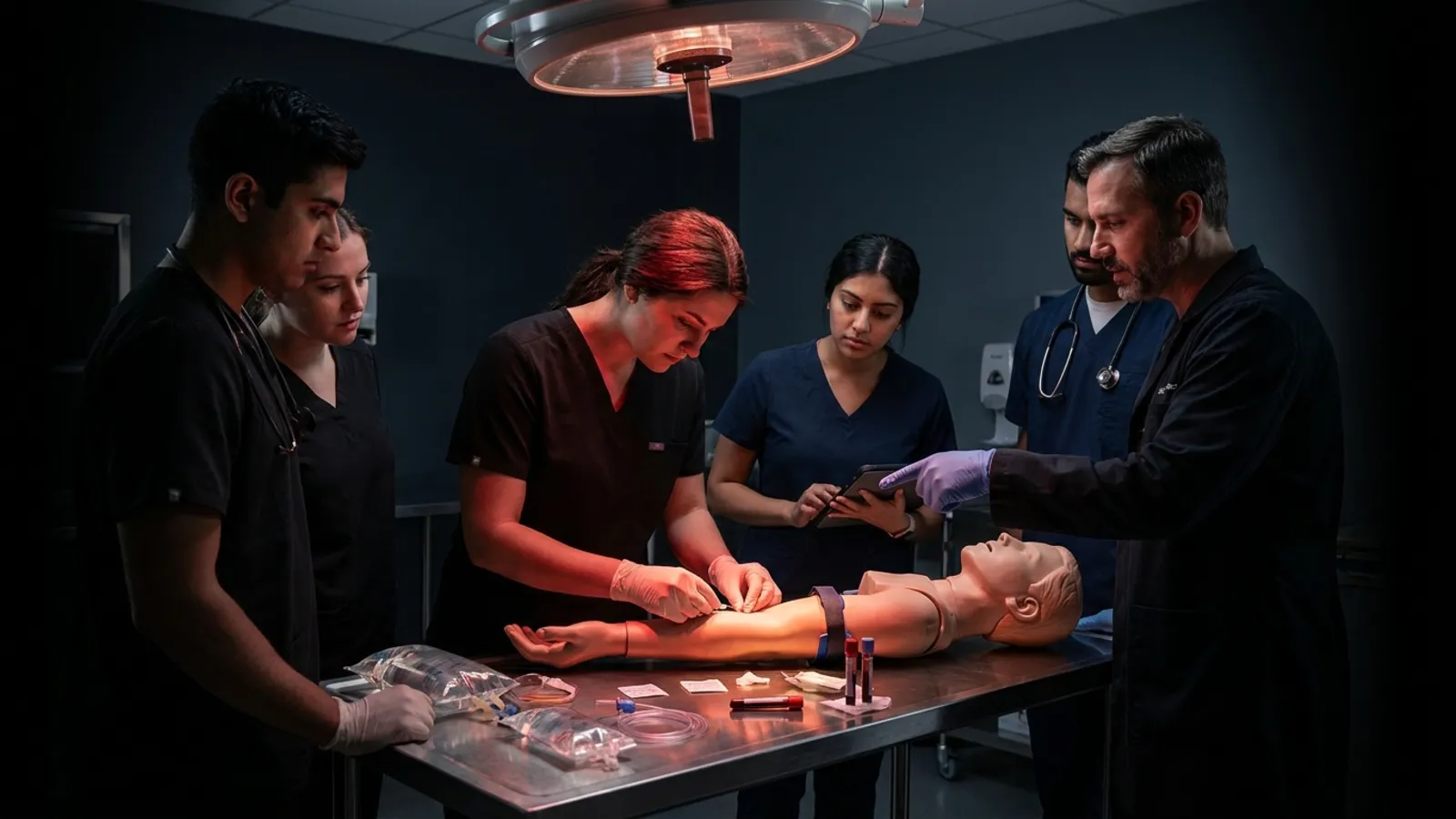
IV training CEU credits are continuing education units awarded for completing an accredited IV cannulation or vascular access course, used to satisfy state nursing license renewal requirements and employer documentation standards. Most states require 20 to 30 CEU contact hours per renewal cycle, and a single hands-on IV course typically counts for 4 to 16 of those hours depending on accreditation level.
If you have searched for IV training that "counts" for license renewal, you are asking the right question. Not every IV course earns CEUs, not every CEU is recognized in every state, and the rules for what gets credited keep changing. This guide explains what CEU-bearing IV training actually means, how to read accreditation language, and how to evaluate a course before you spend money on one.
What is a CEU and how does it apply to IV training?
A continuing education unit (CEU) is a standardized measure of completed continuing professional education. One CEU usually equals 10 contact hours of structured learning, though many state nursing boards now use the term "contact hour" directly (1 contact hour = 60 minutes of instruction). For IV cannulation training, a one-day 8-hour intensive can earn anywhere from 6.5 to 8 contact hours, depending on the accrediting body and how clinical practice time is counted.
The simplest test: if a course advertises "8 CEUs" or "8 contact hours" and names the accrediting body (ANCC, state board, ANA-affiliated), the credit will likely apply to most state license renewals.
Who accredits IV training CEUs?
Several bodies accredit IV training CEUs for nurses. The accreditor matters because state boards recognize specific accrediting organizations:
- American Nurses Credentialing Center (ANCC). The most widely recognized national CE accreditor. ANCC-accredited courses are accepted in nearly every state.
- State Boards of Nursing. Each state board can directly approve providers and individual programs. State-approved CEUs are accepted within that state and often carry reciprocity.
- Specialty Organizations. The Infusion Nurses Society (INS) and the Association for Vascular Access (AVA) provide accredited continuing education in vascular access topics.
- CAPCE (for paramedics). The Commission on Accreditation for Pre-Hospital Continuing Education accredits paramedic CEs, including IV-related courses.
VeinCraft Academy is currently working toward CE provider accreditation, with Arizona Board of Nursing approval as the initial target and CAPCE for paramedic CEs to follow. Until that is in place, our courses are continuing-education appropriate but not yet CEU-bearing.
State CEU requirements at a glance
State requirements vary widely. Common patterns:
- Most states require between 20 and 30 contact hours per 2-year renewal cycle.
- Several states have no contact-hour requirement (you renew your license without proof of CE) but still expect documented competency for clinical skills.
- A few states require specific topic content (pharmacology, jurisprudence, end-of-life care, etc.) within the total contact-hour count.
- Compact states generally accept any ANCC-accredited course earned in any compact state.
This summary is general, not exhaustive. Your state board's website is the source of truth. The most reliable place to verify is the National Council of State Boards of Nursing (ncsbn.org) directory, which links to every state board's CE rules.
What employers expect (versus what state boards require)
Even if a state does not require CEUs for license renewal, many employers do require documented IV training as part of unit competency files, hospital orientation checklists, or scope-of-practice records. Two patterns to know:
- Hospital systems often run their own internal IV training module as part of orientation. They may accept an outside CEU-bearing course in lieu of internal training, but you usually need to present the certificate of completion and accreditation statement.
- Mobile IV companies and home health agencies increasingly require an outside hands-on IV course (with or without CEUs) before letting providers see patients independently. Mobile IV business clients also notice when their provider has documented training, which builds trust faster.
If your career path includes ICU, ER, flight nursing, or critical care, IV competence is a gatekeeper skill on its own, not just a CEU box. Our piece on nurse career advancement IV skills covers how IV proficiency unlocks specific career paths.
What to look for in a CEU-bearing IV course
When you evaluate a CEU IV course, the marketing copy is not the data you need. Look for:
- Named accreditor. Look for "Accredited by [ANCC / state board / INS / AVA / CAPCE]" with a provider number you can verify on the accreditor's directory.
- Contact hours stated explicitly. "8 CEUs" or "8 contact hours" should appear, ideally with a breakdown (didactic vs. hands-on practice).
- Hands-on practice with real patients. A CEU course that is online-only with rubber-arm video demonstrations cannot build cannulation competence even if it issues a certificate. The credit may renew your license; it will not change your first-stick success rate.
- Class size and instructor ratio. A 50-person classroom with one instructor checks the CEU box but limits how much individual coaching you receive. Class sizes of 10 or fewer with credentialed clinical instructors deliver materially better skill outcomes.
- Content depth. Real IV mastery covers psychology, anatomy, technique, troubleshooting, special populations, and live sticks. A 2-hour CEU video on "IV insertion basics" earns the credit but leaves you no more competent than before.
- Certificate format. Make sure the certificate explicitly lists the accreditor, the contact hours, the date completed, and your full legal name as on file with the state board.
If a course cannot answer these questions clearly, the CEU is likely the only thing you will get from it.
Comparison: how IV training options stack up on credit and skill
| Training option | CEU bearing? | Hands-on with real patients? | Typical contact hours | Skill depth |
|---|---|---|---|---|
| Hospital in-service IV training | Sometimes (varies by employer) | Yes (preceptor-dependent) | 4-16 | Inconsistent |
| Online-only IV course | Often yes | No | 4-8 | Theory only, low skill transfer |
| Weekend workshop (rubber arm) | Usually yes | Limited (group setting) | 4-8 | Awareness, not proficiency |
| Multi-day classroom + clinical | Yes (institutional) | Yes (supervised) | 16-30 | Strong, accelerated |
| Specialty courses (UGPIV, INS) | Yes | Yes (variable depth) | 6-16 | Narrow specialization |
| VeinCraft Academy Level 1 | Pending accreditation (in progress) | Yes (live sticks, 10:1 ratio) | 8 | Strong foundation, psychology-first |
| VeinCraft Academy Level 2 | Pending accreditation (in progress) | Yes (hard sticks, UGPIV, special populations) | 8-16 | Mastery-level |
Bottom line: A CEU certificate does not guarantee skill, and a high-skill course does not always carry CEUs. The right course is the one that delivers both, or the one you choose deliberately because the credit or the skill is what you actually need.
Should you take a non-CEU course if it is the best skill match?
Many providers do, especially when the price is right and the skill gap is real. VeinCraft Academy's Level 1: The Method is currently $199 with CEU accreditation pending. That is below every accredited weekend workshop and below most online-only courses, with materially more hands-on time. Many of our students pay out of pocket because the skill is the priority and the CEU is a future bonus once accreditation lands.
If your employer reimburses only accredited training, ask about pre-approved providers and whether non-accredited training counts toward unit competency files. Some hospitals accept VeinCraft training as evidence of competency even without a CEU number, especially for nurses preparing for ICU, ER, or critical care roles. Our IV certification course for nurses guide covers what to ask your manager.
Frequently asked questions
Do all states require CEU credits for nursing license renewal?
No. CEU requirements vary by state. Most states require 20 to 30 contact hours per 2-year cycle, but some states have no formal CEU requirement and use other methods (practice hours, employer attestation) to verify continued competence. Check your state board of nursing's website for the specific rule that applies to your license, since requirements change periodically.
How many CEUs does an IV training course typically provide?
A standard 1-day hands-on IV training course typically provides 6.5 to 8 contact hours of CE credit when accredited. Multi-day intensive programs covering ultrasound-guided IV, special populations, or advanced vascular access can earn 16 to 30 contact hours. The exact number depends on instructional time, hands-on practice hours, and how the accrediting body counts each component.
Can I count IV training CEUs across multiple states?
If your IV training course is accredited by the American Nurses Credentialing Center (ANCC) or another nationally recognized body, the credits typically transfer across most state boards. State-board-only accreditations sometimes require reciprocity verification. The Nurse Licensure Compact recognizes ANCC-accredited continuing education across all member states.
Will my employer reimburse non-accredited IV training?
Employer reimbursement policies vary. Many hospital systems require accredited training for reimbursement, but some accept non-accredited skill-building courses if they fill a documented competency gap. Ask your manager or human resources department for the specific reimbursement criteria before enrolling. If the cost is low (VeinCraft's $199 Level 1, for example), many providers pay out of pocket and treat the skill itself as the return on investment.
What is the difference between a CEU certificate and a clinical competency record?
A CEU certificate documents that you completed an accredited continuing education course and earned a specific number of contact hours toward license renewal. A clinical competency record documents that you can perform a skill (such as IV cannulation) under specific conditions, usually verified by direct observation by a preceptor or instructor. Many courses produce only one of these. The strongest training programs produce both.
Ready to invest in skill (and the credit when it lands)?
VeinCraft Academy is on an active accreditation path. Until CEUs are official, our students enroll for what matters most: psychology-first instruction, live sticks on real patients, mastery-based progression, and class sizes capped at 10 with credentialed clinical instructors. Level 1: The Method is $199 and Level 2: The Craft is $299, both well below comparable accredited courses in the market.
Enroll now and put your skill ahead of the paperwork. The credit follows.
VeinCraft Academy is a mastery-focused IV cannulation training program for healthcare professionals. All instruction is delivered by credentialed clinicians with active field experience. VeinCraft Academy is a RevivaGo Company.