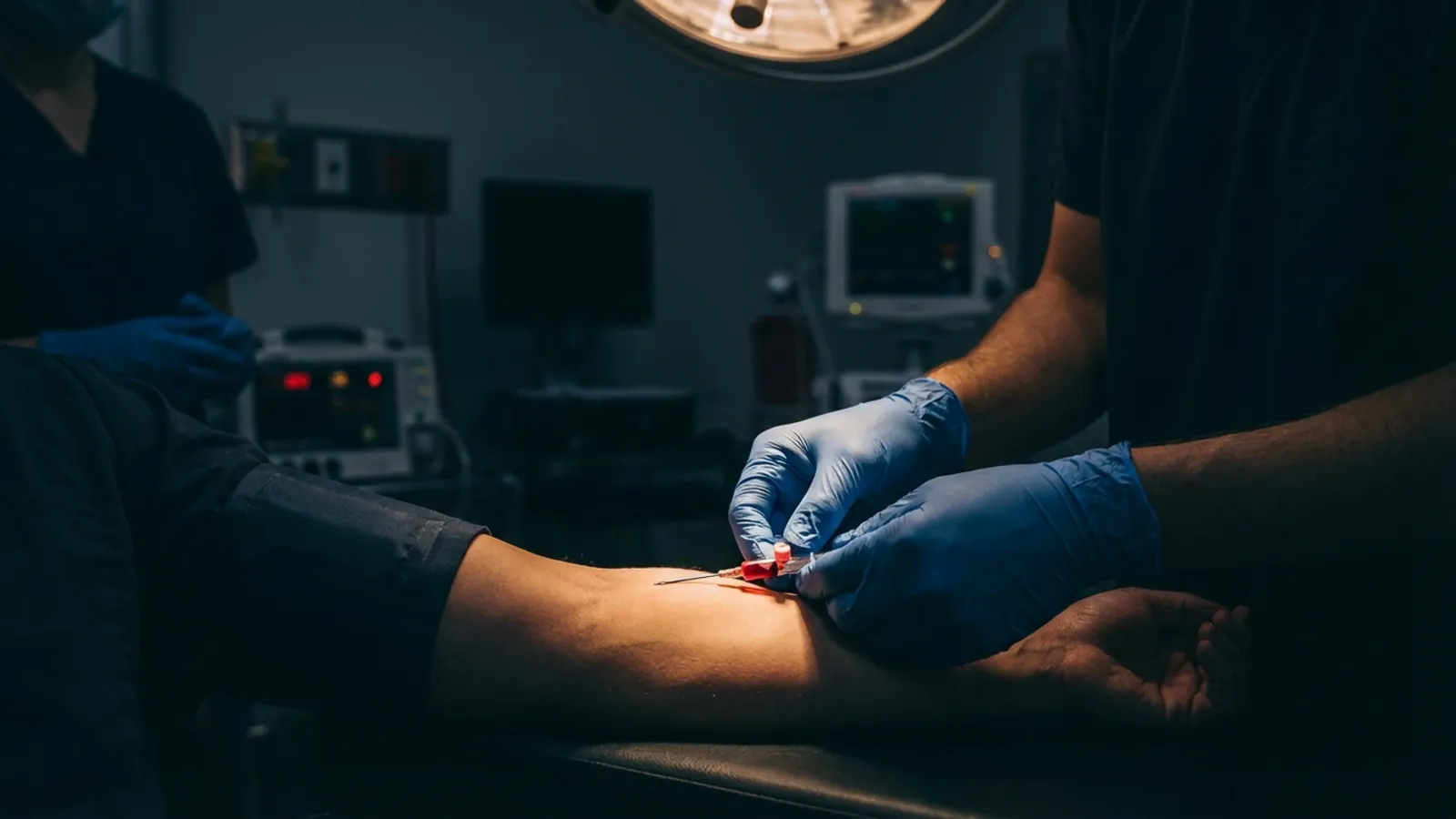
Ultrasound guided IV training teaches healthcare providers to use portable ultrasound probes for real-time vein visualization during peripheral IV cannulation. Studies show UGPIV improves first-attempt success rates by 32% in difficult-access patients compared to traditional palpation techniques, reducing the need for central line escalation.
You've been a competent IV starter for years. You can palpate a vein, anchor it, and get flash on most patients. But then you walk into a room with a dehydrated 80-year-old whose veins have been stuck dozens of times, and your confidence drops. You palpate. Nothing. You try the other arm. Still nothing. You call for backup.
Ultrasound-guided peripheral IV (UGPIV) training exists to eliminate that moment. It's the skill that turns "I can't find a vein" into "I can see one right here."
What is ultrasound-guided IV access?
Ultrasound-guided peripheral IV insertion uses a portable ultrasound probe to visualize veins in real time during cannulation. Instead of relying on palpation and visual assessment alone, the provider watches the needle enter the vessel on screen, confirming placement before advancing the catheter.
According to a systematic review published in the Journal of Emergency Medicine, UGPIV improves first-attempt success rates by 32% in patients with difficult venous access compared to traditional landmark techniques. For patients who've failed two or more blind attempts, ultrasound-guided access reduces the need for central line placement and its associated risks.
This isn't a replacement for traditional cannulation skills. It's an escalation tool. When palpation fails, ultrasound gives you a second pathway before calling for a PICC team or escalating to central access.
Who needs UGPIV training?
Not every provider who starts IVs needs ultrasound-guided skills immediately. But if any of these describe your practice, UGPIV training belongs in your development plan:
- Emergency nurses who see high volumes of difficult venous access patients: dehydrated, obese, elderly, IV drug use history
- ICU and critical care nurses managing patients with limited remaining access sites
- Flight nurses and paramedics working in austere environments where backup isn't a phone call away
- Mobile IV therapy providers whose business reputation depends on first-stick success in clients' homes
- Vascular access team members responsible for the hardest sticks in the hospital
If you regularly find yourself palpating both arms, trying the hand, and then calling someone else, ultrasound guided IV training changes that dynamic entirely.
When to use ultrasound vs. traditional palpation
One of the biggest gaps in UGPIV education is the decision point. Most training teaches the technique but never clearly answers: when should I reach for the probe instead of continuing to palpate?
Use traditional palpation when:
- You can see or feel a viable vein
- The patient has a history of easy access
- Time pressure doesn't allow probe setup (true emergencies may warrant blind attempts first)
Escalate to ultrasound when:
- Two blind attempts have failed
- No veins are visible or palpable after tourniquet application
- The patient reports a history of difficult access
- You're working with fragile or rolling veins in elderly patients
- The clinical situation doesn't tolerate repeated failed attempts (pediatric patients, anxious patients, time-sensitive medication administration)
The goal isn't to use ultrasound on every patient. It's to have it available as a reliable next step when your hands and eyes aren't enough.
What ultrasound guided IV training covers
Quality ultrasound-guided IV training teaches more than "point the probe at an arm." A comprehensive program covers:
Probe positioning and orientation for upper extremity vessel identification. You learn to hold the probe correctly, adjust depth and gain settings, and distinguish arteries from veins using compression and Doppler.
Vessel identification and selection. Not every vein you see on ultrasound is a good target. Training teaches you to evaluate vessel depth, diameter, and surrounding anatomy before committing to a site.
Short-axis vs. long-axis approach. Short-axis (out-of-plane) shows the vessel in cross-section and is easier to learn. Long-axis (in-plane) shows the vessel lengthwise and lets you watch the entire needle path. Most programs start with short-axis and progress to long-axis.
Real-time needle visualization. The core skill. You learn to track your needle tip on screen as it approaches and enters the vessel, confirming intravascular placement before advancing the catheter.
Catheter selection and securing. UGPIV targets are often deeper veins, which means longer catheters (typically 1.75" to 2.5") and different securing techniques than standard peripheral IVs.
Troubleshooting. What to do when you lose the needle on screen, when the vessel collapses, or when you get flash but can't advance the catheter.
At VeinCraft Academy, Module 3 of our Level 2: The Craft course covers ultrasound-guided vascular access with portable point-of-care ultrasound units. No prior ultrasound experience is required. You practice on live patients under direct instructor observation, not simulation phantoms alone.
How long does it take to become competent?
Research from the Annals of Emergency Medicine suggests providers need approximately 10 successful UGPIV insertions to meet basic credentialing requirements. A study using CUSUM statistical analysis found that true procedural competency, defined as a consistent 90% first-attempt success rate, develops after roughly 34 procedures.
The instruction time itself is relatively short. A 2023 study in ATS Scholar described a three-phase training model where providers received 2-3 hours of didactic instruction followed by supervised clinical practice. Most training programs, including VeinCraft Academy's Level 2 course, integrate UGPIV instruction within a broader advanced cannulation curriculum.
Here's what most courses won't tell you: there's a temporary skill regression when you first learn UGPIV. Providers who are confident with blind sticks often feel clumsy and slow when they add the ultrasound probe. You're coordinating your hands, watching a screen, and managing a patient simultaneously. Your success rate may dip before it climbs.
This is normal. It's the same CNS management challenge that makes any new clinical skill feel awkward at first. The providers who push through that discomfort are the ones who come out the other side with a skill that fundamentally changes their practice.
Training options compared
Ultrasound guided IV training varies widely in format, depth, and cost:
| Training type | Format | Typical cost | Live practice? | Best for |
|---|---|---|---|---|
| Online-only courses | Self-paced video + quiz | $20-$200 | No | Theory review, CE credits |
| Weekend workshops | 4-8 hours, group setting | $250-$400 | Limited (phantoms) | Introductory exposure |
| Intensive hands-on | 1-2 days, small class | $250-$500 | Yes (live patients) | Building real competency |
| Full certification bundles | Multi-module + clinical hours | $500-$600+ | Varies | Vascular access specialists |
| Hospital in-service | Varies by institution | Free | Sometimes | If available and well-structured |
Bottom line: Online courses can supplement training but cannot replace hands-on practice with live patients. You cannot learn to visualize vessels and guide a needle in real time by watching videos. Procedural competency requires supervised repetition on real anatomy.
VeinCraft Academy's Level 2: The Craft includes UGPIV training within a comprehensive advanced cannulation program at $299, well below standalone UGPIV courses that charge $350-$500 for ultrasound-guided access alone. Class sizes cap at 10 students with individual coaching throughout.
Why blind-stick mastery comes first
Here's a perspective that separates experienced clinical educators from course marketers: ultrasound-guided IV access is not a beginner skill. It builds on foundational cannulation competence.
If you haven't yet mastered palpation-guided cannulation, the mental load of adding ultrasound (coordinating probe and needle, reading the screen, managing patient positioning) will overwhelm the cognitive bandwidth you need for basic catheter handling.
VeinCraft Academy structures this intentionally. Level 1: The Method builds the foundation: the psychology of the stick, anatomy, technique, and muscle memory through live practice. Level 2: The Craft adds hard sticks, special populations, and ultrasound-guided access on top of that foundation. Students who take the Master the Craft bundle ($449) get both levels plus a free practice kit, saving $98 compared to purchasing separately.
This progression matters because UGPIV confidence depends on cannulation confidence. If your hands shake when you start a standard IV, adding an ultrasound probe doesn't fix the underlying problem. It adds complexity to it.
Common UGPIV mistakes and how to fix them
Even after training, these errors show up most during the learning curve:
Losing the needle on screen. This happens when you advance the needle without maintaining probe alignment. The fix: move slowly. Advance in small increments, adjusting the probe after each movement to keep the needle tip visible.
Targeting vessels that are too deep. Deeper veins are visible on ultrasound but harder to cannulate and more prone to complications. Start with vessels less than 1.5 cm deep until you build confidence with the technique.
Using catheters that are too short. Standard 1.25" peripheral IV catheters may not reach deeper ultrasound-guided targets. Use 1.75" or longer catheters for vessels deeper than 0.5 cm.
Going through the back wall. The vessel compresses as you advance the needle, and it's easy to puncture through both walls. Watch for the vessel to "tent" on ultrasound, indicating your needle is pressing against the anterior wall, then use a steeper angle of approach for deeper vessels.
Skipping the confirmation step. After you get flash and advance the catheter, flush with saline while watching on ultrasound. You should see turbulence (swirling) inside the vessel. If the surrounding tissue swells instead, you've infiltrated.
Can nurses perform ultrasound-guided IV insertion?
Yes. In most states, UGPIV falls within the registered nurse scope of practice as an extension of peripheral IV insertion skills. The American Nurses Association supports point-of-care ultrasound use by nurses who have received appropriate training and demonstrated competency.
Scope varies by state board of nursing regulations and individual facility policies. Some hospitals require a facility-specific competency assessment before nurses can perform UGPIV independently. Check with your state board and your employer's policy manual for specific requirements.
Paramedics and EMTs should check their state EMS regulations, as UGPIV scope varies more widely across state and local protocols.
How much does UGPIV training cost?
Training costs range from $20 for online-only CE modules to $600+ for comprehensive certification bundles. The most common price range for quality hands-on UGPIV training is $300-$500.
VeinCraft Academy includes UGPIV training as part of Level 2: The Craft at $299. This covers hard sticks, special populations, advanced troubleshooting, and ultrasound-guided access, all with live patient practice and a 10:1 student-to-instructor ratio. Compared to standalone UGPIV courses in the $350-$500 range, you're getting a broader advanced skill set at a lower price point.
Do you need certification for ultrasound-guided IV?
There is no nationally mandated UGPIV certification for bedside nurses or paramedics. Most facilities require demonstrated competency (typically 5-10 observed successful insertions) rather than a specific certification credential.
Some organizations offer UGPIV-specific certificates of completion or continuing education credits. These can satisfy employer requirements and document your training, but they are not required by any state licensing board for peripheral IV access.
VeinCraft Academy provides a mastery certificate upon completion of Level 2 that documents your UGPIV training and supervised practice hours. Learn more about IV certification options for nurses.
Ready to add ultrasound-guided IV to your skill set?
Ultrasound guided IV training is the natural next step for providers who've built a solid cannulation foundation and want to handle the patients nobody else can access. It's not about replacing your hands. It's about giving them a tool they didn't have before.
VeinCraft Academy's Level 2: The Craft includes ultrasound-guided vascular access alongside hard sticks, special populations, and advanced troubleshooting at $299 with live patient practice and individual coaching.
Already confident in your foundational skills? Explore Level 2.
Building your foundation first? Start with Level 1: The Method at $199, then progress to Level 2 when you're ready.
Want the complete journey? The Master the Craft bundle combines both levels for $449 with a free practice kit ($98 total savings).
VeinCraft Academy is a mastery-focused IV cannulation training program for healthcare professionals. All instruction is delivered by credentialed clinicians with active field experience. VeinCraft Academy is a RevivaGo Company.