IV training for new nurses is a structured plan that closes the gap between nursing school simulation and independent peripheral IV cannulation on real patients. It covers what to practice, in what order, how often, and when to add supervised live sticks so your first year builds competence instead of avoidance. Orientation checklists alone rarely do that job.
You finished school. You passed the NCLEX. Then orientation handed you a skills packet, a preceptor badge, and a quiet expectation that you would "pick up IVs on the floor."
That is not a training plan. That is hoping volume will sort itself out.
This article is the roadmap most new nurses never get: the skills sequence, a 90-day practice cadence, how to audit your unit orientation for gaps, and when a focused hands-on intensive compresses months of scattershot learning into one deliberate day.
If anxiety is the loudest part of the problem for you, pair this with our guide to new grad nurse IV confidence. This page is about the training system. That page is about the mental game.
What IV training for new nurses should include
Effective IV training for new nurses builds five competencies in order, not five topics dumped into one busy orientation afternoon.
- Nervous system readiness. Learn to keep your hands usable when a patient is watching. Technique collapses if your central nervous system treats every stick like a threat. See the psychology of IV insertion.
- Vein assessment and site selection. Palpation, site hierarchy, and knowing when a "visible" vein is the wrong vein.
- Core cannulation mechanics. Angle, depth, flash recognition, catheter advance, and securement until the sequence is muscle memory.
- Complication literacy. Spot and respond to infiltration, blown veins, and early phlebitis before you chase harder sticks.
- Deliberate practice under observation. Supervised reps on real veins with feedback. Unsupervised volume without coaching locks in whatever habit you started with.
Most hospital orientations cover pieces of items 2 through 4. They almost never teach item 1 well, and they rarely guarantee enough of item 5 for a new nurse to feel steady by the end of residency.
Why orientation rarely finishes the job
Hospital orientation is built for unit safety and policy compliance. It is not built to make you the go-to person for vascular access.
According to a study published in the Journal of Infusion Nursing, only about one in three newly graduated nurses has successfully placed a peripheral IV on a real patient before finishing school. Many programs still deliver only 4 to 8 hours of IV content across an entire degree. Orientation then assumes the floor will supply the missing reps.
Sometimes it does. Often it does not.
| What orientation usually gives you | What a training roadmap adds |
|---|---|
| Policy review and pump competencies | Psychology and CNS management before technique |
| Simulation or limited observed sticks | A target rep count with feedback quality rules |
| Sign-off when a preceptor is free | A 90-day skill sequence with weekly cadence |
| "Ask for help on hard sticks" | Criteria for when to escalate vs when to take the next attempt |
| Unit-specific equipment quirks | Transferable cannulation judgment across patient types |
Bottom line: Orientation gets you cleared to practice. A roadmap gets you competent enough that colleagues stop rescuing every difficult arm for you. For the broader landscape of program types, see IV training for nurses.
A 90-day IV training roadmap
Use this as your personal curriculum. Adjust for your unit's patient mix, but do not skip the order. Skipping ahead to hard sticks before your nervous system and basics are solid is how avoidance patterns form.
Days 1 to 30: Foundation and first supervised sticks
Goal: Approach routine peripheral IVs without a heart-rate spike, and log your first 10 to 15 supervised attempts with notes.
- Build a pre-stick routine. One breath pattern, one grounding cue, one mental walkthrough of angle and flash. Keep it short enough to use on a busy med-surg hallway.
- Volunteer for cooperative veins. Hydrated adults, palpable sites, standard gauges. You are collecting clean reps, not proving toughness.
- Track every attempt. Date, site, gauge, success or miss, one correction. Tracking turns busy shifts into deliberate practice.
- Watch one strong stick artist per week. Ask them to narrate site choice and angle. Steal the decision process, not just the hand motion.
- Ask for observed feedback on at least half of your sticks. Research on procedural skill acquisition keeps landing on the same point: feedback quality moves the curve faster than raw volume. Our breakdown of how many IV sticks to become proficient puts foundational competence around 25 supervised attempts, with broader proficiency closer to 100 varied sticks.
If your orientation has already signed you off but you still freeze, that is a signal to add structured training now, not "later when things calm down." Things rarely calm down.
Days 31 to 60: Expand the patient mix
Goal: Reach roughly 25 supervised sticks across a wider range of arms, and own your own troubleshooting after a miss.
- Add moderate difficulty. Mild dehydration, smaller veins, deeper sites. Stay away from crashing patients and true DIVA cases until your basics hold.
- Practice recovery language. After a miss, what you say to the patient and what you change on attempt two matter as much as the next puncture. See failed IV attempt: what to do next.
- Tighten tourniquet and site habits. Small mechanics errors show up as "unlucky" misses. Review IV tourniquet techniques against what you actually do on shift.
- Add 15-minute home drills between shifts. Catheter handling, advance mechanics, and visualization keep the sequence warm when your unit census is quiet. Use the drills in IV practice at home tips, and be honest about what a kit cannot teach.
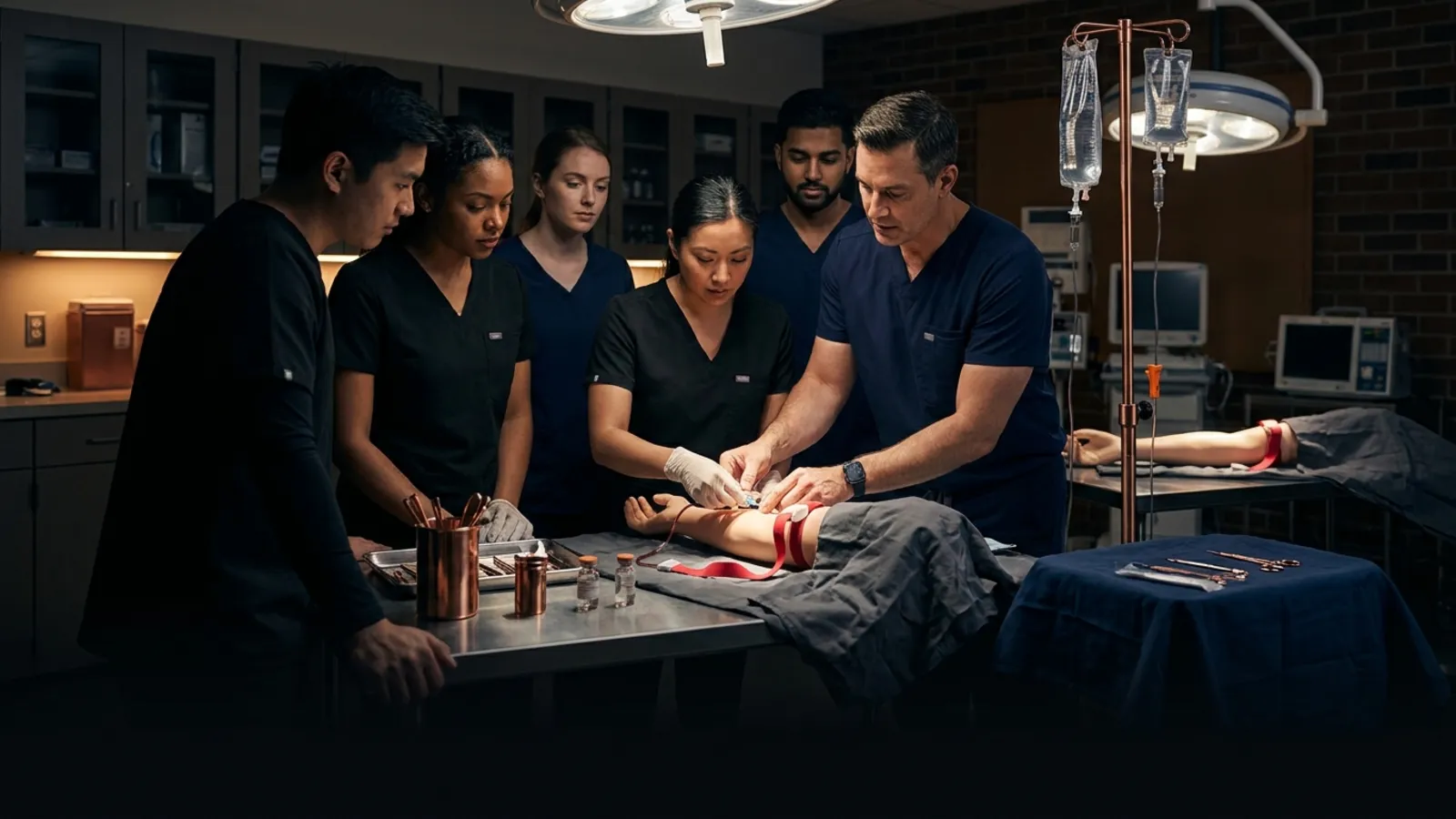
- Book a hands-on intensive if feedback on the floor is thin. VeinCraft Academy Level 1: The Method is an 8-hour intensive taught by credentialed clinicians with active field experience. It pairs psychology-first instruction with simulation and live sticks at a 10:1 student-to-instructor ratio, starting at $199. Students advance when they demonstrate competence, not when the clock runs out.
This is the window where many new nurses quietly stop volunteering. Do the opposite. Keep asking for sticks while your practice still has structure.
Days 61 to 90: Own the skill and protect the habit
Goal: Hit a working first-stick rhythm on routine patients, begin selected harder sticks, and set a maintenance cadence so skill does not decay after orientation ends.
- Take the stick when a colleague hesitates on a moderate arm. Identity forms in public. Becoming "the nurse who will try" starts here.
- Add one hard-stick category with a coach present. Elderly fragile veins, rolling veins, or obese patient access, one category at a time. Use guides like difficult veins and rolling veins as study notes, not as a substitute for supervised reps.
- Review complication patterns weekly. If you are blowing veins or seeing early infiltrations, fix technique before chasing volume.
- Schedule ongoing practice. Stick Lab style drop-in practice, or a standing weekly goal of observed sticks, keeps competence from fading when your assignment mix changes. Skill decay is real once orientation ends and nobody is counting your attempts.
- Decide your next training layer. If you are headed toward ER, ICU, flight, or mobile IV work, plan Level 2: The Craft for hard sticks, special populations, and ultrasound-guided access once your foundation is solid. The Master the Craft bundle at $449 covers Level 1 and Level 2 with a free practice kit.
Ninety days will not make you the unit's vascular access specialist. It can make you the new nurse who does not hide from IVs, and that identity compounds for years.
Practice cadence that actually works
A roadmap without a cadence becomes another unread PDF in your notes app. The skill sticks when the weekly rhythm is boringly consistent.
Use this weekly pattern during the first 90 days:
- On shift: Aim for 3 to 5 IV attempts per week minimum, with feedback on at least half.
- Off shift: Two 15-minute kit or visualization sessions.
- Weekly review: Ten minutes to scan your log for the same miss pattern repeating.
- Monthly check: Are you still only taking easy arms? If yes, deliberately add one harder category with a coach.
According to skill-acquisition research associated with Anders Ericsson's work on deliberate practice, repetition without corrective feedback plateaus quickly. That is why "I'll just get them on the floor" fails so many new grads. The floor gives volume. It does not automatically give coaching.
Orientation vs structured IV training
New nurses often ask whether they need anything beyond what their employer already provides. Honest answer: it depends on the quality of precepting you actually received, not the quality promised in the residency brochure. Structured IV training for new nurses exists to fill the gaps orientation leaves.
| Question | Rely on orientation alone | Add structured hands-on training |
|---|---|---|
| Did you get 25+ supervised sticks with real feedback? | Often no | Designed around observed competence |
| Did anyone teach CNS management? | Rarely | Built into psychology-first curriculum |
| Was your instructor-to-learner ratio usable? | Highly variable | Cap of 10 students with individual coaching |
| Cost | Included in employment | Level 1 at $199; bundle at $449 |
| Risk if you wait | Avoidance hardens in year one | One intensive day can reset the trajectory |
Bottom line: If your orientation already gave you dense, coached live sticks and you feel steady on routine arms, keep the roadmap and keep logging. If you were signed off after a handful of attempts on cooperative patients, do not wait for year two to feel different. Join a VeinCraft Academy cohort while the habit is still forming.
All VeinCraft Academy courses are taught by credentialed clinicians with active field experience under a standardized, mastery-based curriculum. VeinCraft Academy is a RevivaGo Company.
Common mistakes new nurses make with IV training
- Waiting until anxiety becomes identity. The longer you avoid sticks, the more your self-story becomes "I'm just bad at IVs."
- Chasing hard sticks too early. Ego reps before basics create blown veins and deeper fear.
- Confusing sign-off with competence. A checked box means you met a minimum. It does not mean you are ready for every arm on the assignment board.
- Practicing only when the vein looks easy. Easy-only practice freezes your range.
- Skipping the mental rehearsal. Hands learn faster when the nervous system is already regulated.
- Buying another online module and calling it training. Video can refresh steps. It cannot teach tactile flash or composure under observation. Compare formats in online vs hands-on IV training.
Ready to train on purpose
Your first year decides whether IV cannulation becomes a strength or a quiet liability. Use the 90-day roadmap. Track the reps. Demand feedback. And if your unit cannot give you enough coached live sticks, get them in a room built for that work.
VeinCraft Academy Level 1: The Method starts at $199 for an 8-hour psychology-first intensive with live sticks. When you are ready for hard sticks and ultrasound-guided access, move into Level 2: The Craft at $299, or take the full Master the Craft bundle at $449.
Become the new nurse everyone calls when the vein is not cooperating. Serious IV training for new nurses starts with a plan, not with luck.
How is IV training for new nurses different from nursing school IV labs?
Nursing school IV labs teach equipment handling and a basic sequence, usually on simulation arms. IV training for new nurses after licensure has to add live-patient variability, real-time coaching, complication judgment, and nervous system control under observation. School introduces the skill. Your first 90 days on the floor decide whether it becomes usable.
How many IV sticks should a new nurse get in the first 90 days?
Aim for at least 25 supervised attempts in the first 90 days if your patient mix allows it, with notes and feedback on a large share of those sticks. Many new nurses fall short of that number when orientation is busy and precepting is thin. Volume helps, but coached volume helps more. See our research summary on stick counts and proficiency.
Can new nurses improve IV skills without leaving their unit?
Yes, if your unit gives you enough observed attempts, honest feedback, and progressive difficulty. Use the roadmap, keep a stick log, and ask specifically for coaching rather than silent observation. If those conditions are missing, an external hands-on intensive fills the gap faster than hoping the next month of census will teach you.
When should a new nurse take a hands-on IV course?
Take one when you have limited live sticks from school, when orientation sign-off felt thin, or when you notice yourself avoiding IVs by week four to six. Earlier is better than waiting until avoidance feels normal. VeinCraft Academy Level 1 is built for that stage: one day, live sticks, individual coaching, $199.
Does IV training for new nurses include hard sticks and ultrasound?
Not in the first layer. Foundational training should prioritize psychology, assessment, core mechanics, and supervised routine sticks. Hard sticks, special populations, and ultrasound-guided peripheral IV belong in a second stage once your basics hold under pressure. That is the Level 1 to Level 2 progression we use at VeinCraft Academy.
What if my employer will not pay for IV training?
Many new nurses pay out of pocket because Level 1 at $199 is less than a single shift for most RNs, and the career cost of long-term IV avoidance is higher. Ask about professional development funds anyway. Some units reimburse non-accredited skill training. If they decline, treat it as an investment in becoming the provider your team trusts with vascular access.
VeinCraft Academy is a mastery-focused IV cannulation training program for healthcare professionals. All instruction is delivered by credentialed clinicians with active field experience. VeinCraft Academy is a RevivaGo Company.