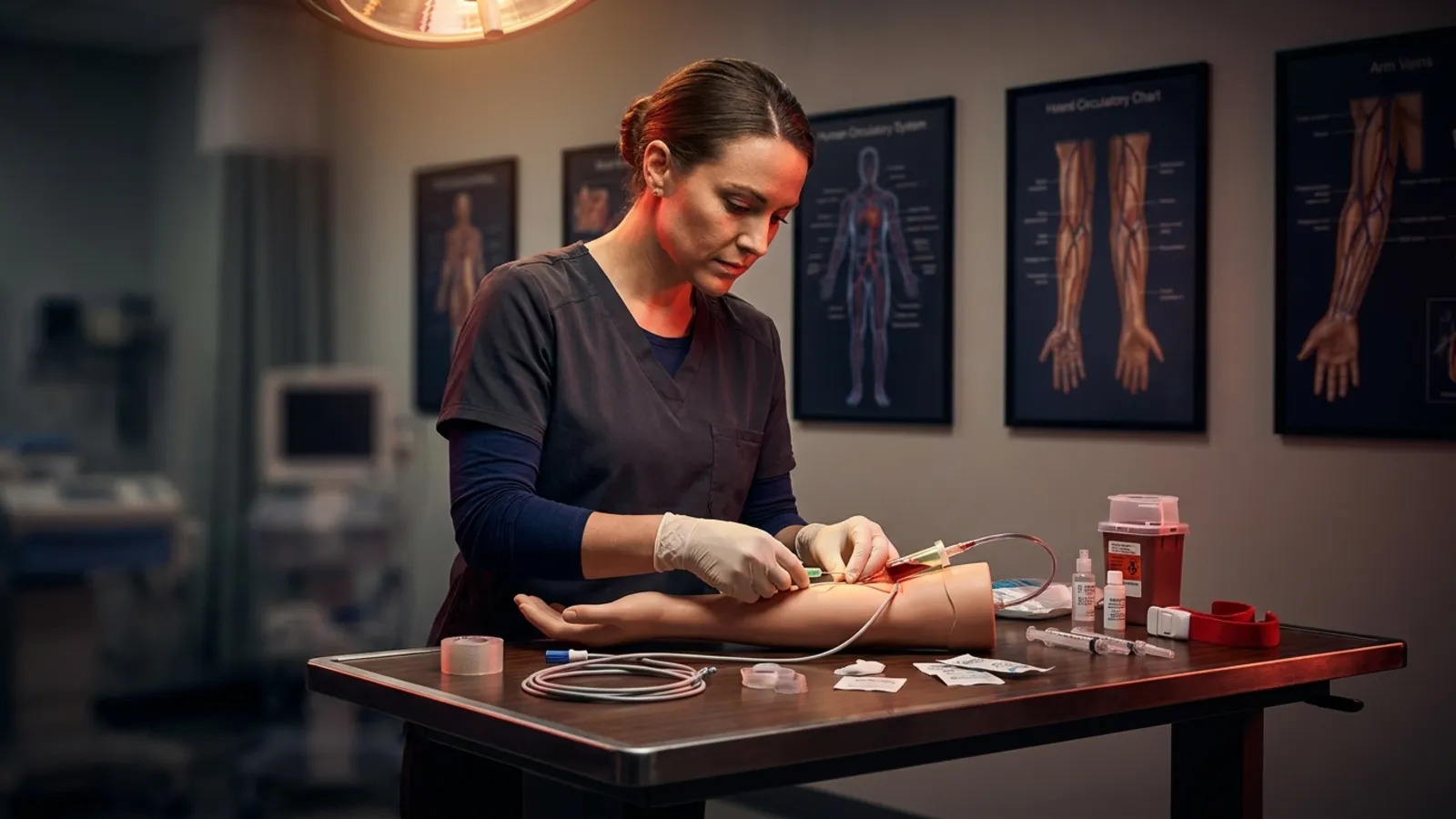
If you have ever found yourself silently asking "failed IV attempt what to do next" between sticks on a difficult patient, this guide is for you. Studies in PMC and the Journal of Infusion Nursing report that roughly half of all first peripheral IV attempts in adults fail, and about 30% of patients meet criteria for difficult intravenous access (DIVA), defined as two or more failed insertion attempts. The miss is not the problem. The next 60 seconds are. What you do clinically, what you say to the patient, and what you tell yourself between sticks is what separates the provider who recovers from the one who spirals.
This guide is the protocol you wish someone walked you through your first year on the floor. It covers the clinical recovery, the two-attempt rule, when to escalate, how to communicate with a patient who just got stuck and missed, how to document, and how to mentally reset before the next attempt.
What counts as a failed IV attempt
A failed IV attempt is any insertion attempt that does not result in a properly placed, patent peripheral IV catheter through which fluid or medication can be infused without infiltration. That definition includes catheters that flashed but kicked out, catheters that threaded but blew the vein, catheters that never got blood return, and catheters that placed correctly but failed within minutes of attempted use.
What does not count as a separate attempt: pulling back the angiocatheter and redirecting under the skin without exiting. The Infusion Nurses Society standard is that a single skin puncture is a single attempt, regardless of how many redirects you perform under that puncture. Once the needle exits the skin, the next stick is attempt two.
This matters because the two-attempt rule (more on it below) is built around skin punctures, not redirects. Counting every redirect as a separate attempt inflates your "miss" record and pushes you toward escalation prematurely.
Failed IV attempt what to do next: the first 60 seconds
The first minute after a miss is the most important minute in the procedure. Here is the clinical and human protocol, in order.
- Apply pressure and secure the site. Hold gauze with firm pressure for 30 to 60 seconds (longer for patients on anticoagulants). Confirm hemostasis. Apply a small dressing. Dispose of the contaminated catheter in the sharps container immediately. Do not skip sharps disposal because you are flustered. That is how needlestick injuries happen.
- Take a breath. Literally. A single deliberate exhale (4 seconds out, slow) drops your sympathetic tone. This is not optional. The CNS state you carry into attempt two is the single biggest predictor of whether attempt two succeeds.
- Re-survey both arms. Do not stick the same vein again. Look at the contralateral arm, the dorsum of the same hand, the forearm, the antecubital fossa. Use a tourniquet, palpate, and choose deliberately. The miss happened. Do not chase it.
- Acknowledge the miss to the patient briefly and move forward. A short, calm acknowledgment ("That one didn't work, I'm going to try another spot") prevents the patient from spiraling, which prevents your stress from spiraling. Long apologies make it worse.
- Decide: second attempt, or escalate. Use the criteria in the next section. If you proceed, change the catheter, change the site, and proceed with deliberate setup. If you escalate, do it without shame. The decision is clinical, not personal.
This sequence takes less than two minutes when you have practiced it. The first time you run it on a real patient, it will feel slow. That is normal. Run it anyway. The reps is what makes it automatic.
Should you try again, or escalate?
The two-attempt rule, codified across most hospital DIVA pathways and infusion nursing standards, is a ceiling, not a target. Use the table below to decide whether the second attempt is appropriate or whether escalation is the safer call.
| Situation | Try again? | Why |
|---|---|---|
| First miss, you saw flash, vein blew on advance | Yes (with technique adjustment) | Your aim was correct; site selection or angle needs adjustment |
| First miss, no flash, you cannot palpate a target vein | No, escalate | Without a clear target, a second attempt has high miss probability and low patient benefit |
| Patient has a documented DIVA history (2+ prior failed attempts in this admission) | No, escalate immediately | DIVA pathway should be activated; vessel visualization is indicated |
| Patient is dehydrated, hypotensive, or peripherally shut down | No, escalate to ultrasound-guided IV or vascular access team | Standard palpation-and-stick is unlikely to succeed; ultrasound-guided IV achieves 93% first-attempt success in this population |
| Patient is crashing, time-critical IV needed | No, escalate to IO or rapid response | Time spent on a second peripheral is time the patient does not have |
| Patient is pediatric, anxious, or has trauma to one or both upper extremities | Consider escalation | Limited sites, high anxiety, and tissue trauma all reduce second-attempt success rates |
| Patient has had two attempts by you already | No, hand off to a colleague or escalate | One clinician should not exceed two skin punctures on one patient |
Bottom line: The two-attempt rule per clinician is a hard ceiling. The decision to try a second attempt should be a deliberate clinical judgment based on visible target, patient stability, and your own state, not a reflex to "make it work" before someone else has to be called.
For the decision flow on when ultrasound-guided IV becomes the right next step, see our guide on when to use ultrasound for IV access.
How to communicate with the patient after a missed stick
What you say in the 30 seconds after a miss directly affects the patient's vasoconstriction, their willingness to let you try again, and their assessment of your competence. The script matters.
Say this:
- "That one didn't work. I'm going to apply a little pressure here, then we'll try a different spot."
- "Sometimes the first stick doesn't take. That's normal. Let me look at your other arm."
- "You did nothing wrong. The vein just rolled / collapsed / wasn't quite in the spot I expected. I'm going to try the [forearm / hand / opposite arm] now."
Don't say this:
- "Sorry, sorry, sorry, that almost never happens." (It does. The over-apology signals panic.)
- "I'm going to try one more time and if it doesn't work I'll get someone else." (Conditional language increases anticipatory anxiety.)
- "Your veins are really hard." (True or not, this transfers your difficulty onto the patient. They will feel responsible for your next miss.)
For pediatric or needle-phobic patients, modify:
- Keep affect calm and matter-of-fact. Children read nervous-but-trying-to-hide-it instantly.
- Do not promise "this one will work." Promise effort: "I'm going to be really careful with this next one."
- Offer a sense of agency where possible: "Which arm feels better for the next try?"
For a deeper guide on the language that calms patients (and protects your own success rate), see how to talk to patients during IV insertion.
How to document a failed attempt correctly
Documentation after a missed IV is not a punishment. It is a clinical record that protects the patient, protects you, and feeds the data that drives your facility's vascular access policies. Follow the standard fields.
- Number of attempts: Document each skin puncture as a separate attempt, even if you used the same catheter. Redirects under one puncture count as one attempt.
- Site attempted: Document anatomic location ("right cephalic vein at antecubital fossa") not just "right arm."
- Catheter gauge attempted: 18g, 20g, 22g, 24g, etc.
- Reason for failure: Vein blew, no flash, infiltration on flush, catheter would not advance, patient withdrew arm. Be specific.
- Patient tolerance: Calm, anxious, refused further attempts, requested specific provider.
- Action taken: Pressure held, dressing applied, escalated to vascular access team / second clinician / ultrasound-guided IV / IO.
- Time of escalation request and time of arrival: Critical for time-sensitive medications.
Two fields people skip and shouldn't: patient education provided ("explained reason for second attempt") and alternative access discussed ("midline considered, declined per provider order"). These two fields show up in chart reviews after adverse events. Document them every time.
How to mentally reset before the next stick
This is where most clinical guides stop. We start here. The mental game after a missed stick is the part nursing school does not teach, and it is the part that separates clinicians who recover from clinicians who carry a missed stick into every subsequent attempt for the rest of the shift.
Three resets, in order.
1. Physiological reset (10 seconds). A single physiological sigh: a deep inhale through the nose, a second smaller inhale stacked on top of it, then a slow exhale through the mouth. This drops sympathetic tone faster than any other intervention you can do at the bedside. Use it before every second attempt. Use it before every escalation call. Use it before you walk into the next patient's room.
2. Cognitive reset (30 seconds). Reframe the miss out loud (silently, to yourself). The script: "The vein rolled. I corrected my angle for next time. The patient is okay. The next stick is a fresh attempt." This sounds simple. It works because it interrupts the rumination loop that turns one miss into a shift-long confidence collapse.
3. Identity reset (ongoing). The provider who never misses does not exist. The provider who recovers from misses without losing technique does. That is the identity to anchor on. Every clinician you respect has missed sticks. Their reputation comes from how they recover, not from a perfect record.
This is the work VeinCraft Academy puts at the front of the curriculum. We teach CNS management before we teach technique because the technique only works when your nervous system is calm enough to execute it. For the deeper psychology of why your hands shake on a hard stick and how to train them to stop, see the psychology of IV insertion and IV insertion anxiety for nurses.
How to prevent the next miss
A failed attempt is also data. Use it. Most repeated misses come from one of five fixable causes.
- Site selection error. You picked a vein that looked good but lacked depth, structure, or hydration. Adjustment: palpate before you stick. Visible is not the same as cannulatable.
- Tourniquet failure. Tourniquet was too loose, too tight, or had been on too long. Adjustment: re-tourniquet for the second attempt and cap dwell time at two minutes.
- Angle error. You went in too steep (blew through) or too shallow (skidded over). Adjustment: 10 to 30 degree insertion angle for most peripheral sites; flatten on advance after flash.
- Anchor failure. You did not anchor the vein, so it rolled on contact. Adjustment: traction below the insertion site with your non-dominant thumb, taut and stable.
- Movement artifact. The patient flinched, you flinched, or the limb shifted mid-stick. Adjustment: pre-position the limb, set yourself up with both elbows supported, and brief the patient before you puncture.
For deeper coverage of common failure modes, see why veins blow during IV insertion and IV cannulation tips and tricks.
Frequently asked questions
How many failed IV attempts are too many?
The widely accepted ceiling is two attempts per clinician, after which the patient should be escalated to a more experienced provider, the vascular access team, or ultrasound-guided IV. Some institutions cap total attempts (across all clinicians) at three to four before activating a difficult IV access (DIVA) pathway. Exceeding that ceiling without escalation is associated with patient harm, vessel damage, and venous depletion that may affect future access for the rest of the admission.
Is it normal to miss IVs?
Yes. Studies report that approximately 50% of first IV insertion attempts in adults fail, and about 30% of patients meet criteria for difficult intravenous access. Missing a stick is not a sign of incompetence, it is a baseline reality of peripheral cannulation in any healthcare setting. What separates strong clinicians is not a perfect record, it is the discipline of the recovery protocol after a miss.
What should I do if I miss two IVs in a row?
Stop. Apply pressure and document both attempts. Hand off to a colleague or escalate to the vascular access team or ultrasound-guided IV. Continuing past two attempts is associated with patient distress, vessel injury, and lower second-attempt success even by a fresh clinician. Use the time to do a brief mental reset (physiological sigh, cognitive reframe) before your next patient or your next attempt on this patient with a more experienced clinician's support.
How do I tell a patient I missed their IV?
Use a short, calm, factual statement. "That one didn't work. I'm going to apply a little pressure, then we'll try a different spot." Avoid over-apologizing, conditional language ("if this one doesn't work either..."), or transferring difficulty onto the patient ("your veins are really hard"). Calm acknowledgment, brief plan, move forward. The patient takes their cue from your affect.
When should I call the vascular access team after a failed IV?
Call them after your first miss when any of the following apply: the patient has a documented DIVA history, you cannot identify a clear target vein for a second attempt, the patient is hemodynamically unstable, ultrasound-guided IV is indicated, or you have already had one attempt and a colleague's prior attempt has also failed. Calling early is not a sign of weakness, it is a sign of clinical judgment. Most facilities track time-to-IV-placement as a quality metric; calling fast helps the patient and your unit.
Master the recovery, not just the stick
A confident clinician is not one who never misses. A confident clinician is one who has run the recovery protocol so many times that the miss does not destabilize the rest of the shift. That muscle is built through deliberate practice, psychology-first training, and live-stick repetitions under instructor observation, not through hoping the next vein will be easier.
VeinCraft Academy builds that muscle. Our Level 1: The Method course covers the psychology of the stick, anatomy, technique, and live cannulation on real patients in an 8-hour intensive. Level 2: The Craft extends into hard sticks, special populations, ultrasound-guided access, and the advanced troubleshooting that turns missed sticks into learning, not shame. Both courses are taught by credentialed clinicians with active field experience under a standardized mastery-based curriculum, and graduates have access to ongoing Stick Lab practice sessions to reinforce the recovery protocol on real anatomy.
A failed IV attempt is not the end of the procedure. It is the start of the protocol that defines you as a clinician. The next time you mentally search for "failed IV attempt what to do next," you want the answer running on autopilot, not improvised under pressure. Ready to drill the recovery until it does? Explore VeinCraft Academy courses and enroll.
This article is educational and is not a substitute for facility policy, your scope of practice, or direct medical oversight. Follow your institution's DIVA pathway and chain-of-command protocols.
VeinCraft Academy is a mastery-focused IV cannulation training program for healthcare professionals. All instruction is delivered by credentialed clinicians with active field experience. VeinCraft Academy is a RevivaGo Company.