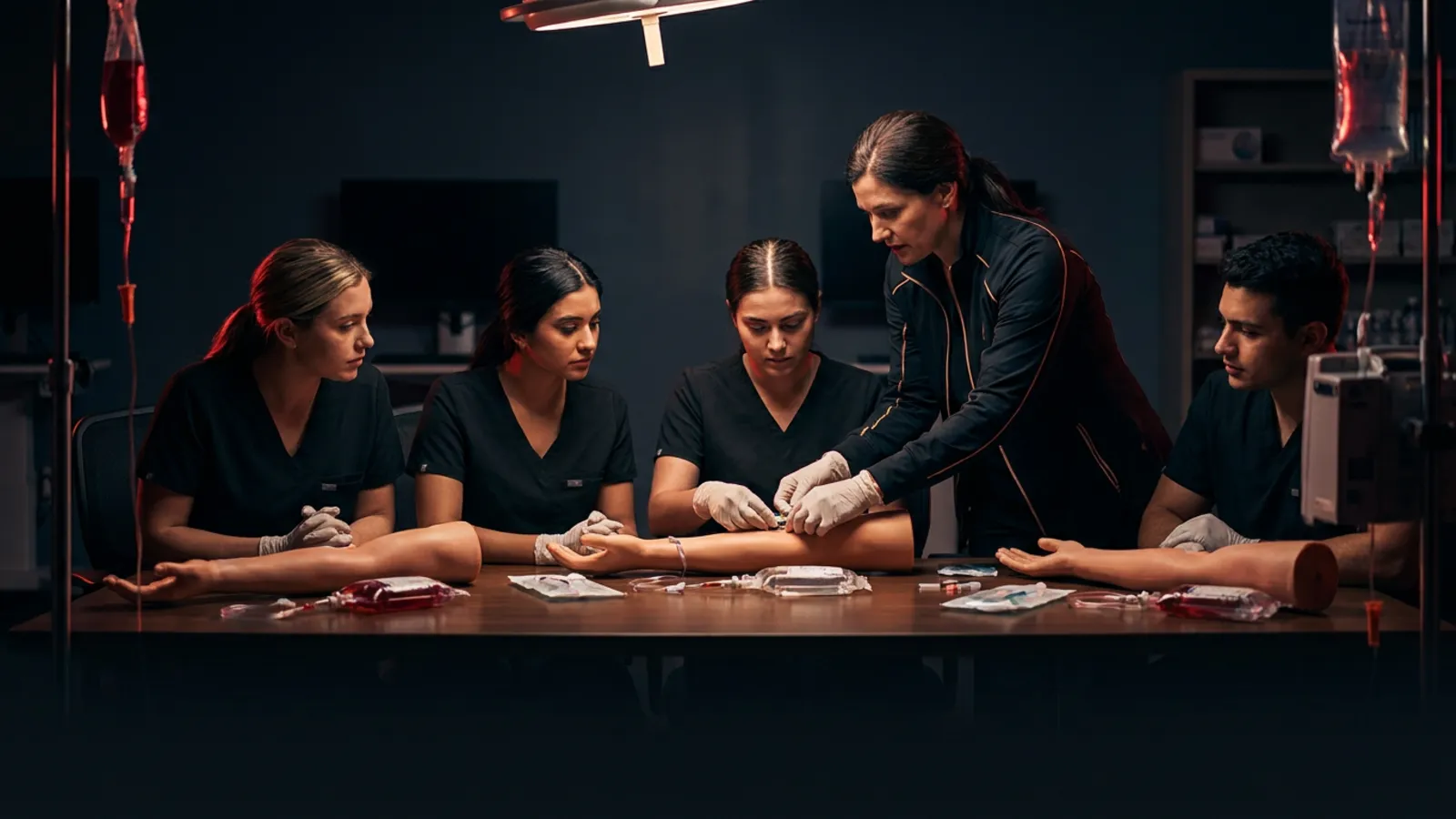
Venepuncture and cannulation training is a combined course that teaches both venous access skills: venepuncture (inserting a needle to draw blood, then removing it) and peripheral IV cannulation (placing a flexible catheter that stays in the vein to deliver fluids and medications). The two procedures share anatomy, vein selection, and infection control, so many programs teach them together in a single course.
Combined training makes sense on paper. In practice, course quality varies enormously. Some programs deliver eight hours of instruction with supervised practice on real veins. Others compress both skills into a half-day of slideshows and a few passes at a latex arm, then hand you a certificate that says you attended.
This guide covers what a combined venepuncture and cannulation course should include, how much supervised practice each skill actually requires, and the questions that separate a real training program from a certificate mill. If you are still deciding whether you need blood-draw training, cannulation training, or both, start with our phlebotomy vs IV cannulation comparison and come back.
Why teach venepuncture and cannulation in one course?
The two skills share most of their foundation. Both require you to read venous anatomy, select an appropriate site, apply a tourniquet correctly, prep the skin, control the needle angle, and recognize when you are in the vein. Both carry the same baseline risks: infection, nerve injury, hematoma, and arterial puncture. A course that teaches these fundamentals once, then branches into skill-specific technique, uses your training time efficiently.
Here is where the shared foundation ends and the skills diverge:
| Component | Venepuncture | Cannulation |
|---|---|---|
| Goal | Collect a blood sample | Establish ongoing IV access |
| Device | Straight needle or butterfly, removed immediately | Catheter-over-needle, dwells for hours or days |
| Key technique moment | Stable needle position while tubes fill | Advancing the catheter off the needle after flash |
| Skill-specific knowledge | Order of draw, sample handling, tube additives | Catheter gauge selection, securement, flushing, dwell care |
| What failure looks like | Hemolyzed sample, missed draw, redraw request | Blown vein, infiltration, failed line, escalation |
The divergence matters when you evaluate a course. A program can produce competent blood collectors in less time than it can produce competent cannulators, because cannulation adds a second motor skill (threading the catheter) and a body of aftercare knowledge that venepuncture never touches. Any course that allocates equal, minimal practice time to both is underserving the cannulation half.
What should venepuncture and cannulation training cover?
A complete combined course covers ten areas. Use this as your evaluation checklist when comparing programs:
- Venous anatomy and site selection. Which veins suit blood draws, which suit catheters, and which to avoid. Our guide to vein anatomy for IV cannulation covers the depth this deserves.
- Legal scope and professional standards. What your license or role permits, documentation requirements, and consent.
- Infection prevention. Skin prep, aseptic non-touch technique, sharps safety, and what the evidence says about each.
- Equipment selection. Needle gauges for draws, catheter sizes for IV access, butterfly vs straight needle decisions.
- Venepuncture technique. Insertion angle, anchoring, tube sequencing (order of draw), and sample handling.
- Cannulation technique. Flash recognition, catheter advancement, securement, and flushing.
- The psychology of the stick. Managing your own stress response so your hands stay steady. Most programs skip this entirely.
- Complications and troubleshooting. Hematoma, nerve contact, infiltration, blown veins, and when to stop and escalate.
- Supervised hands-on practice. Real repetitions with an instructor watching and correcting, not a demonstration you observe.
- Competency assessment. A skills check you must pass, not an attendance sheet you sign.
If a course outline lists fewer than seven of these, you are looking at an orientation, not a training program.
How much supervised practice does each skill need?
More than most combined courses provide. Peripheral IV catheter failure rates run as high as 50% in hospitalized patients, according to a 2015 review in the Journal of Infusion Nursing, and insertion technique is one of the contributing factors training can actually change. Competence comes from repetitions under observation, and the research on skill acquisition points to a meaningful threshold: somewhere between 25 and 50 supervised cannulations before providers reach reliable proficiency. We break down that evidence in how many IV sticks it takes to become proficient.
Venepuncture reaches baseline competence faster because the motor task is simpler: enter the vein, hold position, withdraw. The World Health Organization's phlebotomy guidelines still call for structured training with supervised practice rather than observation alone, because the most common venepuncture errors (poor anchoring, wrong angle, probing) are habits an instructor catches early and self-teaching cements.
The practical takeaway: a half-day combined course cannot deliver the repetition volume that cannulation competence requires. It can deliver the framework, the venepuncture foundation, and your first supervised attempts. What matters is whether the program tells you this honestly and gives you a path to continue practicing, or hands you a certificate and implies you are done.
Simulation arms vs live sticks
Most combined venepuncture and cannulation courses run their hands-on segment entirely on simulation arms. Practice arms have real value for first repetitions. They let you learn the mechanical sequence without consequences, which is why we include one in our take-home practice kit.
But a simulation arm cannot roll, spasm, or vary. It has no anxious patient attached to it watching your face for confidence. The tactile feedback of latex over rigid tubing differs from fascia, vein wall, and the subtle give of real tissue. Providers who train only on simulation report the same experience again and again: the arm was easy, the first real patient was not.
When you compare courses, ask one direct question: will I perform supervised venepuncture and cannulation on real veins before I finish? Programs built around hands-on training with live sticks cost more to run, which is why they are rare. They are also the programs whose graduates walk onto the floor already past the hardest psychological hurdle, the first real stick.
Venepuncture, venipuncture, or phlebotomy?
Three terms, two spellings, one skill. "Venepuncture" is the British and Commonwealth spelling, standard across NHS trusts, Australian nursing programs, and UK training providers. "Venipuncture" is the American spelling used in US textbooks and job postings. Phlebotomy refers to the occupation and practice of drawing blood, which has venipuncture as its core procedure.
The skill is identical regardless of spelling. If you trained under one term, your competence transfers fully to the other. US employers may list "phlebotomy and IV skills" where a UK posting would say "venepuncture and cannulation," and both describe the same combined capability. What varies by country and state is scope of practice and documentation requirements, which is worth checking against your state's IV therapy rules before you enroll.
How VeinCraft Academy trains venous access
We teach cannulation as a craft, and we build it on the same foundation a combined course covers: anatomy, site selection, infection control, needle mechanics, and the psychology that keeps your hands steady when a patient is watching.
Level 1: The Method is an 8-hour intensive at $199. Half the day covers the mental game, anatomy, and technique. The other half is simulation drills and supervised live sticks on real veins, with classes capped at 10 students so the instructor watches every attempt. Level 2: The Craft at $299 extends into hard sticks, special populations, and ultrasound-guided access. Both courses use mastery-based progression: you advance when you demonstrate competence under observation, not when the clock runs out.
Our instructors are credentialed clinicians with active field experience, and every course includes follow-up access to Stick Lab practice sessions so your repetition count keeps climbing after the course ends. If your primary need is blood collection rather than IV access, our cannulation course guide for nurses explains how the pieces fit and where a dedicated phlebotomy program serves you better.
Questions to ask before you enroll
Five questions will tell you almost everything about a combined course:
- How many supervised sticks will I perform, and on what? Simulation only, or real veins? Get a number.
- What is the student-to-instructor ratio? More than 10:1 means the instructor cannot watch your technique closely enough to correct it.
- Is the assessment competence-based or attendance-based? Ask what happens if a student cannot demonstrate the skill by day's end.
- What happens after the course? Practice sessions, refresher access, instructor contact, or nothing?
- Who teaches it? Practicing clinicians who start lines every week, or trainers who left the bedside years ago?
A quality program answers all five without hesitation. A certificate mill gets vague at question one.
Is venepuncture the same as phlebotomy?
Nearly. Venepuncture is the procedure of puncturing a vein with a needle, most often to draw blood. Phlebotomy is the broader practice and occupation built around blood collection, which includes venepuncture as its central skill plus sample handling, labeling, and processing. In everyday clinical use the terms overlap heavily, and a venepuncture course and a basic phlebotomy course teach substantially the same procedure.
Can I learn venepuncture and cannulation in one day?
You can build a working foundation in one day if the course includes enough supervised practice. One day is sufficient to learn the shared fundamentals, achieve baseline venepuncture competence, and complete your first supervised cannulations. It is not sufficient to reach the 25-plus repetition threshold that cannulation proficiency requires. Treat a one-day course as the start of a supervised practice pathway, and choose a program that provides one.
Do nurses need separate certificates for venepuncture and cannulation?
It depends on your employer and jurisdiction. Many US hospitals validate the two skills separately on competency checklists, while a combined course certificate documents training for both at once. Some states restrict which roles may perform each procedure, particularly for LPNs and medical assistants. Check your state requirements and your facility's competency policy before assuming one certificate covers both skills.
Can medical assistants take venepuncture and cannulation training?
Yes, and many do. Venepuncture sits within the medical assistant scope in most US states. Cannulation is more restricted: some states permit trained MAs to place peripheral IVs under supervision, others limit the procedure to licensed nurses and paramedics. Our guide to becoming an IV technician maps the allied health pathways in detail.
What does venepuncture and cannulation training cost?
Combined half-day workshops typically run $150 to $350 in the US market, with UK equivalents at similar price points. Longer programs with live-stick practice and competency assessment cost more per hour of instruction but deliver far more supervised repetition. VeinCraft's Level 1 intensive is $199 for a full 8-hour day including live sticks, which prices a mastery-format course below most half-day workshops.
Train for the vein, whatever you call it
Venepuncture and cannulation training is worth one focused day of your career, but only if the course delivers real supervised practice on both skills. Use the ten-component checklist, ask the five questions, and be skeptical of any program that promises full competence from an afternoon with a latex arm.
If you want training built for mastery rather than attendance, explore Level 1: The Method or tell us where you are in your venous access journey. Classes cap at 10 students, instructors are practicing clinicians, and you leave when you can demonstrate the skill, not when the slides run out.
VeinCraft Academy is a mastery-focused IV cannulation training program for healthcare professionals. All instruction is delivered by credentialed clinicians with active field experience. VeinCraft Academy is a RevivaGo Company.