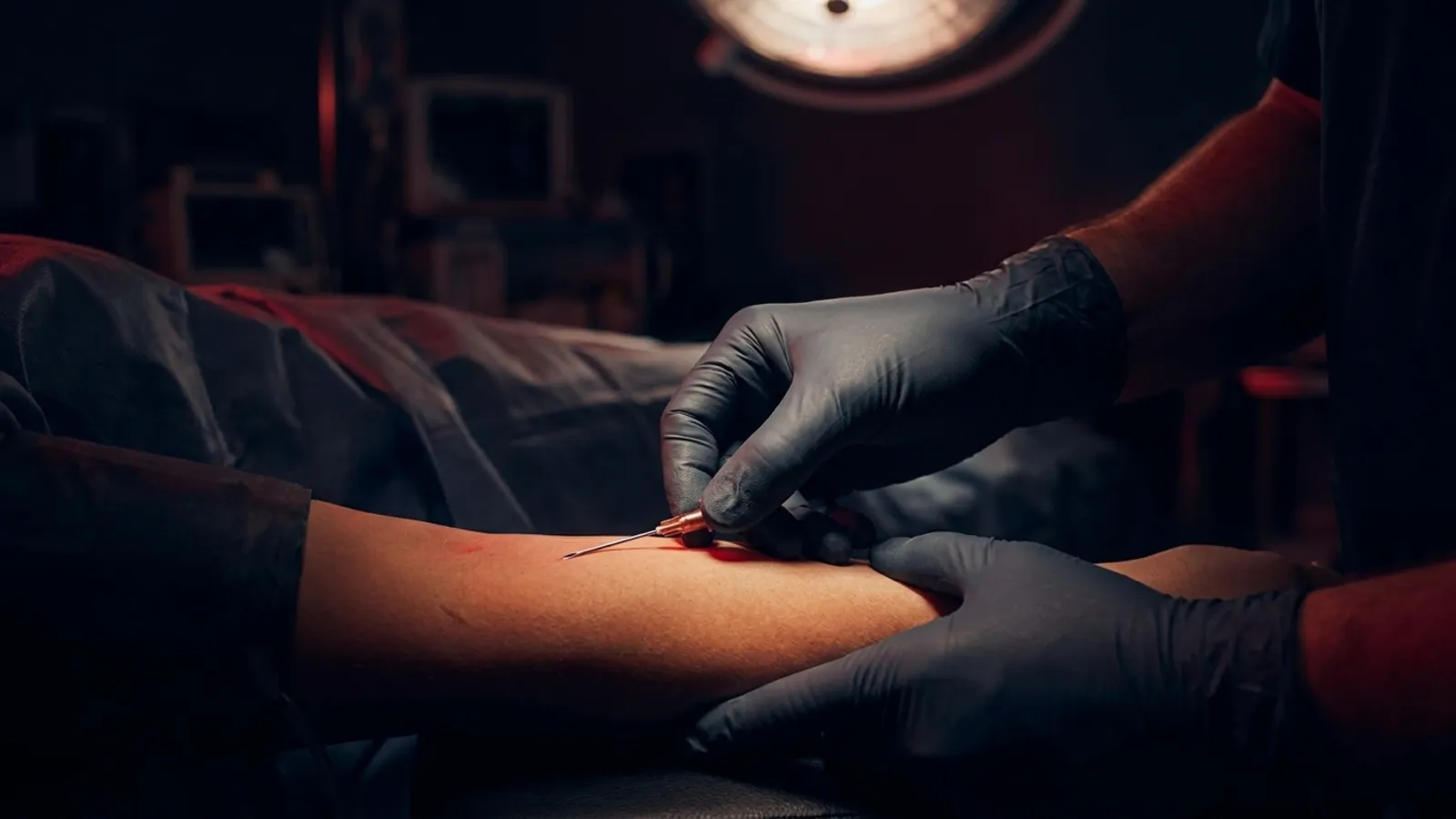
ICU nurse IV skills are the technical floor on which a critical care career is built. The patient has six lines running, two of them carrying vasoactives that titrate to a beat-to-beat blood pressure target, and the third PIV blew an hour ago. The nurse who can re-establish access calmly, identify which line carries what, and recognize when the answer is escalation rather than another stick is the nurse the unit cannot do without.
This is the career guide. It covers the vascular access spectrum in critical care, the core IV skills every ICU nurse needs at baseline, the advanced skills that separate competent from indispensable, ultrasound-guided peripheral access as the new ICU expectation, and the career trajectory from new ICU graduate to charge nurse to NP or CRNA.
Why ICU nurse IV skills are different
Critical care vascular access operates under conditions that floor nursing rarely encounters. Per the Merck Manual professional reference on vascular access in critical care medicine, critically ill patients typically require multiple lines for fluid resuscitation, vasoactive drug titration, parenteral nutrition, lab access, and hemodynamic monitoring. The volume and acuity of vascular work in ICU is unlike anywhere else in the hospital.
Three things define ICU nurse IV skills as a distinct competency set:
- Multi-line management. A typical ICU patient has 4 to 8 lines simultaneously: peripheral IV, central venous catheter, arterial line, possibly PICC or midline, possibly dialysis access. The nurse manages all of them.
- Vasoactive titration. Norepinephrine, vasopressin, dopamine, dobutamine all run continuously through central access with rates adjusted minute by minute. The line that delivers them is the patient's blood pressure.
- Difficult access acuity. ICU patients are dehydrated, edematous, vasoconstricted, post-arrest, or post-cardiac surgery. The peripheral access reality is harder than anywhere else.
For the parallel career path in emergency medicine, see our guide on IV cannulation in the emergency department. The skill sets overlap; the practice environments diverge.
The vascular access spectrum in critical care
Critical care uses every category of vascular access device, often on the same patient at the same time. The spectrum:
| Device | Tip Location | Primary ICU Use | Who Places |
|---|---|---|---|
| Peripheral IV (PIV) | Same peripheral vein | Lab access, brief medication push, secondary fluids | RN at bedside |
| Midline catheter | Axillary vein | 5 to 14 days of non-vesicant therapy when central not needed | Vascular access RN |
| PICC line | Lower SVC | Weeks to months of therapy, intermediate vasoactives, antibiotics | PICC nurse |
| Central venous catheter (CVC, internal jugular or subclavian) | SVC or right atrium | Continuous vasoactives, TPN, frequent labs, central pressure monitoring | Physician or APP |
| Femoral central line | IVC | Emergent or temporary access when IJ/SC unavailable | Physician or APP |
| Arterial line | Radial, brachial, or femoral artery | Beat-to-beat BP monitoring, ABG sampling | Physician, APP, or trained RN |
| Dialysis catheter | SVC or IVC | Renal replacement therapy | Nephrology or interventional |
| Intraosseous (IO) | Tibial, humeral, sternal marrow | Emergent access when peripheral and central unavailable | RN trained in IO |
The ICU nurse manages all of these even when not placing them. Daily care, dressing changes, infection surveillance, patency checks, and complication recognition fall to bedside nursing.
For the bedside decision logic on the peripheral end of the spectrum, see our midline vs PIV decision guide.
Core ICU nurse IV skills (the baseline)
Every ICU nurse needs these skills at baseline. They are the floor, not the ceiling:
- Reliable PIV placement on critically ill patients. Hypotension, edema, vasoconstriction, prior line history. The PIV success rate that floor nursing tolerates does not work in ICU.
- Central line management. Per the NCBI Bookshelf chapter on central line management, nurses provide routine CVAD care including dressing changes, patency checks, line site assessment, and infection surveillance. Knowing what each lumen carries and which medications are compatible is non-negotiable.
- Vasoactive titration. Running norepinephrine to a MAP target requires continuous attention to drip rate, line patency, and BP response. The titration is a nursing skill.
- Multi-line organization. Labeling lines, knowing which medications are running through which lumen, recognizing when two incompatible drugs are about to cross.
- Blood return and patency checks. Verifying central line patency before vasopressor administration, recognizing line occlusion, and intervening before access is lost.
- Infection surveillance. Daily site assessment, recognizing CLABSI signs early, intervening before bacteremia develops.
- Recognizing line-related complications. Pneumothorax post-CVC placement, arterial puncture during attempted venous access, catheter migration, air embolism risk.
For broader troubleshooting on why peripheral lines fail in this population, see our guide on blown veins, causes, and prevention.
Advanced ICU nurse IV skills (the differentiators)
The skills that separate a good ICU nurse from the one the unit calls when nothing else works:
- Ultrasound-guided peripheral IV (UGPIV). Increasingly the baseline expectation in modern ICUs. Critical care nurses with UGPIV skills place lines that previously required physician central placement.
- External jugular cannulation. Useful when standard peripheral access has failed and central placement is delayed.
- Arterial line insertion (in scopes that allow it). Some ICUs train RNs to place arterial lines, particularly radial. Expanding scope opens this skill.
- Intraosseous (IO) access. Code situations and crashing patients where peripheral and central access fail.
- Vasoactive drip line transitioning. Moving a norepinephrine drip from one CVC lumen to another without losing pressure. Involves planning, timing, and a steady hand.
- Dialysis line care and access. Some ICUs run continuous renal replacement; the nurse manages the access integrity.
- Recognizing extravasation in continuous infusions. Vesicant or vasoactive extravasation during continuous infusion is a separate skill from the chemo extravasation conversation. See our IV extravasation management guide for the broader response framework.
UGPIV: the new ICU baseline
Ultrasound-guided peripheral IV access is moving from advanced skill to baseline expectation in critical care. According to a PMC study on asynchronous training for UGPIV among critical care nurses, structured UGPIV training programs produce sustained competence and reduce reliance on physician central line placement for difficult access patients.
The competency standard most ICUs use:
- Prerequisites. Demonstrated proficiency in standard PIV insertion (typically 6 to 12 months of consistent PIV experience). New graduates do not start with UGPIV training.
- Didactic foundation. 4 hours of classroom or asynchronous training covering anatomy, ultrasound physics, probe selection, sterile technique, and complication recognition.
- Simulation practice. Structured practice on phantom arms with instructor feedback before any patient contact.
- Supervised clinical placements. Per published competency standards, at least 10 successful UGPIV insertions under supervision before independent practice.
- Annual maintenance. At least one supervised UGPIV insertion annually with a department superuser to maintain active competency.
The ICU nurse who adds UGPIV to their baseline IV skill set becomes the unit's vascular access escalation point and significantly reduces the physician interruption rate for difficult access. For the broader clinical decision on when ultrasound is appropriate, see our decision guide on when to use ultrasound for IV access.
The vasoactive drip access reality
Vasoactive medication management is where ICU vascular access becomes a life-critical skill. The principles:
- Vasoactives require central access for continuous administration. Peripheral administration of vasopressors is increasingly accepted for short-duration emergent use, but continuous infusion remains a central indication.
- Verify central line patency before initiating vasopressor. A line that will not flush will not deliver the drug. Verify before starting.
- Run vasoactives on dedicated lumens when possible. A norepinephrine drip should not share a lumen with intermittent medications that may interrupt the continuous infusion.
- Know the compatibility chart. Some vasoactives are incompatible with common ICU medications. Mixing through the same line causes precipitation and line failure.
- Recognize extravasation early. Vasopressor extravasation in a peripheral line causes ischemic necrosis. Burning, blanching, or coolness around the IV site warrants immediate stop and treatment with phentolamine per institutional protocol.
- Plan for line transitions. When central access needs to change (CVC removal, lumen failure), the vasoactive drip transition is planned in advance, not improvised.
The ICU nurse career path
ICU nursing is a career trajectory, not a job. The vascular access skill arc shapes the path:
Year 1 to 2: New ICU nurse. Building baseline PIV competence on critically ill patients. Learning central line management, vasoactive titration, and multi-line organization. The curve is steep.
Year 2 to 4: Confident ICU nurse. Reliable PIV success on most patients. Comfortable with central line care and vasoactive titration. Beginning to add UGPIV. Often pursuing CCRN certification.
Year 4 to 7: Senior ICU nurse. UGPIV competent. Becomes the unit's go-to for difficult access. May add arterial line placement, IO competence. Charge nurse role often emerges.
Year 7+: Specialist or advancement. Vascular access team membership, education role, or advancement to ICU NP, CRNA, or critical care medicine specialty. The IV skill foundation translates into APP scope.
The skill that opens every door in this trajectory is reliable IV access. The nurse who cannot get a line cannot escalate to flight, ICU, OR, or anesthesia roles. For the broader career framing, see our guide on nurse career advancement through IV skills.
The psychology of vascular access in critical care
The technical demands of ICU IV access are matched by the psychological demands. The patient is unstable. The team is watching. The line failure has consequences within minutes, not hours.
The providers who succeed long-term in ICU vascular access have trained their nervous system to perform precision motor tasks under acute stress. We teach this connection at VeinCraft Academy as part of our psychology-first curriculum. Central nervous system regulation is the foundation that prevents technical skill from collapsing under pressure.
The identity to cultivate is the ICU nurse who handles every line, every drip, and every difficult access on a 12-hour shift without performance commentary. The unit's quiet anchor. That competence is built, not granted.
How VeinCraft trains for ICU-grade vascular access
Level 1: The Method at $199 builds the cannulation foundation that ICU nurses need before adding the critical care complexity. The 8-hour intensive includes psychology, technique, and live sticks under instructor observation.
Level 2: The Craft at $299 adds the difficult-access skills, ultrasound-guided peripheral access, and the clinical decision-making that defines ICU vascular access competence. Mastery-based progression means you advance when you demonstrate the technique on real patients under credentialed clinical instructors with active field experience.
The bundle (Master the Craft) at $449 saves $49 and includes a free practice kit. Enroll in the next cohort when you are ready to be the ICU nurse who handles the difficult access calls. For parallel career paths, see our guides on flight nurse IV requirements and IV cannulation in the emergency department.
Frequently asked questions
What IV skills does an ICU nurse need?
An ICU nurse needs reliable peripheral IV placement on critically ill patients, central line management (dressing changes, patency checks, infection surveillance), vasoactive titration through central access, multi-line organization across 4 to 8 simultaneous lines, blood return verification, complication recognition, and increasingly ultrasound-guided peripheral IV (UGPIV) competence. Arterial line care and intraosseous access are also commonly expected at the bedside.
Do ICU nurses place central lines?
No, central lines are placed by physicians or advanced practice providers, not bedside ICU nurses. ICU nurses provide routine care of central venous catheters including dressing changes, patency checks, infection surveillance, and lumen management. Some advanced practice nurses (APRNs, CRNAs) place central lines within their scope. The bedside RN role is daily management, not initial insertion.
What is UGPIV and why is it important for ICU nurses?
UGPIV is ultrasound-guided peripheral IV insertion, a technique using bedside ultrasound to visualize and cannulate veins that are not visible or palpable. UGPIV is increasingly a baseline expectation in modern ICUs because it allows nurses to obtain peripheral access on difficult patients without escalating to physician central line placement, reducing patient delay and physician interruption. Most ICU nurses pursue UGPIV training within the first 1 to 2 years of critical care practice.
How long does it take to develop ICU nurse IV skills?
Building baseline ICU nurse IV skills typically takes 1 to 2 years of consistent critical care practice, with senior-level competence (UGPIV, arterial lines, complex multi-line management) developing over 4 to 7 years. The skill curve is steep in the first year because of the patient acuity and line volume. Most ICUs orient new graduates over 12 to 16 weeks specifically because the vascular access learning is dense.
Can ICU nurses run vasopressors through a peripheral IV?
Peripheral vasopressor administration is increasingly accepted for short-duration emergent use under specific institutional protocols, but continuous infusion of vasopressors generally requires central venous access. The peripheral risk is extravasation with subsequent ischemic necrosis. ICU nurses should follow institutional protocols on peripheral vasopressor use, recognize extravasation signs early, and transition to central access as soon as feasible.
What is the career path for an ICU nurse with strong IV skills?
ICU nurses with strong IV skills typically progress from new graduate orientation through CCRN certification (year 2 to 4), then into senior bedside roles, charge nurse positions, vascular access team membership, or advancement to ICU nurse practitioner (ACNP), CRNA, or critical care education roles. The vascular access skill foundation translates directly into advanced practice scope. Strong ICU nurse IV skills also open the door to flight nursing, OR, and anesthesia paths.
VeinCraft Academy is a mastery-focused IV cannulation training program for healthcare professionals. All instruction is delivered by credentialed clinicians with active field experience. VeinCraft Academy is a RevivaGo Company.