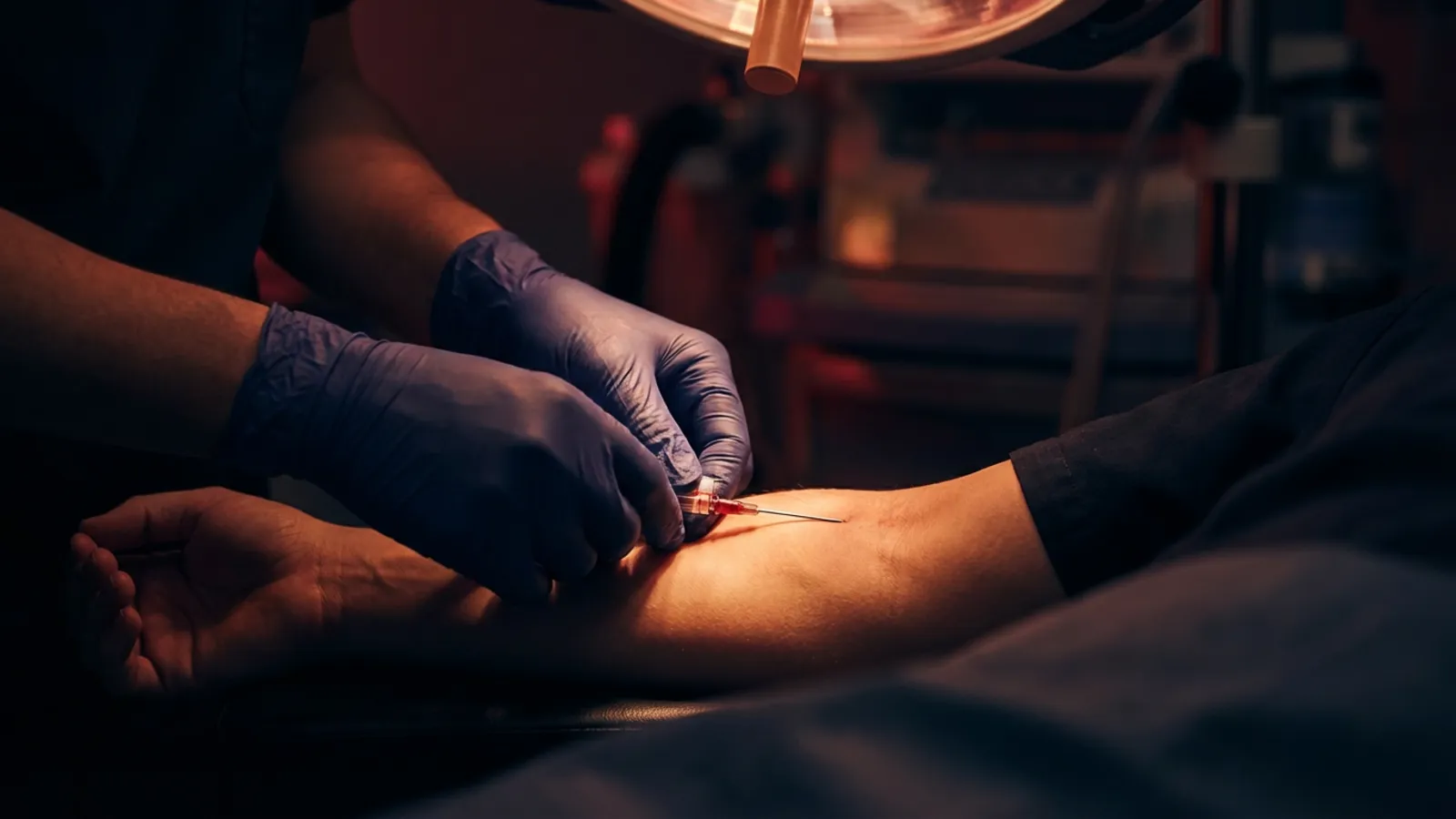
Every flight nurse career guide lists the same certifications. CFRN. CCRN. TNCC. PHTLS. ACLS. PALS. NRP. Three to five years of ICU or ER experience. They tell you what you need on paper.
None of them tell you what happens on skills day.
On skills day, the chief flight nurse walks you to a vibrating cabin mockup. You have one attempt. The patient is hypotensive, dehydrated, and crashing. The lighting is poor and your gloved hands are already sweating. That is the flight nurse IV requirement that matters, and it is the one most applicants fail. CFRN tests your knowledge. The hiring panel tests your hands.
This guide walks through the real vascular access requirements for flight nursing, the CFRN content you need to know, and the skills air ambulance programs actually evaluate before they hand you a pager. If you are an ER or ICU nurse targeting flight medicine, this is what you need to master before you apply.
What is a flight nurse?
A flight nurse is a critical care registered nurse who provides intensive care to patients during air medical transport, typically on helicopters or fixed-wing aircraft. Flight nurses operate under physician protocols with near-autonomous decision-making, managing trauma, cardiac, stroke, pediatric, and obstetric emergencies in the air.
Most flight nurses come from an ER or ICU background with 3 to 5 years of high-acuity bedside experience. They work for air ambulance programs like Air Methods, PHI Air Medical, REACH, Air Evac Lifeteam, and Life Flight Network. The role is competitive, physically demanding, and skill-intensive.
Flight nurse IV requirements at a glance
Here is what air ambulance programs expect before hire:
- 3 to 5 years of ER, ICU, or critical care experience
- Current RN license in the state of practice
- CFRN certification (often required within 6 to 24 months of hire)
- BLS, ACLS, PALS, NRP at minimum
- TNCC or ENPC for trauma and pediatric competence
- PHTLS or ITLS for prehospital trauma
- Peripheral IV first-stick proficiency on hemodynamically unstable patients
- Intraosseous (IO) access competency using EZ-IO on adults and pediatrics
- Ultrasound-guided peripheral IV (UGPIV) capability
- Central line access and maintenance skills
Certifications get you past the application screen. IV and vascular access skills get you past skills day.
Experience and certification requirements
Experience
Most programs want 3 years minimum of adult critical care experience. PHI Air Medical prefers 5 years. Air Evac Lifeteam requires 3. Flight programs weight ICU and ER experience equally, though trauma center exposure is a strong advantage. A year in a busy level I trauma ED often counts more than three years in a community med-surg float pool.
Core certifications
The alphabet soup is non-negotiable:
- CFRN (Certified Flight Registered Nurse). Issued by the Board of Certification for Emergency Nursing. This is the flight nurse credential. The 2026 content outline update places vascular access under Trauma and Medical Emergencies and Patient Care Management.
- CCRN. Critical care credential from AACN, accepted as an alternative or addition by most programs.
- TNCC. Trauma Nursing Core Course, required by most programs within 6 months of hire.
- ENPC or PALS. Pediatric emergency competency.
- PHTLS or ITLS. Prehospital trauma, usually required within 12 months.
- ACLS, NRP. Standard for adult and neonatal resuscitation.
Some programs stack additional requirements like FP-C (Certified Flight Paramedic-equivalent knowledge), advanced airway certification, or specific state endorsements.
CFRN vascular access content areas
The CFRN exam does not have a standalone "IV skills" section. Vascular access competencies are distributed across the content outline and tested through clinical scenarios:
- Peripheral IV access and complications
- Intraosseous access indications and technique
- Central venous catheter management and troubleshooting
- Fluid resuscitation calculations and protocols
- Blood product administration through existing access
- Vasoactive drip management and titration
- Arterial line interpretation and maintenance
You can pass CFRN with strong test-taking skills and weak hands. You cannot pass skills day the same way.
The 10 vascular access skills every flight nurse must master
The flight nurse IV requirements below are the ones air medical programs expect on day one, not day 90. According to the Air and Surface Transport Nurses Association competency standards, vascular access proficiency is evaluated directly at hire, not treated as an on-the-job skill. Rate yourself honestly:
- First-stick peripheral IV on stable patients. Baseline competence. If this is uncertain, flight is not the next step yet.
- First-stick peripheral IV on hemodynamically unstable patients. Hypotension, dehydration, shock, and vasoconstriction all collapse superficial veins. This is where most candidates struggle.
- IV access on trauma patients with peripheral vasoconstriction. Cold, pale, shunting. The veins you see in a clinic visit are not there.
- Pediatric peripheral IV. Smaller targets, more movement, higher emotional pressure from family presence.
- Geriatric peripheral IV on fragile, mobile veins. Rolling veins and thin vessel walls that blow on contact. This is more common in flight than trauma.
- Intraosseous (IO) access using EZ-IO. Proximal humerus, proximal tibia, and distal tibia insertion on adults and pediatrics. Most flight programs require IO competency before skills day.
- Ultrasound-guided peripheral IV (UGPIV). Increasingly non-optional. According to the American Nurse Journal, UGPIV significantly improves first-attempt success in patients with difficult intravenous access, and research in PMC documents first-attempt success rates of 70 to 90 percent for trained providers using ultrasound versus 30 to 50 percent with traditional palpation in difficult-access patients. Flight programs are adopting it faster than ground nursing.
- Central venous catheter access and maintenance. You will draw from, flush, and troubleshoot central lines placed by the sending facility. Some programs train nurses to place central access; most do not.
- Arterial line interpretation and maintenance. Blood draws, waveform troubleshooting, zeroing, and troubleshooting dampening.
- Access in motion. Holding technique during takeoff vibration, turbulence, and rapid altitude changes. This is the skill nobody teaches in a classroom.
If any skill on this list makes your heart rate spike, that is your training gap. Flight nursing is not the place to discover it.
How flight conditions change IV cannulation
Skills you have mastered in a hospital ER often fail in the aircraft. Here is why:
Vibration. Helicopter cabins run at 60 to 90 decibels with constant low-frequency vibration. Your hand moves even when you think it is still. Stabilization technique matters more than in a bed.
Lighting. Cabin lighting is intentionally dim during night flights to preserve pilot vision. Your flashlight hangs from a lanyard. You palpate more than you see.
Space. You work in a cabin the size of a minivan with a patient, a partner, equipment, and sometimes a family member. You cannot step back and reset.
Pressure. Altitude changes affect peripheral vasoconstriction. Hypoxia changes vein visibility. Dehydration from cabin air changes tissue turgor.
Time. You usually get one attempt before the patient needs escalation. Misses get noticed.
Patient condition. Every flight patient is already difficult access by hospital standards. They are why the flight was called.
This is why flight programs test IV skills on manikins and volunteers under simulated stress, not in a quiet skills lab. They are selecting for providers who can execute when conditions are designed to make them fail.
PIV vs IO vs UGPIV vs central: when to use each in flight
Flight nurses need a fast mental decision tree. Here is the framework most programs use:
| Access Type | Primary Use Case | Time to Place | Skill Level |
|---|---|---|---|
| Peripheral IV (PIV) | First-line for most patients | 1 to 3 minutes | Required |
| Ultrasound-guided PIV | Difficult access, DIVA score 4+ | 3 to 8 minutes | Expected |
| Intraosseous (IO) | Cardiac arrest, shock, failed PIV | Under 90 seconds | Required |
| Central line (maintenance) | Already placed at sending facility | Existing access | Required |
| External jugular (EJ) | Failed peripheral, advanced scope | 2 to 5 minutes | Program-dependent |
Bottom line: Start with PIV if the patient allows a stable attempt. If they are coding or peri-arrest, skip to IO without hesitation. Pull ultrasound for difficult access when time permits. EJ and central line placement vary by program scope.
Learn more about the decision criteria in our guide to ultrasound guided IV training, which covers DIVA scoring, probe technique, and when to reach for the ultrasound instead of another blind attempt.
How to build flight-ready IV skills before you apply
Most nurses targeting flight spend years accumulating certifications and wait for IV skills to develop through bedside repetition. That is a slow, uneven path. Your unit's acuity, your preceptor's investment, and pure chance determine whether you build competence or just accumulate hours.
There is a faster way: deliberate, mastery-based training on the exact skills flight programs evaluate.
At VeinCraft Academy, Level 2 (The Craft) is built for exactly this profile. It is not foundational. It assumes you can already start an IV and focuses on the skills that separate confident providers from flight-ready ones:
- Hard stick technique for dehydrated, obese, elderly, and scarred veins
- Pediatric access fundamentals
- Ultrasound-guided peripheral IV instruction and live practice
- Central nervous system management under clinical pressure
- Live sticks on real patients under instructor observation
- Mastery-based progression, where you advance when you demonstrate competence, not when the clock runs out
Our instructors are credentialed clinicians with active field experience. Class sizes cap at 10 students for individual coaching. Level 2 is $299, which is well below the $350 to $500 that most standalone ultrasound-guided IV courses charge. If you are building toward flight, the bundle (Master the Craft) combines Level 1 and Level 2 with a practice kit for $449.
If your peripheral IV fundamentals are still uneven, start with Level 1: The Method. It is the foundation that makes Level 2 possible.
The psychology-first curriculum matters here. Flight nurses operate with adrenaline surging and time running out. If your hands shake on a stable patient in a well-lit ER, they will shake worse in a cabin at 3 a.m. The mental game is not optional for flight medicine. It is the entry requirement nobody writes down.
Read more about how IV skills unlock nursing career advancement, or see our breakdown of the psychology behind confident IV insertion if you are working through performance anxiety before you apply.
How many years of experience do you need to become a flight nurse?
Most air ambulance programs require 3 to 5 years of critical care experience, typically in an ER, ICU, or trauma center. PHI Air Medical prefers 5 years. Air Evac Lifeteam and Air Methods accept 3 years. Programs weight ICU, ER, and trauma experience more heavily than med-surg or floor nursing.
Is CFRN required to become a flight nurse?
CFRN is not always required at hire, but most air medical programs require it within 6 to 24 months of starting. Some accept CCRN as an alternative at hire. CFRN is the gold-standard credential for flight nursing and issued by the Board of Certification for Emergency Nursing. Without it, career advancement in flight medicine is limited.
Do flight nurses place intraosseous (IO) lines?
Yes. Intraosseous access is a required competency for nearly every flight nursing program. Flight nurses must be able to place IOs using EZ-IO on adults and pediatrics, typically at the proximal humerus, proximal tibia, or distal tibia. IO is the default for patients in cardiac arrest or when peripheral access fails under time pressure.
Do flight nurses use ultrasound for IVs?
Yes, ultrasound-guided peripheral IV (UGPIV) is increasingly expected in flight nursing. Many programs train new hires in UGPIV during onboarding, but candidates who arrive with existing competency have a significant advantage. The American Nurse Journal reports that UGPIV improves first-attempt success rates substantially in patients with difficult intravenous access.
Can an ER nurse become a flight nurse?
Yes. ER nursing is one of the most common and respected backgrounds for flight nurses. Most air medical programs actively recruit experienced ER RNs because the trauma exposure, rapid assessment skills, and high-acuity decision-making translate directly to flight medicine. The transition usually requires adding certifications (CFRN, TNCC, PHTLS) and demonstrating advanced vascular access skills on skills day.
What IV skills should I master before applying to a flight program?
Master first-stick peripheral IV on hemodynamically unstable patients, intraosseous access with EZ-IO, ultrasound-guided peripheral IV, and central line access and maintenance. Flight programs evaluate these skills directly during skills day. Structured training in hard sticks, pediatric access, and ultrasound-guided techniques is the fastest way to prepare. See our first-stick IV training guide for the foundational framework.
Ready to master the first stick, every time?
The flight nurse IV requirements above are the floor, not the ceiling. Flight nursing is the purest expression of what VeinCraft Academy trains for: first stick, every time, under conditions designed to make you fail. If you are building toward air medical and your vascular access skills are the gap between where you are and where you want to be, stop waiting for your next shift to slowly fill it in.
Level 2 (The Craft) is built for providers preparing for the highest-acuity environments in nursing. Live sticks. Ultrasound-guided peripheral IV. Hard sticks. Psychology-first instruction from credentialed clinicians with active field experience. Mastery-based progression, so you do not leave until you can demonstrate the skill under pressure.
Explore Level 2: The Craft or enroll in the next cohort and start preparing for skills day before you submit your application.
VeinCraft Academy is a mastery-focused IV cannulation training program for healthcare professionals. All instruction is delivered by credentialed clinicians with active field experience. VeinCraft Academy is a RevivaGo Company.