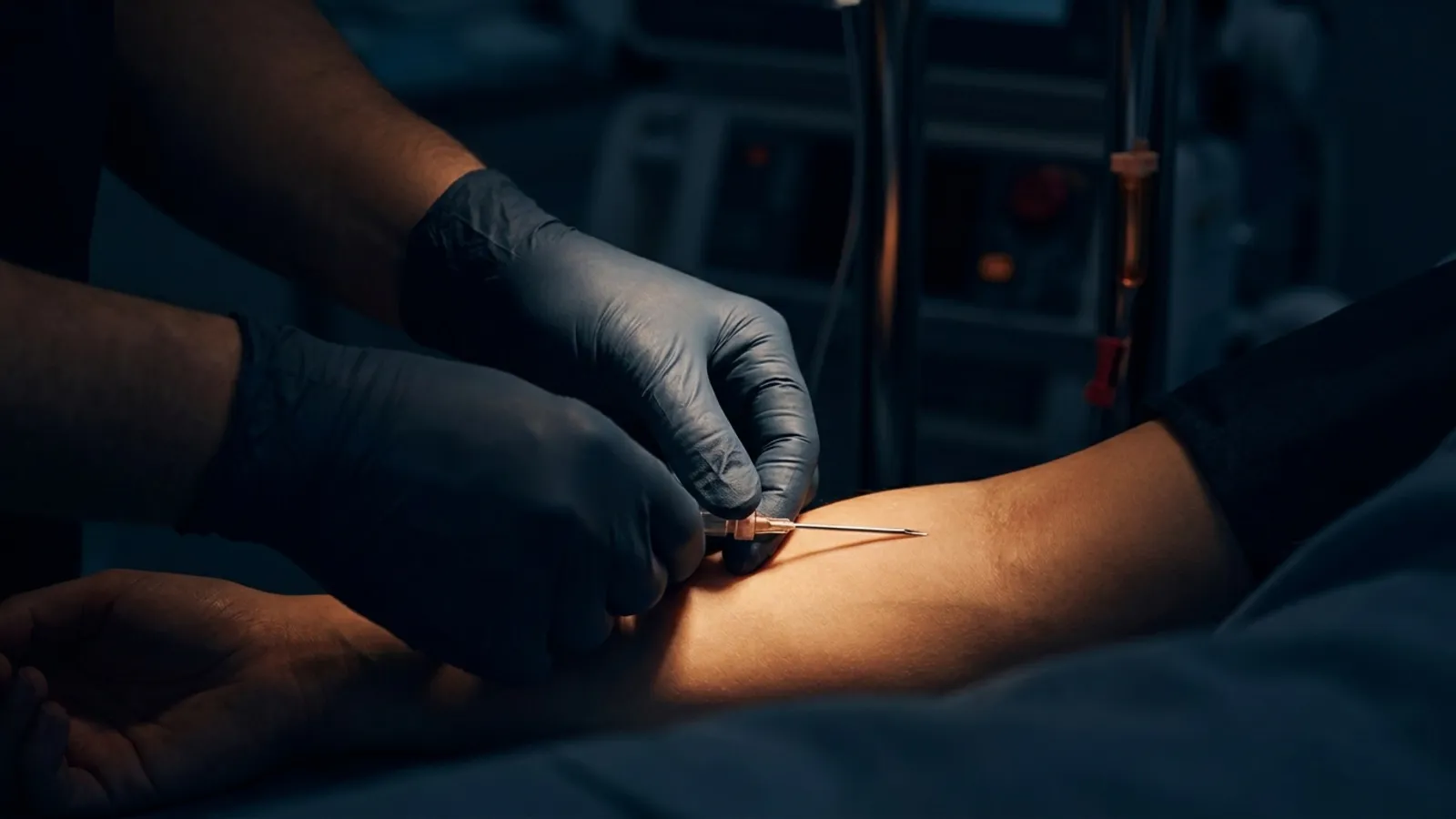
Aseptic technique for IV insertion is the disciplined process that keeps key parts and the insertion site free of contamination during peripheral cannulation, from hand hygiene and skin antisepsis through non-touch catheter handling and hub care. You can place a beautiful flash and still fail the patient if your aseptic steps collapse under pressure.
Most IV courses talk about angle and flash. Fewer treat infection prevention as a skill you rehearse the same way you rehearse the stick. This guide gives you a bedside ANTT framework, skin-prep evidence, the breaks that show up on audits, and the training path that makes aseptic discipline automatic when the room is chaotic.
What aseptic technique for IV insertion means
Aseptic technique for IV insertion means preventing pathogenic organisms from reaching the catheter, the vein, and the patient's bloodstream by protecting critical surfaces and completing skin antisepsis before the needle enters. It is not the same as a full sterile field for central line placement. For most peripheral IVs, Standard ANTT with clean non-sterile gloves and strict non-touch handling is the expected approach when you can complete the procedure without directly touching key parts or the prepped site.
Educational note: follow your facility policy and product labels. This article summarizes widely cited practice frameworks and is not a substitute for institutional procedure or medical advice.
Aseptic vs sterile vs clean: stop mixing the words
Nurses use these terms interchangeably. Auditors do not.
| Term | What it means in practice | Typical IV use |
|---|---|---|
| Clean | General hygiene, reduced bioburden, not procedure-ready | Room wipe-down before setup |
| Aseptic (ANTT) | Protect key-parts and key-sites from contamination | Peripheral IV insertion and hub access |
| Sterile / maximal barrier | Sterile gloves, gown, large sterile field, full barrier precautions | Central lines, many midlines/PICCs |
Bottom line: Peripheral cannulation is usually Standard ANTT, not maximal sterile barrier. Central devices escalate. Calling every IV start "sterile" hides the actual critical behaviors: non-touch handling and intact skin prep.
According to Rowley and Clare's ANTT standardization work (Journal of the Association for Vascular Access, 2019), aseptic, sterile, and clean practice can be taught under one consistent framework instead of conflicting local jargon. That clarity is half the competence.
ANTT: key-parts and key-sites
Aseptic Non-Touch Technique (ANTT) organizes the procedure around two questions:
- What surfaces, if contaminated, create a direct infection risk?
- Can I complete the procedure without touching those surfaces with my hands?
Key-parts include catheter hubs, needle and catheter tips, syringe tips, spike ends, and any surface that will enter the fluid pathway or the patient.
Key-sites include the prepared insertion site and open wounds or access points on the patient.
If you can protect those surfaces with packaging, sterile covers, and non-touch handling, non-sterile gloves are usually appropriate for peripheral insertion. If you must re-palpate after antisepsis, escalate to sterile gloves so your fingers do not recontaminate the key-site. NHS Scotland cannulation guidance and related evidence summaries make that re-palpation glove distinction explicit.
Step-by-step aseptic technique for IV insertion
Use this sequence as your default peripheral IV ANTT loop.
- Prepare the environment. Clear a clean work surface. Gather supplies before you touch the patient so you are not improvising mid-procedure.
- Perform hand hygiene. Soap and water or alcohol-based hand rub before you touch the patient or the sterile components of the kit. CDC intravascular catheter guidance lists hand hygiene before and after site palpation and before and after insertion or dressing care.
- Don clean gloves. New pair for the insertion. Contaminated gloves from a prior task do not count as a fresh start.
- Assess and select the site before antisepsis. Palpate while the skin is still unprepped. Decide gauge and vein first. See our catheter size selection guide when therapy and vein caliber disagree in your head.
- Apply skin antiseptic with friction. Many UK and European best-practice summaries recommend 2% chlorhexidine gluconate in 70% isopropyl alcohol for peripheral sites when not contraindicated. CDC guidance for peripheral venous catheters allows alcohol, tincture of iodine, or alcoholic chlorhexidine, and recommends greater than 0.5% chlorhexidine with alcohol for central and arterial catheters. Follow your formulary.
- Use back-and-forth strokes, then air dry. A British Journal of Nursing expert panel on vascular-access skin antisepsis recommended bidirectional friction for about 30 seconds with 2% CHG in 70% IPA, then approximately 30 seconds of air drying. Do not fan, blot, or blow on the site.
- Do not re-palpate the dry site with bare or non-sterile fingers. If you lose the vein and must re-feel, use sterile gloves or restart antisepsis per policy.
- Insert with non-touch technique. Hold the catheter by approved surfaces. Keep the tip off unclean fields. If you miss and need a second attempt, do not reuse a contaminated catheter.
- Secure and dress aseptically. Stabilize without dragging non-sterile tape across the open site. Assess the site through a clear dressing when possible.
- Protect hubs after placement. Scrub the hub before every access. A common ANTT teaching point is friction scrubbing of the port tip with chlorhexidine/alcohol for about 15 seconds, then full dry time before connection.
Anxiety is where aseptic technique dies. When your heart rate spikes, people skip dry time, re-touch the site, and drop the catheter tip on the bed. That is why VeinCraft Academy pairs psychology-first CNS management with live sticks. Calm hands keep key-parts clean.
Skin prep that actually works
Skin flora at the insertion site is a primary source of extraluminal colonization. A 2023 scoping review and expert consensus in Infection Prevention in Practice supported skin preparation with 2% chlorhexidine gluconate in 70% alcohol before peripheral catheter insertion and at dressing changes, noting that iodine in alcohol alone was viewed as inadequate by that panel for this use case.
Practical rules that survive busy shifts:
- Friction matters as much as the chemical. Wipe like you mean it.
- Dry time is part of antisepsis, not wasted seconds.
- Chlorhexidine allergy or open wounds may require an alternate agent. Know your backup.
- Single-patient tourniquets reduce cross-contamination risk compared with shared reusable straps when policy allows.
Common breaks in aseptic technique
These are the failures infection-control rounds catch repeatedly.
- Touching the prepped site to "find the vein again" with the same glove that held the tourniquet
- Inserting before the antiseptic dries
- Laying the catheter tip on the patient's gown, bedrail, or unopened wipe wrapper
- Reusing a catheter after a failed pass that contacted skin or bedding
- Skipping hub scrub because "it was just connected"
- Tearing tape with teeth or contaminated scissors over the field
- Leaving the hub uncapped while you hunt for a flush
Each break is a training target, not a personality flaw. Providers who never practiced under observation invent shortcuts. Providers who train with feedback unlearn them.
Peripheral ANTT vs central sterile barriers
| Element | Peripheral IV (Standard ANTT) | Central line (maximal sterile barrier) |
|---|---|---|
| Gloves | Clean non-sterile if non-touch possible; sterile if re-palpating | Sterile gloves |
| Gown / large drape | Not routine | Required |
| Cap / mask | Per facility; often not full barrier for simple PIV | Required |
| Skin prep | Alcoholic antiseptic per CDC/local policy | >0.5% chlorhexidine with alcohol preferred when not contraindicated |
| Goal | Protect key-parts and key-site | Full barrier against insertion-related CLABSI |
Bottom line: Do not under-aseptic a peripheral stick because it is "just a PIV," and do not pretend a peripheral start needs an OR field. Match the barrier to the device, then execute it fully.
For device escalation decisions, see PICC vs midline vs PIV. For infection-adjacent site problems after placement, see IV phlebitis signs and treatment and IV infiltration signs and treatment.
VR and aseptic technique for IV insertion
VR modules can rehearse the sequence of hand hygiene, prep, and non-touch steps, and some learners search specifically for VR aseptic or sterile-field training. Sequence memory helps. It does not replace the tactile discipline of keeping a real catheter tip off a real bedsheet while a patient moves.
Our review of VR IV simulation training covers what headsets measure well (knowledge, confidence, order of steps) and where they stop (real anatomy, real pressure, real contamination risk). Pair VR or pad practice with supervised live sticks if you want aseptic habits that survive the floor.
Train the habit, not the lecture
Aseptic technique for IV insertion holds when it is automatic under stress. VeinCraft Academy teaches cannulation with credentialed clinicians who still work in the field, mastery-based progression under observation, psychology-first CNS management, and hands-on live sticks. Level 1: The Method starts at $199. Level 2: The Craft expands hard-stick and advanced troubleshooting when you are ready. Join the next cohort if you want the infection-prevention half of competence trained with the same seriousness as the flash.
Become the provider whose lines are trusted in an audit, not only when nobody is watching.
What is ANTT in IV insertion?
ANTT (Aseptic Non-Touch Technique) is a standardized framework for protecting key-parts and key-sites during procedures such as peripheral IV insertion. You identify critical surfaces, choose Standard or Surgical ANTT based on risk, and avoid touching those surfaces with contaminated hands or gloves. For most PIVs, Standard ANTT with non-touch handling is appropriate.
Do I need sterile gloves for a peripheral IV?
Usually no, if you can insert without touching the catheter tip or the prepped site. Clean non-sterile gloves plus strict non-touch technique are standard for many peripheral starts. If you must re-palpate after antisepsis, switch to sterile gloves or re-prep per policy. Facility rules override general guidance.
How long should chlorhexidine dry before IV insertion?
Follow the product label and your policy. Expert panel guidance summarized in the British Journal of Nursing for 2% chlorhexidine in 70% isopropyl alcohol commonly cites about 30 seconds of application with friction and about 30 seconds of air drying before insertion. Wet antiseptic is incomplete antisepsis and a contamination risk if wiped away early.
What are key-parts in aseptic technique?
Key-parts are equipment surfaces that, if contaminated, create a direct path for organisms into the patient or the fluid pathway. Examples include catheter and needle tips, syringe tips, spike ends, and needleless connector faces. Protect them with packaging, covers, and non-touch handling throughout the procedure.
How does poor aseptic technique relate to phlebitis and bloodstream infection?
Breaks in aseptic technique raise the risk of bacterial colonization at the insertion site and hubs, which can present as bacterial phlebitis or, less often with short peripherals, bloodstream infection. Mechanical trauma and chemical irritation cause many phlebitis cases too, so infection prevention is one pillar beside gauge selection, securement, and dwell management. Clean technique reduces the bacterial share of that burden.
VeinCraft Academy is a mastery-focused IV cannulation training program for healthcare professionals. All instruction is delivered by credentialed clinicians with active field experience. VeinCraft Academy is a RevivaGo Company.