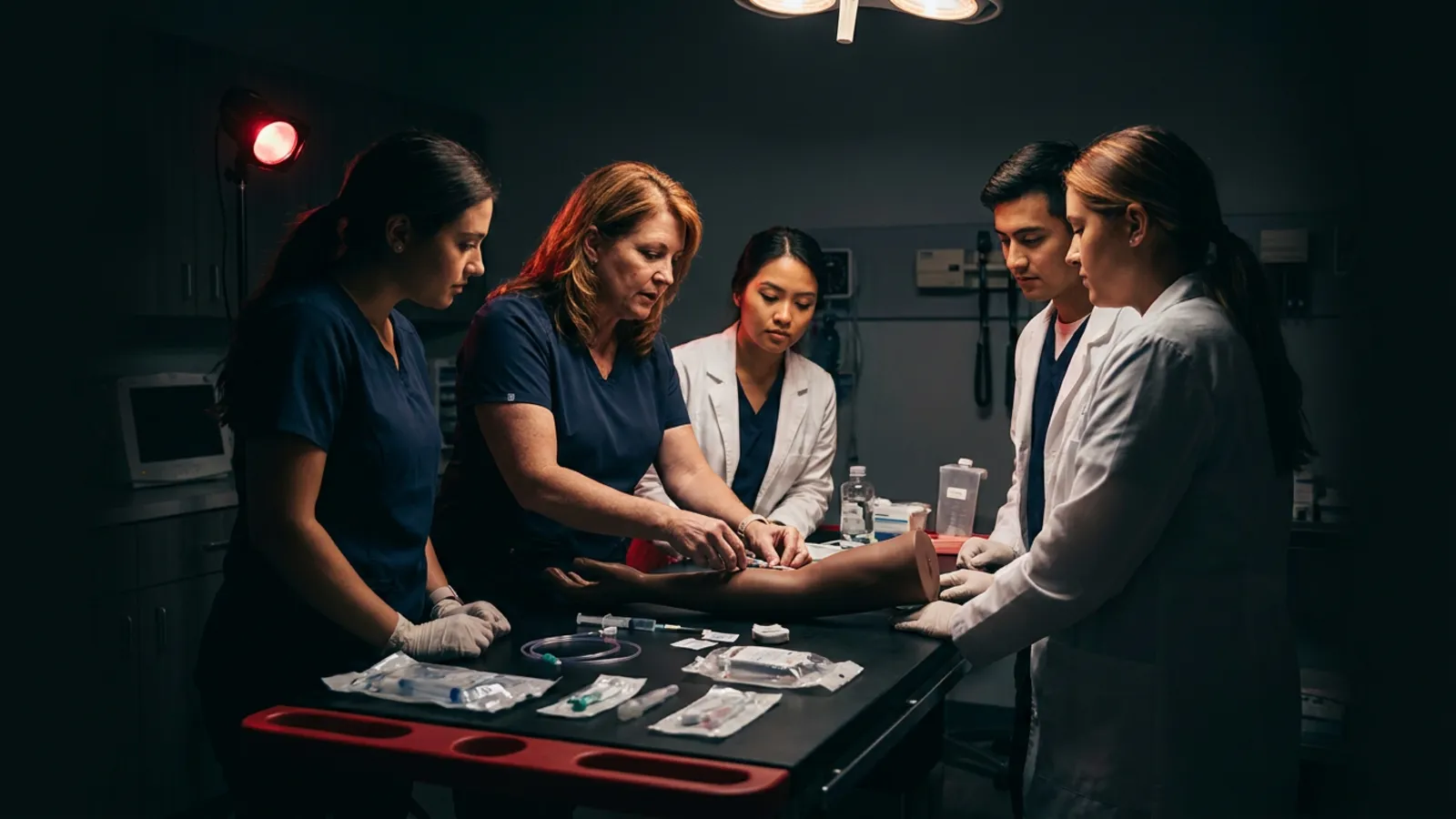
VR IV simulation training uses a virtual reality headset, sometimes paired with a haptic device that simulates resistance, to let healthcare providers rehearse peripheral IV insertion in a computer-generated environment. You select a site, control the needle angle, watch for flash, and advance a virtual catheter, with the software scoring each step. Nursing schools and hospital education departments are adopting it fast.
The question providers actually ask is simpler than the technology: does VR IV simulation training make you better at real cannulation, or does it just feel like practice?
The honest answer is both more positive and more limited than the marketing on either side suggests. The research shows VR does some things genuinely well. It also shows a hard boundary that no headset has crossed: a virtual vein cannot teach your fingers what a real one feels like. This article covers what the evidence says, where VR stops, and how to sequence VR, practice arms, and live sticks on real patients so each does the job it is actually good at.
What the research says about VR IV training
The evidence base is young but consistent, and it is fairer to VR than you might expect from a company that trains on real veins.
A 2024 systematic review in Nurse Education Today examined whether VR intravenous injection training programs work for nurses and nursing students. The review found that VR training improved knowledge and performance confidence compared to conventional instruction. It also reached a second conclusion that matters more: the authors recommended combining VR with physical simulator practice rather than treating it as a standalone method.
A 2022 study published in the International Journal of Environmental Research and Public Health compared nursing students trained with a VR IV injection system against students who practiced only on a standard IV arm simulator. The VR group scored higher on knowledge and clinical performance competency. Even so, the study authors landed in the same place as the systematic review: VR IV training should be combined with hands-on simulator practice, not substituted for it.
Notice what these studies measure. Knowledge scores. Confidence ratings. Performance in simulated assessments, usually with nursing students. What the research has not demonstrated is that VR practice alone produces reliable first-attempt success on real patients. That gap between simulated competence and bedside competence is exactly where peripheral IV performance breaks down, and it is worth taking seriously in a procedure where failure rates in hospitalized patients run as high as 50%, according to a 2015 review in the Journal of Infusion Nursing.
What VR simulation does well
VR earns its place in IV training for specific reasons:
- Unlimited repetition without consequences. You can run the insertion sequence fifty times in an afternoon. No supplies consumed, no patient discomfort, no instructor required for each pass.
- Procedural sequencing. VR drills the order of operations: tourniquet, site selection, prep, angle, flash recognition, advance, secure. Learners who arrive at hands-on training already knowing the sequence spend their supervised time on technique instead of memorization.
- Visual anatomy. Good VR modules render vein depth and branching in three dimensions, which builds a mental map that flat diagrams cannot.
- Low-pressure early learning. For a student who has never held a catheter, rehearsing in VR first reduces the cognitive load of the first physical attempt.
- Standardized assessment. The software scores every learner against the same checklist, which is more consistent than the variable attention of a busy preceptor.
If your program offers VR modules, use them. They are a legitimate rehearsal tool, and the research supports them for knowledge and confidence building.
What VR cannot replicate
The limits are just as specific, and they cluster around the two things that determine whether a real IV goes in.
Tactile feedback. Cannulation is a touch skill. You find most veins by palpation, not sight. You feel the pop of the vein wall, the change in resistance that precedes flash, the subtle difference between a vein and a tendon. Even haptic VR systems, which add force feedback through a stylus or glove, cannot simulate the feel of a real vein under real skin. The device renders resistance; it does not render tissue. Researchers studying haptic simulators note this directly: the technology cannot reproduce the touch of a person's veins during needle insertion.
Variability. Every virtual patient is a rendered model. Real veins roll, spasm, collapse, and scar. A dehydrated 80-year-old and a muscular 25-year-old present completely different problems, and the judgment to adapt comes from encountering that range on real anatomy.
The psychology of a real patient. This is the limitation nobody's product page mentions. In VR, nothing is at stake. At the bedside, a person is watching your face, wincing at the tourniquet, and trusting you not to hurt them. Your heart rate climbs, your hands want to rush, and the skill that fails first is not knowledge of the sequence. It is your nervous system's response to pressure. No simulation can recreate the moment a patient says "everyone always misses my veins" while you palpate. Managing that moment is a trainable skill, but it has to be trained where it actually happens.
VR IV simulation vs live-stick training
| Factor | VR simulation | Live-stick training |
|---|---|---|
| What it builds | Procedural knowledge, sequencing, confidence | Tactile skill, adaptability, composure under observation |
| Feedback | Software scoring, instant and standardized | Instructor coaching plus the vein itself |
| Repetition cost | Near zero per attempt | Supplies, supervision, willing veins |
| Tactile realism | Low, even with haptics | Complete |
| Patient pressure | None | Real, which is the point |
| Transfer to bedside | Unproven for first-attempt success | Direct, because it is the bedside skill |
| Typical access | Institutional programs, simulation labs | Hands-on courses with supervised practice |
Bottom line: VR builds the knowledge layer of cannulation efficiently and safely. Live sticks build the skill itself. The research recommending VR as a supplement to hands-on practice, never a replacement, reflects exactly that division.
How to sequence VR, practice arms, and live sticks
Used in the right order, each tool hands off to the next. Here is the progression we recommend:
- Learn the sequence in VR or video. If you have access to a VR module, use it to drill the procedural steps until the order is automatic. No access? Structured video plus a checklist accomplishes the same knowledge-building step.
- Move to a physical practice arm. A simulation arm adds what VR lacks: a real catheter in your hand, real angles, the mechanical act of advancing the catheter off the needle. Our guide to practicing IV skills at home covers what a practice arm can and cannot teach.
- Get supervised live sticks. This is the step most training skips and the one that matters most. Research on skill acquisition points to a threshold of roughly 25 to 50 supervised cannulations before providers reach reliable proficiency. Those repetitions need real veins and an instructor watching.
- Train the pressure, not just the procedure. Seek instruction that addresses the mental game directly: managing your stress response, resetting after a miss, staying methodical while a patient watches.
- Maintain the skill. Cannulation decays without repetition, whatever method you trained with. Build a plan for ongoing practice before the skill fades.
A program that offers only step 1 is selling you the cheapest part of the progression. The programs that fail their students usually fail by stopping before step 3.
Should you pay for VR IV training?
It depends on who is paying and what it replaces. For hospitals and nursing schools, VR systems are an institutional purchase that stretches simulation lab capacity, and the investment can make sense at scale. For an individual provider deciding where to spend training money, the calculation is different. VR access is rarely sold to individuals, and when it is, you are buying the knowledge layer you could build for far less with video and a practice arm.
If you have several hundred dollars to invest in your own cannulation skill, the evidence says spend it where the transfer is proven: supervised practice on real veins. That comparison is worth making concretely. UGPIV and specialty hands-on courses run $350 to $500. VeinCraft Academy's Level 1 intensive is $199 for a full 8-hour day that ends with supervised live sticks.
Where live sticks fit: how we train at VeinCraft Academy
We built VeinCraft Academy around the parts of cannulation that VR cannot reach. Level 1, The Method, starts with the psychology of the stick: why your hands shake, how to manage your nervous system under pressure, then anatomy and technique, then simulation drills, then supervised live sticks on real patients. Level 2, The Craft, extends that foundation into hard sticks, special populations, and ultrasound-guided access.
All instruction comes from credentialed clinicians with active field experience, in classes capped at 10 students. Progression is mastery-based: you advance when you demonstrate competence under observation, not when the clock runs out. Level 1 is $199, Level 2 is $299, and the Master the Craft bundle is $449 with a take-home practice kit included.
If you have already done VR modules or simulation-arm practice, you are not starting over. You are arriving with the knowledge layer built, ready to add the layer that makes patients stop flinching when you pick up the catheter. Ready to master the first stick? Enroll here.
Is VR IV simulation training effective?
Yes, for specific outcomes. Peer-reviewed studies, including a 2024 systematic review in Nurse Education Today, found that VR IV training improves knowledge and performance confidence in nurses and nursing students. The same research consistently recommends pairing VR with hands-on practice, because effectiveness at building knowledge is not the same as effectiveness at building bedside cannulation skill.
Can you learn IV insertion with VR alone?
No. VR teaches the visual and procedural components of cannulation, but the skill itself is tactile. Finding a vein by palpation, feeling the wall give way, and adapting when a vein rolls all require real tissue under your fingers. No published study has shown that VR-only training produces reliable first-attempt success on real patients. Treat VR as preparation for supervised live practice, not a substitute.
Does VR IV training count toward competency requirements?
Usually only partially. Most employers and state boards that require documented IV competency look for supervised hands-on practice with a skills assessment, and facility competency validation typically requires observed performance on real patients or, at minimum, physical simulation. A VR completion certificate can supplement your training record, but few validators accept it as the hands-on component.
What should come after VR practice?
Supervised live sticks with instructor feedback. VR builds your procedural knowledge; a physical practice arm adds the mechanical feel of a real catheter; live sticks on real patients complete the skill. If you have finished VR or simulation modules, your next step is a hands-on course where an instructor watches your technique on real veins and corrects it in the moment. That progression, knowledge first and live repetitions second, matches what the research recommends.
How much does VR IV simulation training cost?
VR IV simulators are priced for institutions, not individuals. Systems combining headsets, haptic devices, and software licenses are typically sold to nursing schools and hospital education departments, and individual access is rare outside those settings. If you are self-funding your training, compare what the same money buys: a full day of hands-on instruction with live sticks starts at $199, less than most online-only or VR-based coursework once you account for what transfers to the bedside.
VR IV simulation training has earned a real place in cannulation education, and the honest reading of the evidence is that it works for what it targets: knowledge, sequencing, and early confidence. The same evidence is unambiguous that the skill is finished on real veins, under real pressure, with an instructor watching. Build your knowledge wherever you like. Build your craft where it counts.
VeinCraft Academy is a mastery-focused IV cannulation training program for healthcare professionals. All instruction is delivered by credentialed clinicians with active field experience. VeinCraft Academy is a RevivaGo Company.