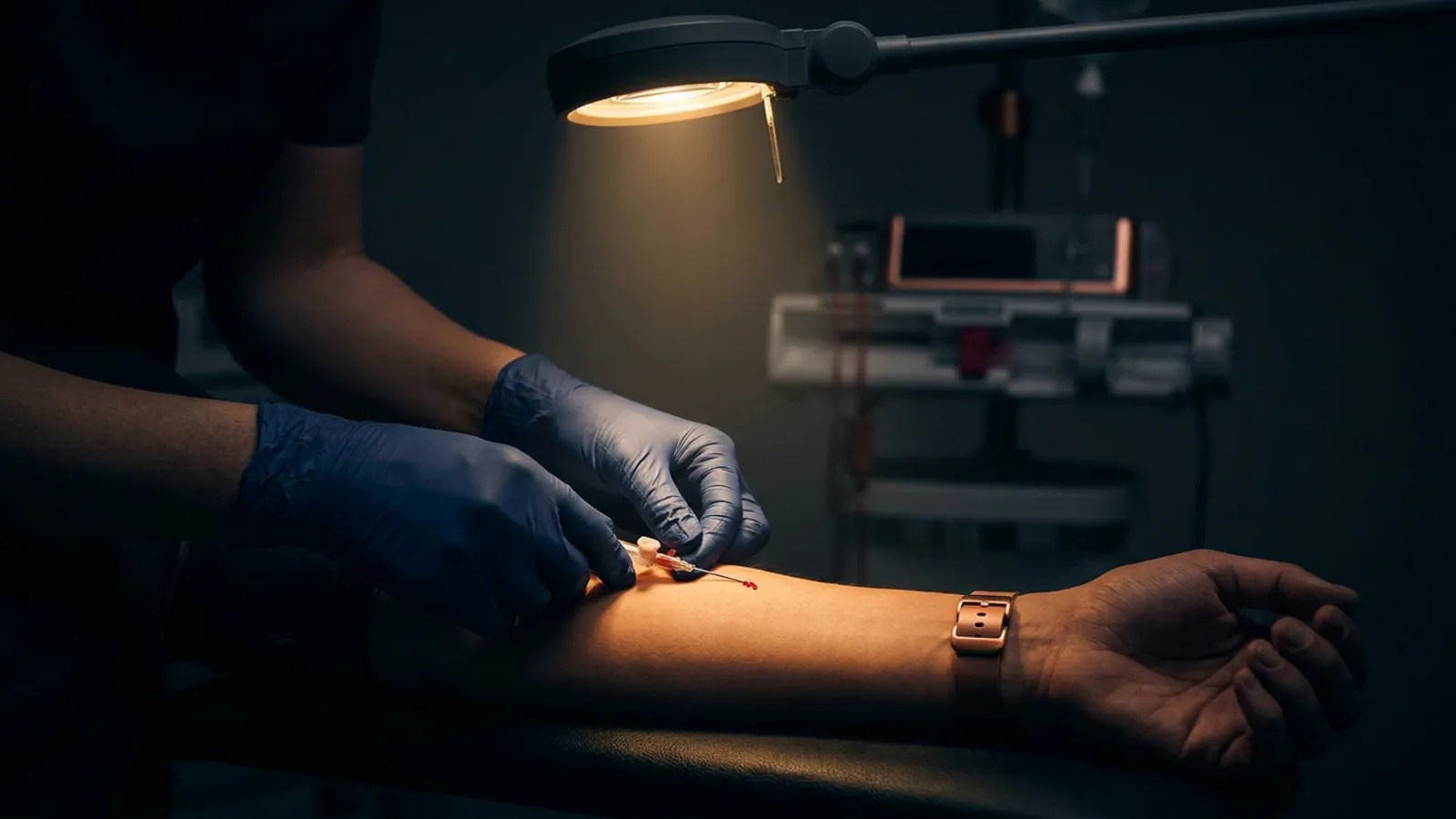
PICC vs midline vs PIV is the vascular access escalation continuum every infusion nurse, vascular access team member, and bedside RN navigates daily. The right device depends on three primary factors: anticipated therapy duration, infusate characteristics (osmolarity, pH, vesicant status), and the patient's peripheral access reality. As a general rule, a peripheral IV (PIV) is appropriate for therapy under 5 days, a midline catheter is appropriate for 5 to 30 days with peripheral-compatible infusates, and a peripherally inserted central catheter (PICC) is appropriate for therapy longer than 14 days or for any infusate that requires central venous tip placement.
That rule is the starting point. The actual bedside decision is more nuanced, and getting it wrong costs the patient and the institution in measurable ways. PIVs that should have been midlines run out at 72 hours and force restarts on a patient whose veins are already exhausted. Midlines that should have been PICCs infuse a vesicant that damages soft tissue. PICCs placed when a midline would have done create unnecessary infection risk and cost.
This guide breaks down each device, the full decision framework drawn from Infusion Nurses Society standards and the Michigan Appropriateness Guide for Intravenous Catheters (MAGIC), the osmolarity and pH thresholds that disqualify peripheral access, scope of practice for each device placement, and the common decision errors that escalate complications.
For the dedicated midline vs PIV decision flow including INS guidance and the 5-day rule in depth, see our midline vs PIV clinical decision guide. This article extends that framework to the full PICC vs midline vs PIV continuum.
What each vascular access device actually is
Peripheral IV (PIV). A short catheter (1 to 1.75 inches) inserted into a peripheral vein in the hand, forearm, or antecubital fossa, with the tip ending in the same peripheral vein where it was inserted. PIVs are the standard short-duration vascular access device, placed by RNs, LPNs (in applicable states), and paramedics within scope. Typical dwell time is 72 to 96 hours per current Infusion Nurses Society guidance.
Midline catheter. A longer catheter (8 to 20 cm, or roughly 3 to 8 inches) inserted into the basilic, cephalic, or brachial vein in the upper arm, with the tip advanced no farther than the distal axillary vein. The midline catheter is a peripheral device because the tip remains peripheral, not central. Typical dwell time is 5 to 30 days. Placement requires ultrasound guidance, sterile technique, and is typically performed by vascular access teams or PICC-trained RNs.
Peripherally inserted central catheter (PICC). A long catheter (40 to 65 cm) inserted into a peripheral arm vein (basilic, brachial, or cephalic), with the tip advanced into the lower third of the superior vena cava (SVC) at the cavoatrial junction. The PICC is a central venous catheter (CVC) because the tip is central, even though insertion is peripheral. Typical dwell time is several weeks to up to a year with proper care. Placement requires ultrasound guidance, tip confirmation via ECG or fluoroscopy, sterile technique, and credentialed PICC nurse or interventional radiology insertion.
The key clinical distinction is where the tip ends. PIVs and midlines are peripheral devices because the tip stays peripheral. PICCs are central venous catheters because the tip is central, regardless of where they were inserted. This single distinction drives every infusate compatibility decision that follows.
PICC vs midline vs PIV at a glance
| Feature | Peripheral IV (PIV) | Midline Catheter | PICC |
|---|---|---|---|
| Catheter length | 1 to 1.75 inches | 8 to 20 cm | 40 to 65 cm |
| Tip location | Peripheral vein (same as insertion) | Distal axillary vein (peripheral) | Lower SVC (central) |
| Device classification | Peripheral | Peripheral | Central venous catheter |
| Typical dwell time | 72 to 96 hours | 5 to 30 days | Weeks to 1 year |
| Therapy duration target | Under 5 days | 5 to 30 days | Over 14 days, often weeks to months |
| Osmolarity tolerance | ≤ 900 mOsm/L | ≤ 900 mOsm/L | Any (including >900 mOsm/L) |
| pH range tolerated | 5 to 9 | 5 to 9 | Any (including extremes) |
| Continuous vesicants | No | No | Yes |
| Parenteral nutrition (>10% dextrose, TPN) | No | No | Yes |
| Continuous chemotherapy | No | No | Yes |
| Insertion technique | Palpation, traditional landmarks (ultrasound for difficult access) | Ultrasound-guided, sterile technique | Ultrasound-guided, sterile technique, tip confirmation required |
| Who typically places | RN, LPN, paramedic within scope | Vascular access team or PICC-trained RN | PICC-credentialed RN, interventional radiology |
| Estimated insertion cost | $5 to $20 | $80 to $200 plus team fee | $200 to $600+ plus team or IR fee |
Bottom line: Match the device to both the therapy duration AND the infusate characteristics. PIV for short-duration peripheral-compatible therapy. Midline for medium-duration peripheral-compatible therapy. PICC for long-duration therapy OR any therapy requiring central tip placement, regardless of duration.
The decision framework: matching the device to the therapy
Four bedside factors drive the device decision. None of them alone is sufficient. All four together produce the right answer.
Therapy duration as the primary driver
The Infusion Nurses Society 2021 Standards of Practice and the Michigan Appropriateness Guide for Intravenous Catheters (MAGIC) converge on duration thresholds:
- Less than 5 days: Short peripheral IV is appropriate, assuming the infusate is peripheral-compatible.
- 5 to 14 days: Midline catheter is appropriate, assuming the infusate is peripheral-compatible.
- 14 to 30 days: Midline may still be appropriate for peripheral-compatible infusates; PICC if the therapy requires central tip access.
- More than 15 days (MAGIC threshold): PICC is generally preferred for peripheral-compatible therapy because peripheral devices fail at increasing rates beyond this duration.
- Long-term ongoing therapy (months to years): Implanted port or tunneled central catheter.
Osmolarity and pH thresholds
Osmolarity and pH are the second-most important factors and the ones that most frequently determine the device choice independent of duration. According to INS standards summarized in current vascular access guidance, peripheral devices (PIV and midline) tolerate infusates with osmolarity below 900 mOsm/L and pH between 5 and 9. Anything outside those ranges requires central venous access.
Common infusates that exceed peripheral tolerances and require central access:
- Parenteral nutrition with dextrose concentration greater than 10% (TPN typically exceeds 1,500 mOsm/L)
- Vancomycin at higher concentrations and prolonged infusion durations
- Continuous vasopressors (norepinephrine, vasopressin, dopamine at central concentrations)
- Continuous vesicant chemotherapy
- 20% mannitol, hypertonic saline at concentrations exceeding peripheral limits
Vesicant and irritant considerations
Vesicants cause tissue damage and necrosis if they leak outside the vein during infusion. Irritants cause inflammation but not necrosis. INS guidance prohibits continuous vesicant infusion through both PIV and midline catheters. PIVs may be acceptable for short, monitored vesicant administration (such as IV push chemotherapy under specific protocols at some institutions), but continuous vesicant infusion always requires central access.
For specific guidance on vascular access in oncology and chemotherapy contexts, see our guide to IV access in chemotherapy patients.
Patient access reality
The fourth factor is the patient's peripheral access reality at the bedside. A patient with no usable peripheral veins after two failed attempts is a midline candidate even if the planned therapy duration is short, because the next stick is the immediate clinical problem. Patients with anticipated repeat hospitalization, chronic disease requiring intermittent IV access, or scarred veins from prior chemo or IV drug use frequently warrant earlier escalation than duration alone would suggest.
MAGIC criteria: the evidence-based standard
The Michigan Appropriateness Guide for Intravenous Catheters (MAGIC) is the most widely cited evidence-based framework for vascular access device selection. Developed by an expert consortium using a modified Delphi approach across 667 clinical scenarios, MAGIC categorizes device choices as appropriate, neutral, or inappropriate based on the combination of therapy duration and infusate characteristics.
The MAGIC framework's clinical impact is most visible at the duration thresholds:
- For peripheral-compatible therapy expected to last fewer than 6 days, MAGIC recommends short peripheral IV.
- For peripheral-compatible therapy expected to last 6 to 14 days, MAGIC recommends midline catheter as the preferred device.
- For peripheral-compatible therapy expected to last 15 days or longer, MAGIC recommends PICC.
- For any therapy requiring central tip access (vesicants, TPN, extreme pH or osmolarity, vasopressors), MAGIC recommends central venous access regardless of duration, with PICC as the appropriate choice for most non-critical-care indications.
The MAGIC criteria are not the only framework, but they are the most operationally clear and the one most commonly cited in nursing education materials, hospital protocols, and vascular access team training. Institutions that have implemented MAGIC-aligned protocols have reported reductions in PICC use for short-duration therapy and reductions in PIV restart rates for medium-duration therapy.
Who places each device
Scope of practice for vascular access device placement is regulated at the state board of nursing level and at the institutional credentialing level. Both must be satisfied before a clinician places any device.
PIV placement. Within RN scope of practice in every U.S. state. LPN/LVN scope varies by state and requires documented IV training and (in many states) state-issued IV authorization. Paramedics place PIVs under EMS scope of practice. Ultrasound-guided PIV access in patients with difficult vascular access is a specialty competency that requires additional training. For the broader context of UGPIV decision-making, see our guide on when to use ultrasound for IV access and our ultrasound-guided IV training article.
Midline placement. Typically performed by vascular access teams (VATs), PICC nurses, or RNs who have completed a credentialed midline insertion course. Midline placement requires ultrasound guidance, sterile technique, and documented competency under observation. Some institutions credential bedside RNs for midline insertion through internal training pathways.
PICC placement. Performed by PICC-credentialed RNs (typically VAT members), advanced practice providers, or interventional radiology depending on institution. PICC placement requires ultrasound guidance, tip confirmation (via ECG, fluoroscopy, or post-insertion chest X-ray), and sterile technique. Credentialing typically requires didactic instruction, hands-on training, supervised insertions, and ongoing competency validation.
For specific catheter sizing decisions across all device types, see our IV catheter size selection guide.
Common decision errors that escalate complications
Three patterns of vascular access decision errors account for most of the avoidable complications.
1. Placing a PIV when therapy duration clearly exceeds peripheral capacity. The patient with anticipated 10 days of IV antibiotics started on a PIV will need 2 or 3 restarts before someone escalates to midline. Each restart adds insertion attempts, patient frustration, and infection exposure. The right call at hour zero is the midline.
2. Placing or maintaining a midline for a vesicant or extreme-osmolarity infusate. The midline tip is peripheral. INS guidance is clear: continuous vesicants, parenteral nutrition, and infusates exceeding 900 mOsm/L or outside pH 5 to 9 should not run through a midline. Tissue damage from peripheral extravasation of a vesicant is the kind of complication that ends careers and triggers lawsuits. For the management protocol when extravasation does occur, see our IV extravasation management guide and our IV infiltration signs and treatment guide.
3. Defaulting to PICC for medium-duration therapy when a midline would have done. PICCs carry higher per-device infection rate than midlines, require more intensive maintenance, and cost more to place and maintain. For peripheral-compatible therapy in the 6 to 14 day window, the midline is the appropriate first choice. PICC use should be reserved for therapy requiring central tip access or therapy exceeding 14 to 30 days.
The clinical judgment that prevents these errors is built through repetition under observation. Most providers learn the rules in nursing school but build the judgment at the bedside, where the right call often runs against time pressure, charge nurse preferences, or patient resistance.
How VeinCraft Academy builds the clinical judgment behind the device decision
Mastering the PICC vs midline vs PIV decision is the upstream judgment that determines whether your day proceeds cleanly or unravels at hour 72. VeinCraft Academy's curriculum builds the cannulation skill and clinical judgment that the entire vascular access continuum depends on, starting at the peripheral access foundation.
We start with psychology, not technique. Before catheter gauge, site selection, or insertion angle, we address how your nervous system behaves under performance pressure and how to build the calm, repeatable focus that bedside cannulation requires.
From there, progression is mastery-based. You advance when credentialed clinical instructors with active field experience observe you demonstrating competence on real patients, not when the clock runs out on the course schedule.
Level 1: The Method is an 8-hour intensive at $199 that covers psychology, anatomy, technique, simulation drills, and live cannulation on real patients with individual coaching at a 10:1 student-to-instructor ratio. This is the foundation that the entire vascular access escalation continuum builds on.
Level 2: The Craft at $299 extends into hard sticks, special populations, and ultrasound-guided peripheral IV access. Level 2 covers the difficult-access skill set and the clinical decision framework that determines when to escalate from peripheral to midline.
VeinCraft Academy does not currently offer dedicated midline or PICC insertion training. Those are institution-specific credentialing pathways that build on the peripheral access foundation. Our role in the vascular access continuum is to build the cannulation skill and judgment that everything else assumes.
Explore enrollment or compare Level 1: The Method and Level 2: The Craft to find the right starting point.
When should you escalate from PIV to midline?
Escalate from PIV to midline when any of three conditions are met: anticipated therapy duration is 5 days or longer with peripheral-compatible infusates, the patient has had two failed PIV attempts and no obvious peripheral access remains, or the planned therapy includes infusates that approach peripheral limits (high-concentration vancomycin, dextrose between 10% and the central threshold, prolonged duration antibiotics). The midline is also the right answer when the patient has anticipated repeat IV access needs over the next 2 to 4 weeks. For the in-depth midline vs PIV decision framework with INS guidance, see our midline vs PIV clinical decision guide.
Can a midline catheter handle vesicants?
No. The midline catheter tip terminates in the peripheral axillary vein, which means any vesicant infused through a midline is being administered into a peripheral vein. Infusion Nurses Society guidance prohibits continuous vesicant infusion through both peripheral IV and midline catheters. Vesicant administration always requires central venous access (PICC, tunneled CVC, or implanted port) where the tip terminates in the SVC and the vesicant is rapidly diluted by central blood flow. Short, monitored IV push of vesicant medications may be acceptable through PIV under specific institutional protocols, but continuous vesicant infusion always requires central access.
How long can a PICC line stay in?
PICC lines can remain in place for weeks to a year with appropriate care, dressing changes, and competency-based maintenance. The Infusion Nurses Society does not specify a maximum dwell time for PICC lines; instead, INS standards focus on the assessment of ongoing need, condition of the catheter and insertion site, and absence of complications. PICC removal is indicated when the line is no longer needed, when complications develop (catheter-related bloodstream infection, thrombosis, occlusion that cannot be resolved), or when the patient transitions to long-term central access via tunneled CVC or implanted port.
Who can insert a midline catheter?
Midline catheter insertion is typically performed by vascular access teams (VATs), PICC nurses, or RNs who have completed a credentialed midline insertion course and demonstrated documented competency under supervision. Some institutions credential bedside RNs for midline insertion through internal training pathways that include didactic content, ultrasound proficiency, sterile technique validation, and a defined number of supervised insertions. Midline insertion requires ultrasound guidance to identify and access the basilic, cephalic, or brachial vein, sterile technique, and post-insertion verification that the catheter tip terminates in the distal axillary vein (not advanced into central venous territory).
What's the difference between a PICC and a central line?
A PICC line is a type of central line, specifically a central venous catheter inserted peripherally (typically in an upper arm vein) with the tip advanced into the superior vena cava. Other types of central lines include tunneled central catheters (Hickman, Broviac), non-tunneled central catheters (subclavian, internal jugular, femoral CVCs typically placed in ICU settings), and implanted ports (Port-a-Cath, MediPort). PICCs share the central venous tip placement that allows them to handle vesicants, parenteral nutrition, and infusates with extreme pH or osmolarity, but they are inserted peripherally rather than directly into the chest or neck.
PICC vs midline vs PIV is not a one-time decision. It is the daily judgment that defines specialty-level vascular access practice. The framework is straightforward: match the device to the therapy duration and the infusate, account for the patient's access reality, and escalate when peripheral capacity will not hold. Ready to build the cannulation foundation that the entire vascular access continuum depends on? Enroll at VeinCraft Academy and become the provider whose first call is always the right one.
This article is educational and is not medical advice or a substitute for institutional protocols. Verify current Infusion Nurses Society standards and your facility's vascular access policies before clinical practice.
VeinCraft Academy is a mastery-focused IV cannulation training program for healthcare professionals. All instruction is delivered by credentialed clinicians with active field experience. VeinCraft Academy is a RevivaGo Company.