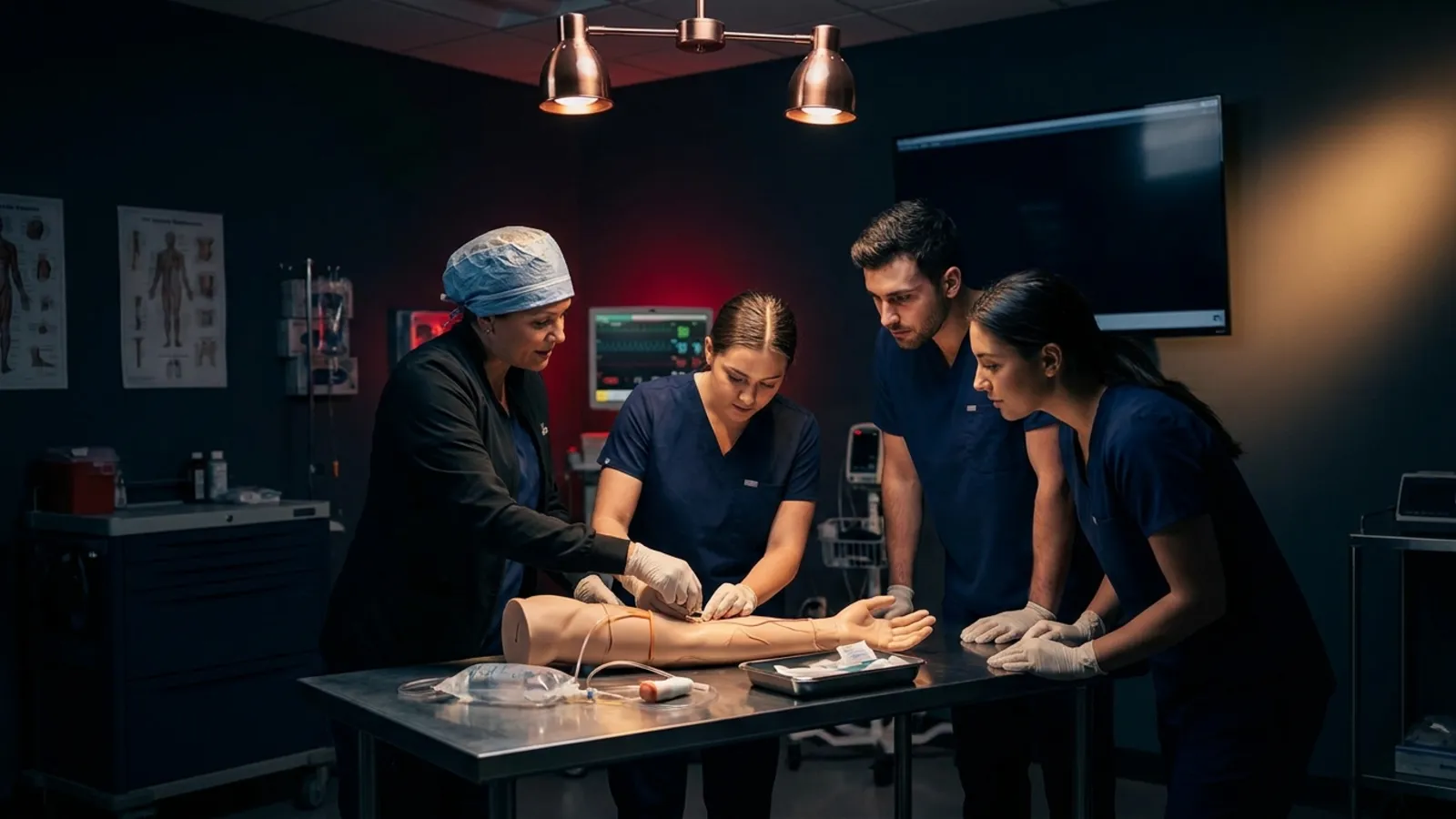
If you are a nurse educator, clinical development specialist, or EMS training officer, you already know the pattern. A cohort of new grads arrives with almost no supervised cannulation experience. The annual competency cycle turns into a paperwork exercise because nobody has time to actually coach technique. And the same three nurses field every hard-stick escalation on the unit. Onsite IV training for hospitals exists to break that pattern: a qualified instructor comes to your facility and rebuilds cannulation competence across an entire team in one scheduled day.
This guide covers what a real onsite program includes, what it costs, how it compares to sending staff out or assigning online modules, and how to evaluate a training partner before you sign a contract.
What onsite IV training for hospitals includes
Onsite IV training is instructor-delivered cannulation education held at your facility, using your schedule, for a group of your staff. A complete program combines didactic instruction, simulation practice, supervised live sticks, and documented competency assessment in a single visit, so your team finishes the day with validated skills rather than webinar certificates.
That last element separates real programs from box-checking. A slideshow in the break room does not change anyone's first-attempt success rate. Supervised repetitions with individual coaching do.
Why hospitals are bringing IV training in-house
The clinical math drives the decision. Peripheral IV catheters are the most common invasive device in the hospital, and the failure numbers are stubborn: a widely cited 2015 review in the Journal of Infusion Nursing found that up to half of peripheral IVs fail before therapy is complete. Behind that statistic sits a training gap, because most nurses learn cannulation through whoever happened to precept them, on whatever patients happened to show up that week.
The operational costs are familiar to any educator:
- Escalation load. When most of a unit avoids hard sticks, the vascular access team and the two or three confident nurses absorb the volume, which delays therapy and burns out your best people.
- Inconsistent onboarding. New grad residencies produce nurses with wildly different IV exposure. Our guide on new grad nurse IV confidence covers why the first year determines whether avoidance patterns set in for good.
- Competency validation without teaching. Annual skills fairs verify a checklist, but they rarely improve technique. Validation and instruction are different activities, a distinction we break down in IV competency for nurses.
- Skill decay between validations. Clinical motor skills fade measurably when they sit unused, which is why maintaining IV competence requires structured practice, not just annual observation.
Onsite training addresses all four in one intervention, because the whole unit trains on the same curriculum, on the same day, to the same standard.
Onsite vs sending staff out vs online modules
Hospital educators have three realistic options for group IV training. Here is how they compare when you are training a team rather than one individual:
| Factor | Onsite institutional training | Sending staff to courses | Online modules |
|---|---|---|---|
| Cost for 10 staff | $2,500 to $5,000 flat day rate | $2,500 to $5,000 in tuition plus travel and shift coverage | $500 to $1,500 in licenses |
| Scheduling | One day, your calendar | Staggered over weeks as seats open | Self-paced, often incomplete |
| Curriculum consistency | Identical for every trainee | Varies by course and cohort | Identical but theory-only |
| Hands-on repetitions | Simulation plus supervised live sticks | Varies, often rubber arms only | None |
| Competency documentation | Standardized, delivered same day | Certificate of attendance | Quiz completion record |
| Skill transfer to the bedside | High, trained in your environment | Moderate | Low without a hands-on component |
Bottom line: online modules cover theory cheaply but cannot build cannulation skill. Sending staff out works for one or two nurses. Once you are training five or more, an onsite day costs about the same as tuition alone while eliminating travel, standardizing the curriculum, and keeping staff near their unit.
The same logic applies outside acute care. We wrote a companion guide for ambulatory operators on clinical training for vein clinics, where the ROI math centers on client retention rather than escalation load.
What an onsite training day looks like
A well-run onsite program follows a predictable structure. Here is the sequence we use at VeinCraft Academy:
- Pre-visit intake assessment. Every participant completes a skills questionnaire so instruction targets the group's actual level, and the roster stays within a 10:1 student-to-instructor ratio.
- Psychology and technique didactics. The morning covers the mental game first: why hands shake under pressure, how to manage your own nervous system before the stick, then anatomy, site selection, and insertion mechanics.
- Simulation drills. Structured repetitions build the muscle memory foundation before anyone touches a patient.
- Supervised live sticks. Participants cannulate real volunteers under direct instructor observation, with individual coaching on every attempt.
- Competency sign-off and documentation. Each participant is assessed against a standardized checklist, and your education department receives completion documentation the same day.
Units that run high-acuity access, from the ED to critical care transport, can extend the day with difficult-access content: dehydrated and edematous patients, ultrasound-guided technique, and the escalation decisions we cover in IV cannulation in the emergency department.
Who onsite IV training serves best
The model fits any group that needs consistent cannulation competence on a shared schedule:
- Med-surg and telemetry units clearing an escalation bottleneck
- New grad residency cohorts starting with a uniform foundation instead of precepting roulette
- EMS agencies building or refreshing paramedic IV skills under field-realistic conditions
- Float pools and agency staff who need standardized validation fast
- Infusion centers and outpatient departments where every failed stick is visible to the patient
What onsite IV training costs
VeinCraft Academy prices institutional training at $2,500 to $5,000 per day, depending on group size, curriculum depth, and whether ultrasound-guided content is included. That is the whole number: instructor, standardized curriculum, training supplies, and same-day competency documentation travel with us.
Run the per-clinician math before comparing quotes. A $3,500 training day for 10 nurses is $350 per validated clinician, at or below the tuition of most individual courses, before you count the travel and coverage costs you did not spend. Most providers in this market quote institutional pricing only after a sales call. We publish ours because transparent pricing is how we operate on the consumer side too, where Level 1: The Method runs $199 and Level 2: The Craft runs $299.
How to evaluate an onsite training partner
Ask five questions before signing with any provider, ours included:
- Do participants perform supervised live sticks? Rubber-arm-only programs transfer poorly to real patients. This is the single biggest quality divider, and the reason most IV training programs fail.
- What is the student-to-instructor ratio? Beyond roughly 10:1, individual coaching disappears and the day becomes a lecture with props.
- Who teaches? Instructors should be credentialed clinicians with active field experience, not trainers reading from a deck.
- How is competence assessed? Attendance certificates document presence. You want observed, checklist-based assessment where participants demonstrate the skill before sign-off.
- What documentation does your education department receive? Same-day, standardized records that slot into your credentialing files.
One honest disclosure on the credentialing question: VeinCraft Academy does not yet offer accredited CEU credit. We are pursuing CE provider accreditation, beginning with the Arizona Board of Nursing. Our institutional programs deliver documented hands-on training and competency assessment, which serves facility-level validation requirements, but verify CEU eligibility with your state board before promising contact hours to staff.
How VeinCraft Academy runs hospital and EMS training
We built the institutional program on the same model as our consumer courses: psychology-first curriculum, mastery-based progression, and live sticks under a 10:1 ratio. Instructors are credentialed clinicians with active field experience who travel to your facility, simulation lab, or station. Participants advance when they demonstrate competence under observation, not when the agenda says so.
Because we deliver on-site with no campus overhead, scheduling works around your shifts, including split sessions for units that cannot release everyone at once.
Ready to fix the escalation bottleneck?
If your unit's IV competence depends on which preceptor a nurse happened to draw, one scheduled day can reset the baseline for the whole team. Contact VeinCraft Academy with your group size and setting, and we will scope the curriculum and quote the day rate up front.
How much does onsite IV training for hospitals cost?
VeinCraft Academy prices onsite institutional training at $2,500 to $5,000 per day, covering the instructor, curriculum, training supplies, and same-day competency documentation for the group. Per clinician, a full training day typically works out to less than sending each staff member to an individual course, once travel and shift coverage are counted.
How many staff can train in one onsite session?
We cap instruction at a 10:1 student-to-instructor ratio so every participant gets individually coached repetitions. Larger groups are handled with additional instructors or split sessions across shifts, which many hospitals prefer anyway since a whole unit rarely comes off the floor at once.
Does onsite IV training count toward annual competency validation?
Yes, when the program includes observed, checklist-based skills assessment. VeinCraft institutional training delivers standardized competency documentation the same day, which education departments use for facility-level validation files. It is not yet accredited CEU credit, so confirm contact-hour eligibility with your state board separately.
Can EMS agencies use the same onsite model?
Yes. The onsite format was built for exactly this case: paramedics and EMTs training as a shift group at their own station, with curriculum adjusted for field conditions like poor lighting, moving vehicles, and stressed patients. Agencies use it both for initial IV skill building and for refresher cycles.
What does the hospital need to provide for an onsite training day?
A room with tables, chairs, and decent lighting for up to 10 participants, plus handwashing access. VeinCraft brings the standardized supply box, simulation equipment, and all training materials. Facilities with their own simulation labs can host the day there, and we fold your equipment into the curriculum.
VeinCraft Academy is a mastery-focused IV cannulation training program for healthcare professionals. All instruction is delivered by credentialed clinicians with active field experience. VeinCraft Academy is a RevivaGo Company.