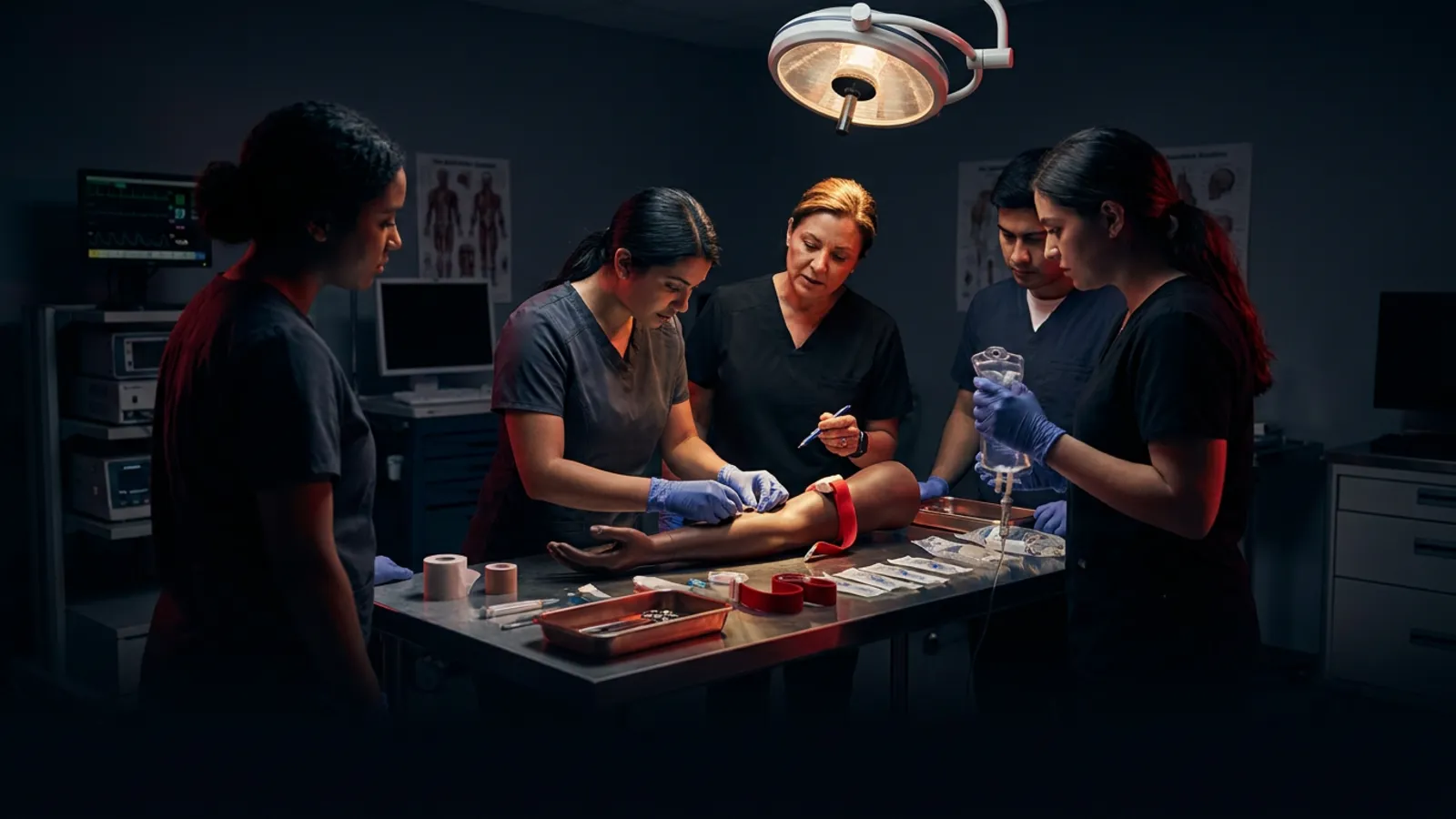
Clinical training for vein clinics is structured IV cannulation and infusion therapy instruction provided to clinical staff at an operating IV hydration clinic, vein practice, or mobile IV company, designed to standardize technique, reduce failed-stick rates, and satisfy ongoing competency requirements set by state boards and collaborating physicians. Training delivery models range from sending individual staff to external courses, to online-only programs, to on-site institutional training where instructors travel to your facility and train the full team in one session. The right model depends on team size, geographic distribution, budget, and how much your reputation depends on first-attempt success rates.
For vein clinic operators, this is the quiet operational problem that determines whether the business scales or stalls. Failed sticks at the chair tank reviews. Inconsistent technique across staff creates unpredictable patient experience. New hires take weeks to ramp up to the bar your senior staff sets. And the moment your highest-volume nurse leaves, the operational cost of replacing their competence is several times your direct training spend.
This guide is for the operator evaluating clinical training for vein clinics. It breaks down what institutional training actually delivers, the three delivery formats and when each makes sense, what an effective clinical training for vein clinics program covers, the compliance baseline you must satisfy, the real ROI math, and how to evaluate a training partner before signing a contract.
Why staff training is the highest-leverage investment for vein clinic operators
The math is unforgiving in clinic-based IV practice. A nurse who places the first stick at 95% success rate produces a patient experience your reviews and referrals depend on. A nurse who places the first stick at 70% spreads the cost of every failed attempt across patient discomfort, longer chair time, supply waste, and the quiet decision the patient makes about whether to come back.
According to industry reporting on IV hydration clinic operations, the most common operational drivers of clinic underperformance are not pricing, marketing, or location. They are clinical inconsistency at the chair: variable first-attempt success rates, inconsistent client communication during the procedure, and unstable response to adverse reactions. All three are training-solvable.
Three categories of vein clinic operator benefit most directly from structured clinical training:
- Multi-location clinic operators who need standardized technique across sites to protect brand consistency
- Mobile IV company founders whose providers work alone in client homes, where one bad visit equals one lost client and their referral network
- Growth-stage IV hydration clinics scaling from a 1- to 2-nurse team to 5+, where senior-nurse knowledge transfer can no longer happen organically
For broader context on building a sustainable mobile IV practice from the clinical side, see our guide on mobile IV therapy training and how to start a mobile IV business.
The three formats: sending staff out, online, or on-site institutional
Vein clinic operators have three structurally different ways to deliver clinical training to staff.
| Format | What It Looks Like | Cost (per nurse) | Best Fit |
|---|---|---|---|
| Send staff to external courses | Each nurse books and attends a public IV training program individually | $200-$750+ per nurse + travel, lodging, lost productivity | Single-nurse hires, small clinics with low turnover, geographically isolated practices |
| Online-only training | Theory-only modules with video instruction, no hands-on assessment | $100-$300 per nurse | Refresher content, compliance documentation, supplemental knowledge |
| On-site institutional training | Instructor travels to your facility, trains your full team in one session, customized to your protocols and equipment | $2,500-$5,000/day per group | Teams of 5-15 staff, multi-site operators, standardization-critical brands |
Bottom line: Sending individual staff to public courses costs less per session but compounds with turnover and travel overhead. Online-only training satisfies documentation requirements but does not build the cannulation skill the patient experiences at the chair. On-site institutional training carries the highest single-engagement cost but delivers consistent technique across the team, customizes to your specific protocols, and amortizes well at 5+ nurses per session.
The break-even point typically falls between 5 and 8 staff. Below that team size, sending individuals to public courses is operationally simpler. Above that, on-site institutional training is the better economic and quality decision.
What an effective clinical training program for a vein clinic includes
Not every training program produces the same outcome at the chair. An effective institutional clinical training program for a vein clinic addresses six domains, not just procedural technique.
1. Psychology of cannulation under pressure. The most overlooked domain in standard IV training is what happens between the provider's ears when the patient is watching, the lighting is poor, and the first stick has to land. Programs that address central nervous system management, performance anxiety protocols, and pre-stick routines build the calm-under-pressure technique that clinic patients experience as confidence. For the underlying methodology, see our piece on the psychology of IV insertion.
2. Foundational anatomy and technique. Vein structure, valve placement, site-selection hierarchy, tourniquet technique, flash recognition, securement, and dressing standards. The fundamentals every cannulation depends on, taught to the depth required for reliable first-attempt success rather than the depth required for an exam.
3. Difficult-access protocols. Dehydrated patients, rolling veins, obese patients, geriatric fragile veins, and the patient who shows up after a hard week of IV hydration with limited venous real estate. Difficult-access skill separates the team you can scale from the team that struggles when the easy patients are not on the schedule.
4. Adverse event response. Infiltration recognition, vasovagal management, allergic reaction protocols, and the systematic decision-making that determines when to stop, when to escalate, and when to call EMS. Clinic patients trust providers who handle the rare bad moment calmly. For deeper troubleshooting context, see our guide to IV infiltration signs and treatment and IV extravasation management.
5. Patient communication during the procedure. What you say during the cannulation shapes whether the patient leaves a five-star review or never books again. Calm language, transparent narration of what is happening, and the script for managing a missed first attempt are clinical skills, not soft skills.
6. Documentation and competency validation. The training must produce documentation that satisfies the facility's competency records, the collaborating physician's oversight responsibilities, and the malpractice carrier's underwriting requirements. For the broader competency framework that applies to vein clinic staff, see our guide on IV competency for nurses.
Programs that cover all six domains, taught by credentialed clinicians with active field experience, produce the technique consistency that clinic patients experience as a brand promise.
Compliance and credentialing: what institutional training must satisfy
Clinical training for a vein clinic operates inside three layers of compliance, and the training program you choose must satisfy all three.
State board of nursing scope of practice. Each state defines what RNs and LPNs can do within their scope. For LPN-heavy clinics, state-specific IV authorization rules apply. The full state-by-state regulatory picture is in our IV therapy certification requirements by state guide and the LPN IV certification guide for LPN-specific scope.
Collaborating physician or medical director oversight. Vein clinics and IV hydration clinics typically operate under a medical director or collaborating physician arrangement. The medical director carries clinical oversight responsibility for staff competency and is typically the party signing off on training adequacy. Training documentation should integrate with the medical director's competency validation process.
Malpractice and general liability insurance underwriting. Most professional liability carriers serving the IV therapy industry, including American IV Association (AIVA) members, expect documented staff training, ongoing competency validation, and adverse event protocols. Carriers can require specific training documentation as a condition of coverage or premium tiering.
Training programs that satisfy all three layers reduce the operator's compliance overhead significantly. Programs that only satisfy one (typically the state board requirement) leave the operator manually building the bridge to medical director sign-off and carrier documentation.
Cost vs ROI: pricing institutional training against the alternative
The headline cost of on-site institutional training (typically $2,500-$5,000 per day per group) sounds high until you price out the alternatives.
Alternative 1: Send individual staff to public courses.
- 7-nurse team × $550 average per nurse = $3,850
- Plus travel/lodging if any nurse must travel: $500-$1,500 per nurse for out-of-market courses
- Plus lost clinical revenue during course attendance: 1 nurse day at typical clinic revenue per nurse per day
- Estimated all-in cost for a 7-nurse team: $5,000-$15,000+ for individual external training
Alternative 2: Online-only training.
- 7-nurse team × $200 average per nurse = $1,400
- Plus the cost of skill gaps that online training does not close: failed sticks, patient experience inconsistency, hands-on credentialing still required separately
- Estimated effective cost: $1,400 in direct spend plus ongoing operational cost from unresolved skill gaps
Alternative 3: Do nothing (status quo on-the-job training).
- Direct cost: $0
- Indirect cost: clinical inconsistency across staff, longer ramp time for new hires, higher first-stick failure rate during peak hours, slower clinical onboarding for new locations
- The hardest number to quantify until your monthly review trend tells you
On-site institutional training cost: $2,500-$5,000 for a single-day intensive that trains the full team to standardized technique on the clinic's actual equipment, with documentation that integrates with medical director records.
For most multi-nurse vein clinics, on-site institutional training delivers lower total cost per nurse than sending staff to public courses, faster team-wide implementation than rolling individual training across months, and stronger documentation than online-only programs.
How to evaluate a clinical training partner for your vein clinic
Five criteria separate institutional training partners that deliver consistent results from training partners who deliver a certificate and a slide deck.
1. Instructor credentials and active field practice. Ask who actually teaches the training. Credentialed clinicians with active field experience teach from current practice, not from textbooks they read years ago. Instructors who only teach (no current clinical practice) drift from what works at the chair today.
2. Mastery-based progression vs clock-hour completion. Programs that advance students when they demonstrate competence produce different outcomes than programs that advance everyone on the same schedule regardless of performance. Ask whether the program defines "completion" by attendance or by observed competence.
3. Live patient sticks (not simulation only). Simulation arms build muscle memory at a basic level. Live cannulation on real patients is where actual technique develops. For institutional training, this means the training partner can deliver live-patient practice as part of the on-site session, typically using consenting volunteers or staff.
4. Customization to your protocols and equipment. Generic training delivers generic technique. Effective institutional training customizes to your clinic's specific catheter types, vein finder devices, ultrasound equipment, infusion pumps, and documentation systems. The training should fit your team into the operation, not require the operation to fit the training.
5. Post-training support and ongoing competency. Single-event training rarely makes skills permanent. Strong institutional training partners offer post-training competency check-ins, refresher session pricing, and ongoing instructor access for the inevitable difficult-case questions. For details on what ongoing competency assessment involves, see our guide on IV competency for nurses.
A training partner that delivers all five is rare. A training partner that delivers three is usable. A training partner that delivers fewer than three is a certificate factory that will leave you doing the real training internally anyway.
How VeinCraft Academy delivers on-site institutional training for vein clinics
VeinCraft Academy provides on-site institutional clinical training for vein clinics, IV hydration practices, mobile IV companies, and infusion centers. Our model is structured around the six training domains outlined above, taught by credentialed clinical instructors with active field experience, in a mastery-based progression that advances staff when they demonstrate competence under observation, not when the clock runs out.
What an on-site VeinCraft engagement includes:
- Pre-engagement consultation to align curriculum with your clinic's protocols, equipment, and patient population
- 8-hour intensive on-site session covering psychology, anatomy, technique, difficult access, adverse events, and patient communication
- Live cannulation practice with instructor coaching at a 10:1 student-to-instructor ratio
- Customization to your catheter types, vein finder and ultrasound equipment, and documentation systems
- Competency documentation that integrates with medical director records and supports malpractice carrier requirements
- Post-engagement competency check-in within 30 days
Pricing model: On-site institutional training is priced at $2,500 to $5,000 per day per engagement, depending on team size, customization scope, geographic location, and instructor travel requirements. Pricing typically beats the all-in cost of sending the same team to public courses.
One honest note: VeinCraft Academy does not currently hold CE provider accreditation, so our training does not directly award accredited continuing education units. Our role is to build the cannulation skill and the team consistency that clinic patients experience at the chair. Pair our intensive with state-specific accredited CE if your jurisdiction requires it for license renewal.
For consumer-stage staff considering individual training before institutional engagement, our Level 1: The Method ($199, 8-hour intensive) and Level 2: The Craft ($299, advanced including ultrasound-guided access) provide the same skill foundation in public-cohort format.
Ready to discuss on-site clinical training for your vein clinic team? Explore institutional training enrollment and a member of our team will scope the engagement with you.
How much does institutional IV training cost for a vein clinic?
On-site institutional IV training for vein clinics typically costs $2,500 to $5,000 per day per engagement, scaled by team size, customization scope, geographic location, and instructor travel requirements. A single-day intensive for a 7-10 nurse team usually falls in the $3,000 to $4,500 range. The per-nurse cost typically beats the all-in cost of sending the same number of nurses to public IV training courses (typically $550-$750 per nurse plus travel, lodging, and lost clinical revenue during attendance).
Does institutional training satisfy state CE requirements?
It depends on the training provider's accreditation status and your state's CE rules. CE-accredited institutional training programs satisfy continuing education hour requirements for license renewal in most states. Training programs without CE accreditation produce documented professional development hours and competency validation but may not satisfy state-mandated CE for nursing license renewal. For state-by-state CE and IV authorization details, see our IV therapy certification requirements by state guide and verify current requirements directly with your state board of nursing.
How long does on-site training take?
Standard on-site institutional IV training for vein clinics runs as an 8-hour intensive single-day session for the full team. More advanced curricula (ultrasound-guided peripheral IV, hard-stick population training, midline insertion competency) typically extend to 12 to 16 hours across one or two days. Pre-engagement consultation and post-engagement competency check-in add 1 to 2 hours of additional time but do not require the full team to be present. Most vein clinics schedule on-site training on a Saturday or a slow day to minimize impact on patient bookings.
Can the training be customized to our clinic's protocols?
Yes. Strong institutional training partners customize curriculum to the clinic's specific catheter types, vein finder devices, ultrasound equipment, infusion pumps, documentation systems, and adverse event escalation protocols. Customization is one of the primary advantages of on-site training over sending staff to public courses. During pre-engagement consultation, the training partner should review your clinic's existing protocols and adapt curriculum to fit your operation rather than requiring your operation to fit the curriculum.
What size of clinic benefits most from on-site training vs sending staff out?
The break-even point typically falls between 5 and 8 staff. Single-nurse clinics and 2- to 4-nurse practices generally find sending individual staff to public courses operationally simpler and economically comparable. Teams of 5 to 15 staff almost always benefit from on-site institutional training, both economically and from a team-consistency standpoint. Multi-site operators and clinics with 15+ staff often schedule rolling on-site engagements across locations to standardize technique brand-wide.
Clinical training for vein clinics is the operational investment that defines whether your team produces the consistent patient experience your reviews and referrals depend on. The operators who treat clinical training for vein clinics as a recurring investment rather than a one-time compliance line item build the brands that outscale single-location competitors. The right training partner builds the technique foundation, satisfies the compliance layers, and gives your team the brand identity that translates to patient confidence at the chair. Ready to scope institutional training for your vein clinic? Explore institutional training enrollment and we will design the engagement around your team.
This article is educational and is not legal, business, or compliance advice. Verify current state board, medical director, and insurance requirements before relying on any summary.
VeinCraft Academy is a mastery-focused IV cannulation training program for healthcare professionals. All instruction is delivered by credentialed clinicians with active field experience. VeinCraft Academy is a RevivaGo Company.