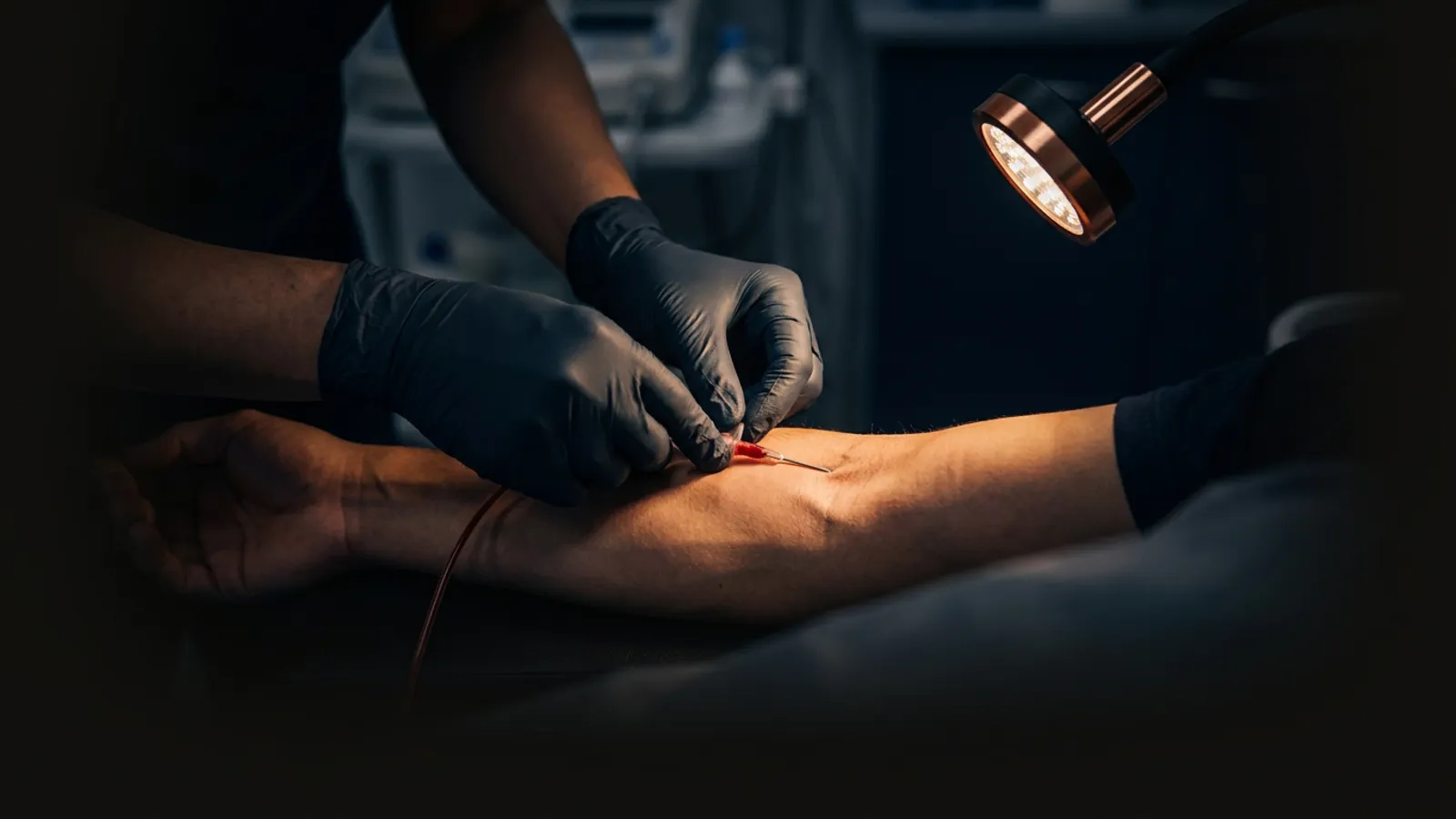
Your IV start success rate is the percentage of attempts that achieve venous access on the first stick, and it is the single most reliable measure of cannulation competence. Most staff nurses sit somewhere between 44% and 77%. Experienced IV providers run 91% to 98%. The gap between those two numbers is not talent. It is technique, tracking, feedback, and the willingness to practice the parts that hurt.
If you have never measured your own success rate, you are guessing. If you have measured it and the number embarrasses you, that is the starting line, not the verdict. This article covers the published benchmarks, a tracking method you can run on a sticky note, the five interventions that actually move the rate, and a 30-day plan to lift your number by 10 to 15 percentage points.
What is a good IV start success rate?
A "good" success rate depends on who is sticking, who is being stuck, and what tools are in the room. Published research gives us a useful frame.
According to a peer-reviewed analysis cited in B. Braun's Optimizing First-Stick Success and Peripheral IV Catheter Management clinical brief, first-attempt success for staff nurses across diverse patient populations ranges from 44% to 76.9%. Experienced IV nurses and dedicated vascular access teams range from 91% to 98%. In pediatric populations, first-attempt success drops to roughly 53% on the initial attempt and only reaches 91% by the fourth cumulative attempt.
Here is a working benchmark table for adult peripheral IV access:
| Provider profile | First-attempt success rate |
|---|---|
| New grad nurse (first 6 months) | 40% to 55% |
| Staff nurse (1 to 2 years) | 55% to 70% |
| Staff nurse (3+ years, mixed unit) | 70% to 80% |
| Experienced IV nurse / vascular access team | 91% to 98% |
| Ultrasound-guided peripheral IV (USGPIV) | 85.9% (vs 47.3% blind landmark) |
| Near-infrared vein visualization | Up to 90% on visible-vein populations |
Bottom line: if you are below 70% with two years of experience, you have room to move. If you are below 60% in your first year, you are not behind. You are exactly where structured training would expect you to be. The article you are reading now is the road map. Our companion guide on how many IV sticks it takes to become proficient covers the rep counts behind those benchmarks in detail.
How to track your IV start success rate
Most nurses do not track because the numbers feel personal. They do not realize that the act of tracking is itself an intervention. Skill-acquisition researchers call this metacognition, and it has been studied directly in IV cannulation through cumulative sum (CUSUM) charts, which medical educators use to determine when a learner reaches procedural competence.
You do not need a chart. You need three columns on a notecard or notes app:
- Date and patient profile (age range, vein quality on a 1 to 5 scale, why this stick was easy or hard)
- Outcome (first stick, second stick, escalated, or did not attempt)
- One observation (what worked, what failed, what you would change)
After 20 sticks, calculate your first-attempt rate. After 40, calculate again. The trend matters more than any single shift.
Two cautions:
- Do not compare your rate to a colleague's without comparing patient profiles. Pre-op on healthy adults is not the same as the ED on dehydrated geriatrics.
- Do not let the number become an identity. A 62% rate after 30 sticks is information about your current technique, not about your worth as a clinician.
The five interventions that actually move the needle
These are the levers most worth pulling, in priority order. Most providers who lift their rate from 60% to 80%+ do so by working on items 1 through 3. Items 4 and 5 carry the rate from 80% into the 90s.
- Pre-stick assessment routine. Spend 60 seconds before the tourniquet goes on. Use a structured difficult intravenous access (DIVA) screen: visible veins, palpable veins, history of difficult access, age extremes, body habitus, and dehydration status. Identify your three best candidate sites before you choose one. Most missed sticks are missed at site selection, not at insertion.
- Tourniquet and warming as a two-tool combo. Apply the tourniquet 4 to 6 inches above your candidate site. If veins do not respond, add a warm pack for 2 to 3 minutes. Warming raises vein diameter measurably and improves first-attempt success in patients with hard-to-find veins. Tourniquet pressure should be just enough to engorge the vein without occluding arterial flow. Too tight is a common reason veins blow on insertion.
- Anchor and advance. Use your non-dominant thumb to pull the skin taut below the insertion site, locking the vein in place. Insert at 15 to 30 degrees, bevel up. The moment you see flash, drop the angle to nearly parallel and advance the catheter another 1 to 2 millimeters before threading. Most catheter misadvancement happens because the provider threads on flash without seating the catheter tip fully in the lumen. Our IV cannulation tips and tricks guide covers anchor variations for fragile and rolling veins.
- Post-flash verification. When you see flash, pause for half a second. Confirm the catheter is in the vein, not just the needle tip. Then advance the catheter off the needle and watch for a second flash in the catheter chamber. Skipping this step is why "I had flash but lost it" happens.
- Deliberate practice with feedback. Repetition without feedback locks in whatever you are already doing. According to Anders Ericsson's research on expert performance, applied to medical procedures in a 2012 PLOS One randomized controlled trial, supervised skills-laboratory training measurably improves cannulation quality and transfers into clinical practice. Find a colleague, instructor, or program where someone watches your technique and tells you what they see.
Why supervised reps move your rate faster than solo reps
A nurse who runs 100 unsupervised sticks at 65% success usually ends the year at 65%. A nurse who runs 50 supervised sticks with corrective feedback often ends the year at 80%+. The difference is not effort. It is whether someone catches the small errors you cannot see.
Common faults a skilled observer catches inside the first five live sticks:
- Tourniquet too tight, blowing the vein on insertion
- Insertion angle drifting toward 35 degrees instead of 15 to 20
- Anchor hand relaxing during advance, letting the vein roll
- Threading the catheter on flash without seating the tip
- Holding breath through the entire stick, raising tremor
This is why VeinCraft Academy's Level 1: The Method intensive caps class size at 10 students with individual coaching during live sticks on real patients. The ratio matters because the feedback is the curriculum. For graduates, ongoing supervised practice through Stick Lab is how providers prevent IV skill decay and continue compounding their success rate after the class ends.
The psychology of the success rate
Tracking your rate creates a feedback loop that some clinicians find motivating and others find paralyzing. If you are in the second group, two reframes help.
First, a missed stick is data, not an indictment. Every miss carries information about site selection, angle, anchor pressure, or post-flash technique. Providers who treat misses as feedback move up the curve. Providers who treat misses as personal failure freeze and avoid hard sticks, which slows learning further.
Second, your nervous system shows up before your hands do. Heart rate spikes, hand tremor, and tunnel vision are physiological responses to perceived threat. They can be trained. CNS management techniques, including paced breathing before the stick and a deliberate pre-stick routine, lower sympathetic tone and raise success rates measurably. Our psychology of IV insertion guide covers the mental-game protocol VeinCraft teaches before any hands touch a patient.
Identity matters here. The provider who walks into the room thinking "I might miss this" performs differently than the provider thinking "I get the line." Neither is bravado. Both are mental states the nervous system reads, and the patient reads, and the vein reads through your hand pressure. Becoming the go-to person on your unit is a measurable outcome of consistent technique and trained calm, not a personality trait.
When to add tools (ultrasound, vein finders)
Tools are useful. They are not a substitute for foundational technique. The decision matrix below is what experienced vascular access providers use.
| Patient situation | Best first tool | Why |
|---|---|---|
| Visible, palpable veins, no history of difficult access | Standard blind technique | Tools add time without adding success rate |
| Visible but fragile veins (geriatric, oncology, dehydrated) | Standard technique with warming | Vein quality matters more than visualization |
| Non-visible, palpable veins | Near-infrared vein finder if available | Confirms what your fingers already feel |
| Non-visible, non-palpable veins | Ultrasound-guided peripheral IV (USGPIV) | Research shows 85.9% USGPIV success vs 47.3% blind landmark in DIVA patients |
| Two failed attempts by competent provider | Escalate to USGPIV or vascular access team | Continued blind attempts damage veins and patient trust |
Bottom line: add ultrasound when the patient profile predicts difficult access or after a structured failed-attempt protocol. Do not reach for the probe on every stick. The provider who can land easy and moderately difficult veins blind, and pick up the probe when it is genuinely indicated, is the one units depend on.
If ultrasound is new to you, our when to use ultrasound for IV access guide walks through the clinical decision flowchart in detail.
A 30-day plan to move your rate by 10 to 15 points
This plan assumes you currently start at least 5 IVs per week. Adjust the timeline if your volume is lower.
Week 1, baseline. Track every stick using the three-column method. Make no technique changes. Calculate your week-1 success rate at the end of the week.
Week 2, pre-stick discipline. Add the 60-second DIVA assessment and the warming step before each stick. Continue tracking. Expect a 5 to 10 point bump.
Week 3, anchor and advance focus. Lock the vein with thumb tension below the site and consciously slow your needle insertion. Pause for the second flash before threading. Continue tracking.
Week 4, supervised feedback. Ask a colleague you respect to observe two of your sticks. Take their feedback without defending. Apply it for the rest of the week. If you have access to a structured training program, this is the week to schedule a Stick Lab session or course.
End of month. Compare week 4 success rate to week 1. Most nurses who run this protocol with discipline see 10 to 15 percentage points of movement. Larger gains are possible but usually require restructured live-stick training, not solo practice.
A foundation course like Level 1: The Method compresses the 30-day plan into one focused 8-hour day with supervised live sticks, which is why graduates often post their biggest single jump in success rate within their first week back on the floor. For providers already at 80% who want to move into the 90s, Level 2: The Craft covers hard sticks, special populations, and ultrasound-guided access.
Frequently asked questions
What is a good IV start success rate for a new nurse?
A new grad nurse in their first six months typically lands between 40% and 55% on first-attempt IV starts in adult populations. By the end of the first year of structured practice with feedback, 60% to 70% is realistic. If your number is lower, the issue is almost always site selection and anchor technique, not raw skill.
How long does it take to improve from 60% to 90%?
For most providers, the move from 60% to 80% takes three to six months of focused, tracked practice with supervised feedback. Moving from 80% to 90%+ usually takes another six to twelve months and often requires exposure to harder patient populations, ultrasound training, or both. Providers who attend an intensive program with live-stick coaching often compress the first half of that timeline by 50% or more.
Can vein finders or ultrasound replace technique?
No. Tools amplify technique. They do not replace it. Near-infrared vein finders raise visualization of subcutaneous veins, but the catheter still has to be inserted, advanced, and threaded by your hand. Ultrasound-guided IV requires its own technique training. Providers who lean on tools as a shortcut around foundational skills end up with a higher rate on easy patients and a lower rate on hard ones, which is the opposite of what they want.
Should I track my success rate at work?
Yes, with two boundaries. Track for your own learning, not for performance review or comparison with peers. Keep your records private unless you choose to share. The act of tracking creates the feedback loop that drives improvement. Sharing the raw number with management before you have built the rate up creates pressure that often makes the rate worse.
What success rate do experienced IV nurses achieve?
Published research puts experienced IV nurses and dedicated vascular access teams between 91% and 98% on first-attempt success across mixed adult populations. The high end of that range usually involves ultrasound integration on difficult-access patients. Outside specialized teams, a sustained 90%+ rate as a generalist nurse is uncommon and notable.
How do I know if my success rate is improving from skill or just easier patients?
This is why the patient-profile column on your tracking notecard matters. If your rate climbs but you are also seeing easier veins (post-op, hydrated, younger), the gain may be patient mix, not skill. Look at your rate on a defined subset, for example all patients over age 65, across two periods. If that subset rate also climbs, the skill is improving. If only the overall rate climbs, the patient mix probably shifted.
Ready to move your number?
If your current success rate is below where you want it, the fastest path forward is supervised live-stick practice with someone who can see what you cannot. Explore Level 1: The Method for foundational technique with live sticks, or Level 2: The Craft for advanced access including ultrasound-guided IV. Both courses are taught by credentialed clinicians with active field experience, under a mastery-based curriculum where students advance when they demonstrate competence, not when the clock runs out. Enrollment is open, and pricing starts at $199 for Level 1.
VeinCraft Academy is a mastery-focused IV cannulation training program for healthcare professionals. All instruction is delivered by credentialed clinicians with active field experience. VeinCraft Academy is a RevivaGo Company.