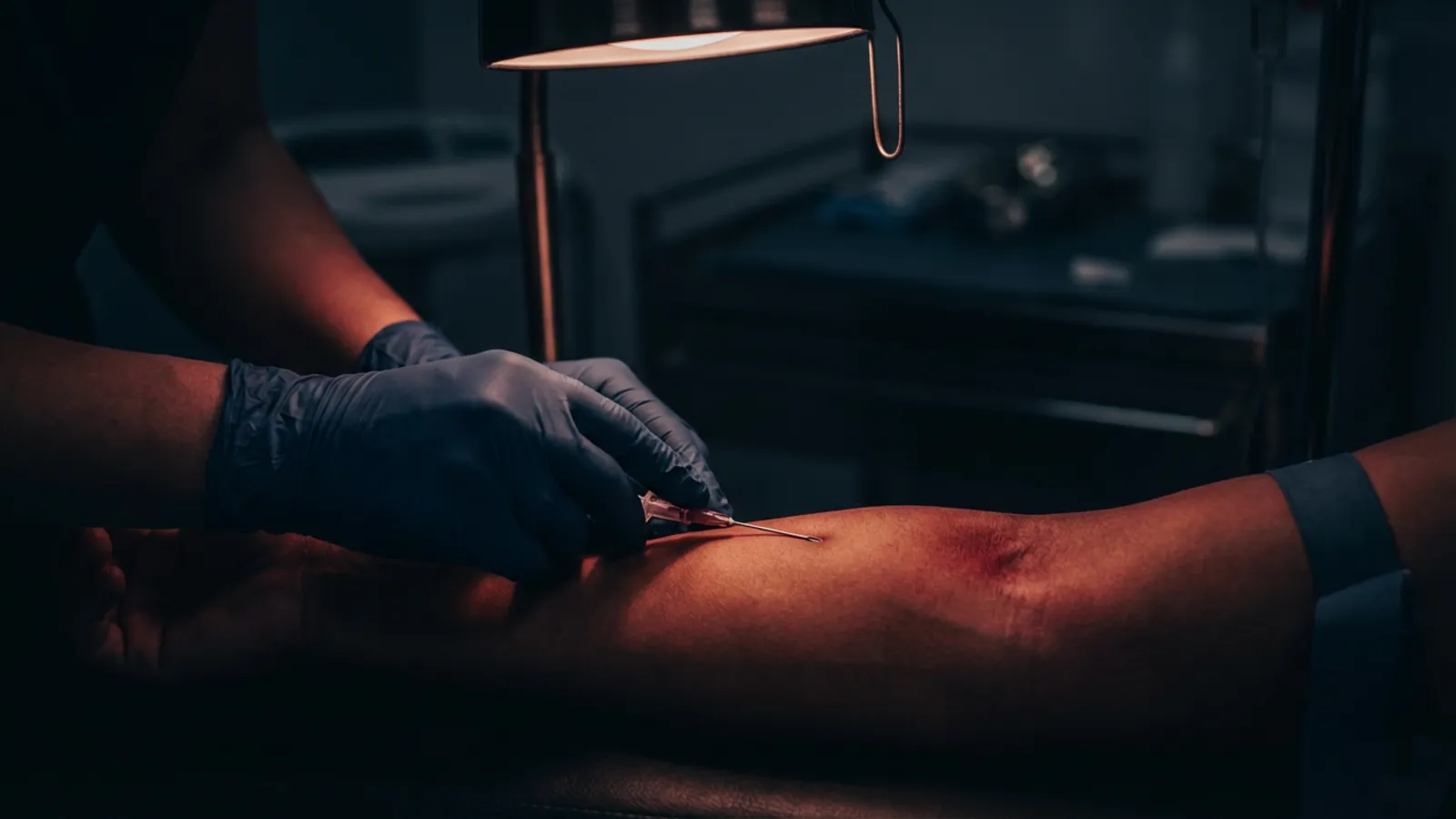
IV cannulation training prepares nurses and healthcare providers to perform peripheral IV insertion on real patients by combining vascular anatomy education, hands-on technique practice, site selection skills, and performance psychology. Effective programs bridge the gap between simulation lab experience and confident, reliable IV starts in clinical settings.
You already know the feeling. The textbook made IV starts look straightforward. The sim lab gave you a rough idea. But rubber arms and live human beings are different animals, and nobody told you how wide that gap would be.
Here's the thing: how you close that gap in your first few months on the floor determines whether you build real confidence or drag IV anxiety around for years. Most new nurses don't think much about picking the right training program. They should.
Why nursing school leaves you short
Most nursing programs spend somewhere between four and eight hours on IV cannulation across the entire degree. You practice on a simulation arm, watch a demo, maybe get one or two supervised attempts on a classmate during clinicals.
So it's no surprise that a 2023 survey of new graduate nurses found IV insertion ranked as the number-one anxiety-producing clinical skill in their first year of practice. Over 60% said they felt unprepared for real-world IV starts after graduation.
I don't blame nursing schools for this. They have hundreds of competencies to cover in limited time, and IV cannulation is one skill among dozens. But understanding why the gap exists doesn't help much when you're standing in a patient's room with a catheter kit, hands slightly shaking, trying to look like you've done this before.
What IV cannulation training actually covers
"Find a vein, insert a needle" is the cliff notes version. A program worth your time goes much deeper.
Vascular anatomy and physiology
You start with understanding why veins behave the way they do. The difference between superficial and deep veins. How valve placement affects catheter threading. Why some veins roll and others stay put. How hydration status changes everything.
Most nurses learn vein anatomy from a diagram. Better training teaches you to feel it -- to read what your fingertips are telling you about depth, diameter, direction, and resilience before you ever pick up a catheter.
Site selection and assessment
Choosing the right vein matters as much as your insertion technique. You need to know the hierarchy of preferred sites, contraindications for specific locations, how to assess veins you can feel but can't see, and when to abandon a site instead of poking the same spot again.
Insertion technique
The mechanics -- angle of approach, skin traction, flash recognition, catheter advancement, securing the line -- are what most people picture when they think of IV training. But mechanics alone won't carry you. You need enough practice to develop the tactile sensitivity for that subtle "pop" of venipuncture and the body awareness to adjust mid-stick.
The mental game
Here's where most training programs fall short, and honestly, where the biggest gains in first-stick success come from. Your pre-stick routine. Managing patient anxiety (which causes vasoconstriction and makes veins physically harder to access). Recovering from a miss without spiraling into your next attempt. We wrote a whole piece on the psychology of IV insertion if you want to go deeper on this.
At VeinCraft Academy's Level 1: Foundation course, the psychology piece isn't tacked on at the end. It's where the curriculum starts. Before students touch a catheter, they work through visualization techniques, breathing protocols, and confidence-building frameworks that reshape how they approach every stick going forward.
Simulation vs. live practice
Flight schools don't hand out pilot's licenses after students master the simulator. Same principle applies here.
Sim arms give you consistent, predictable veins. Real patients don't. A sim arm won't flinch, won't have paper-thin skin, won't have veins that roll or collapse, and won't stare at you while you're trying to concentrate. That social pressure alone changes the experience completely.
Any training worth paying for has to include serious live-patient practice. Not a couple of supervised attempts -- enough reps to build actual muscle memory. Research on clinical skill acquisition puts the number at 25 to 50 successful insertions before the skill becomes reliably automatic.
VeinCraft Academy built its model around 1:1 instruction with live patients for exactly this reason. Every student gets individualized coaching on real people, not mannequins.
Picking the right program
Not every IV training program will get you where you need to be. (We broke down why most programs fail in a separate article.) A few things to pay attention to:
Student-to-instructor ratio. Programs with 20 or 30 students per instructor can't give you the feedback you need. Look for 10:1 or better. VeinCraft Academy caps at 10 because we've seen the difference direct attention makes in how fast students progress.
Number of live sticks. Ask specifically. If the answer is vague or the program leans mostly on simulation, move on.
Mental preparation. Does the program teach the psychology of IV insertion, or just the mechanics? Confidence is a clinical skill. It has to be taught.
Mastery-based progression. Some programs advance students based on seat time. Others require demonstrated competence before you move forward. You want the second kind.
Post-course support. Follow-up resources, refresher sessions, or mentorship make a real difference once you're back on the floor trying to apply what you learned.
How long does training take?
Depends on the format. Weekend workshops run 8 to 16 hours. More thorough programs span multiple days or offer levels that build on each other.
VeinCraft Academy's Level 1: Foundation course is a one-day intensive -- roughly 8 hours -- covering psychology, anatomy, technique, and live-patient practice. Students who want to work on difficult-access scenarios like rolling veins and specialized populations can continue to Level 2: Mastery.
But honestly, duration is the wrong thing to optimize for. A focused 8-hour day with 1:1 instruction will do more for your skills than a multi-day program that spreads thin content over more hours.
Do I need prior experience?
Most programs are designed for licensed healthcare professionals (RNs, LPNs, paramedics, EMTs) or students in nursing and EMS programs. You don't need prior IV experience. You should have a working understanding of aseptic technique, patient assessment, and basic anatomy.
If you're a new grad or heading into clinical rotations soon, doing this training early is one of the smartest moves you can make. You show up to your first clinical assignment already knowing what you're doing instead of trying to learn under pressure with a patient watching.
What this is really about
You want to walk into any patient room -- tough veins, anxious patient, time pressure -- and trust yourself to perform. That's what good IV cannulation training gets you.
It comes from the mental preparation, from enough reps on real patients to trust your hands, and from training that was hard enough to actually prepare you for the floor.
Check out VeinCraft Academy's enrollment options when you're ready.
How long does IV cannulation training take?
Most programs run one to three days depending on depth. VeinCraft Academy's Level 1: Foundation is a one-day intensive covering psychology, anatomy, technique, and live-patient practice. What matters is whether you leave with real skill, not just a certificate.
Do I need prior experience?
No prior IV experience is required for entry-level training. Most programs accept licensed healthcare professionals (RNs, LPNs, paramedics, EMTs) and students in nursing or EMS programs. You should have a basic understanding of sterile technique and patient assessment.
What's the difference between IV cannulation training and IV certification?
Training builds actual skill through hands-on practice with expert instruction. Certification is a credential showing you completed a program. Good programs do both -- they build real competence and document it. Be cautious of programs that lean harder on the certificate than the learning.
How many IV sticks will I practice during training?
This varies widely. Some programs offer only simulation practice with no live sticks at all. VeinCraft Academy gives every student extensive live-patient practice with 1:1 instruction. Research puts the competence threshold at 25 to 50 successful insertions, so look for programs that prioritize time with real patients.
VeinCraft Academy is a mastery-focused IV cannulation training program for healthcare professionals. All instruction is delivered by credentialed clinicians with active field experience. VeinCraft Academy is a RevivaGo Company.