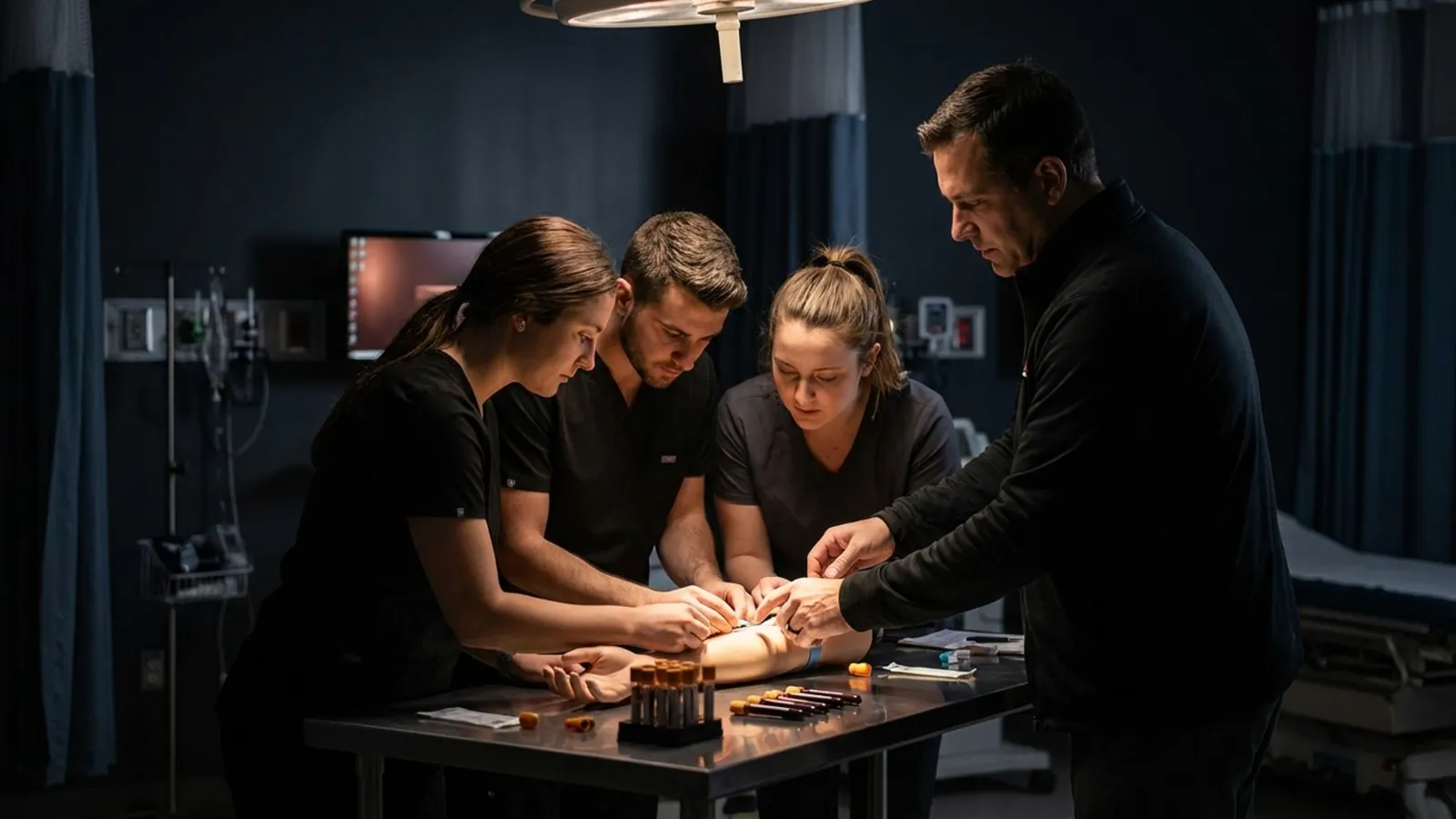
Most IV training programs fail because they use completion-based models that prioritize seat time and certificates over demonstrated competence. Common failures include high student-to-instructor ratios, insufficient live-patient practice, no psychology training, and one-size-fits-all progression. Mastery-based programs fix this by advancing students only when they prove skill proficiency.
Nobody in IV education wants to say this out loud: most graduates walk out feeling just as anxious about IV starts as they did walking in. They have the certificate. They sat through the hours. They practiced on simulation arms. But the first time they face a real patient with deep, rolling veins and coworkers watching over their shoulder, that anxiety floods right back.
The students are not the problem. The model is. Most IV training programs quietly prioritize throughput over skill, and once you see it, you cannot unsee it.
The certificate problem
The standard model is completion-based. You attend a course, work through a checklist, pass a written test, get a certificate. Certificate equals competence, right?
Not even close. A provider who sat through 16 hours and did three supervised sticks on a plastic arm has completed the program. That does not mean they can confidently cannulate a dehydrated 80-year-old whose veins roll at the slightest touch.
The problem goes deeper than pedagogy. Programs need to graduate students to stay in business. Students need the certificate for jobs or credential advancement. Nobody in that equation has a reason to slow down and ask whether the student can actually perform. It is a misaligned incentive, and it runs the whole industry.
So you get an industry that mass-produces anxious providers holding impressive-looking certificates.
Five ways IV training programs break down
We have trained hundreds of healthcare providers and heard their stories about previous training. The same failures come up over and over.
1. Too many students, too few instructors
The economics of IV training push operators toward bigger classes. A session with 12 or 15 students and one or two instructors generates far more revenue than a small-group format. But IV cannulation is a hands-on skill. You need someone watching your angle, your traction, your timing, in real time.
When an instructor is juggling 12 students, they cannot catch the subtle errors that matter. They cannot coach you through the mental side of a tough stick. They cannot give you immediate, specific correction.
This is not a marginal thing. The gap between 1:1 instruction and 12:1 is not a slight difference in outcomes. It is a completely different training experience.
2. Not enough live-patient practice
Many programs lean heavily on simulation, and some rely on it exclusively. Simulation arms have a place -- they let beginners work on basic mechanics without putting patients through unnecessary discomfort. But a simulation arm cannot replicate real venous anatomy, real skin texture, or the psychological weight of performing on another human being.
Providers who train only on simulation develop confidence that evaporates the moment they face a difficult real-world stick. That transition from sim to live patient is where a lot of graduates fall apart. Programs that skip it or rush through it leave their students unprepared for day one on the job.
3. No psychology training
Ask most IV training instructors what they teach and you will hear: anatomy, site selection, insertion technique, safety protocols. Ask about performance psychology and you usually get a blank stare. "That comes with experience."
Except it often does not. Provider anxiety is a huge factor in missed IV sticks. Anxious providers rush their assessment, pick suboptimal sites, use too much force, and miss tactile feedback cues. Worse, they transmit their anxiety to patients, which triggers vasoconstriction, which makes the veins physically harder to access. Anxiety literally makes the veins worse.
The psychology of IV insertion is not a nice-to-have. Programs that skip it are teaching mechanics without the mental framework that makes those mechanics work when the pressure is on.
4. One-size-fits-all progression
In a completion-based program, everyone moves at the same pace. A five-year paramedic who wants to sharpen technique on difficult veins sits through the same introductory anatomy review as someone who has never held a catheter.
This wastes the experienced provider's time and rushes the beginner through material they need to sit with longer. Students who struggle with a specific thing, whether that is palpation, angle control, or performance anxiety, do not get extra reps on their actual weakness.
The fix is straightforward: tie progression to demonstrated competence. You advance when you can perform. Not when the clock says you should.
5. Nothing happens after training ends
Skill development does not stop when the session is over. The weeks right after training are where consolidation happens, or where it falls apart. Without practice and feedback, newly acquired skills fade fast.
Most programs end with a handshake and a certificate. No follow-up. No refresher pathway. No mentorship. The student walks out and figures it out on the job, alone.
This is why we created the Stick Lab: drop-in practice sessions where graduates practice IV starts on each other in a supervised setting for $35. Stick Lab keeps your hands sharp, gives you ongoing feedback, and keeps you connected to a community of other providers who are working on the same stuff. It is the opposite of "here's your certificate, good luck."
What mastery-based learning gets right
The alternative is mastery-based learning, where you progress based on what you can do rather than how long you sat in a chair.
Individualized assessment and pacing
An experienced paramedic refining technique with special populations starts at a different point than a new graduate building basic confidence. The curriculum adapts to the student, not the other way around.
Competence gates, not checklists
Instead of checking boxes ("student observed three insertions," "student attempted one stick on a sim arm"), mastery-based programs require demonstrated proficiency at each stage. You do not move from anatomy to live-patient practice until you can show solid vascular assessment. You do not graduate until you can perform successful insertions consistently.
Psychology as the foundation
In VeinCraft Academy's Level 1: Foundation course, performance psychology is not a 20-minute add-on at the end of the day. It comes first. Students learn visualization techniques, pre-stick routines, and anxiety management before they ever touch a catheter.
There is a reason for this order. When students develop mental tools for managing pressure before they encounter performance situations, they pick up the mechanical skills faster. They are not fighting their own nervous system during practice.
1:1 instruction ratio
At VeinCraft Academy, we maintain a 1:1 instructor-to-student ratio because we have seen what it produces. Your instructor is watching every assessment, every insertion, every line securement. They catch technique issues in real time, reinforce good decisions immediately, and adjust their teaching to how you actually learn.
Progressive skill building
VeinCraft Academy's two-level structure follows a logical progression. Level 1: Foundation builds psychology, anatomy, and technique with live-patient practice. Level 2: Mastery moves into difficult access -- rolling veins, dehydrated patients, elderly and fragile vasculature, special populations. You need the foundational skills to be solid before tackling those.
Students do not jump to Level 2 because they paid for it. They advance because they have demonstrated Level 1 competence.
What the research says
A systematic review in Academic Medicine found that mastery-based learning outperformed time-based training across procedural skills. Students trained under mastery models showed higher first-attempt success rates, lower complication rates, and better skill retention at follow-up.
For IV insertion specifically, the number of supervised live-patient insertions is the best predictor of future competence -- more predictive than written test scores, simulation performance, or hours in a classroom. Programs that maximize supervised live practice produce better clinicians. There is no shortcut around reps.
The psychology piece is backed by research too. Providers who receive explicit training in anxiety management and mental rehearsal perform measurably better under pressure than those who get only technical instruction.
How to evaluate an IV training program
If you are comparing programs, these are the questions worth asking:
What is the student-to-instructor ratio? Anything above 10:1 should make you pause.
How many live sticks will I perform? If the answer is vague or leans heavily on simulation, that is a warning sign.
Does the curriculum include psychology? If not, the program is teaching mechanics without the mental framework needed to perform under pressure.
Is progression competence-based or time-based? Programs that advance students based on demonstrated skill produce better results than programs that advance based on attendance.
What happens after training? Look for follow-up resources or refresher sessions. A certificate and a handshake is not enough.
Making the investment count
A quality mastery-based program costs more than a weekend workshop, but the difference in outcomes is not close.
Providers who complete mastery-based training report higher confidence, lower anxiety during IV procedures, and better first-stick success rates. They also report more career satisfaction because they are not dreading one of the most common procedures in their daily practice.
If you are ready for training that actually changes how you perform, explore VeinCraft Academy's enrollment options.
Frequently asked questions about IV training programs
What makes mastery-based IV training different from traditional programs?
Traditional programs advance students based on completing a set number of hours. Mastery-based training advances students based on demonstrated competence. You do not move forward until you can actually perform the skill, and you do not graduate until you have shown consistent performance with live patients.
How much do quality IV training programs cost?
Most mastery-based programs range from $350 to $500 depending on the level and duration. VeinCraft Academy's Level 1: Foundation is $199 for a one-day intensive, well below most accredited competitors. Level 2: Mastery, which includes ultrasound-guided vascular access, is $299.
Can experienced nurses benefit from IV training programs?
Yes, and many do. Experienced nurses often develop habits or workarounds over the years that limit their effectiveness with difficult veins. A mastery-based program can identify and correct technique issues, introduce advanced assessment strategies, and rebuild confidence with challenging patients. VeinCraft Academy's Level 2: Mastery is built for providers who want to move past baseline competence into expert-level performance.
How long does it take to see results from mastery-based IV training?
Most students notice a measurable difference in confidence and first-stick success rates within their first week back on the job. Because mastery-based training requires demonstrated competence before graduation, the skills are already solidified by the time you leave the course. Ongoing practice through resources like VeinCraft Academy's Stick Lab helps maintain and build on that progress over the following weeks and months.
VeinCraft Academy is a mastery-focused IV cannulation training program for healthcare professionals. All instruction is delivered by credentialed clinicians with active field experience. VeinCraft Academy is a RevivaGo Company.