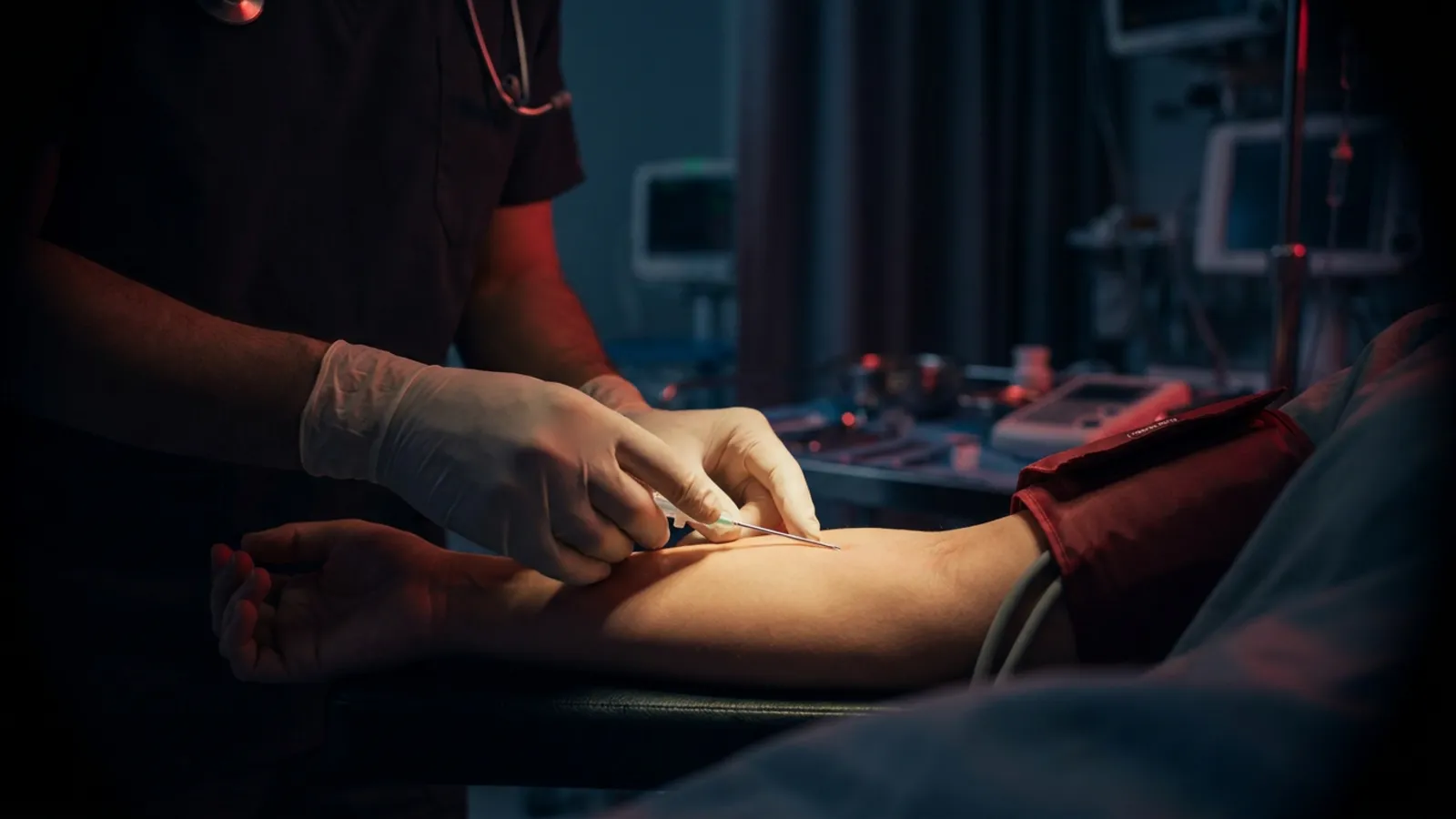
The patient has rolling veins, low blood pressure, and arms that show nothing on visual inspection. You reach for the AccuVein on the wall. Should you?
Vein finder devices have become standard equipment in many hospital units and mobile IV practices. The evidence on whether they actually improve first-stick success is more nuanced than the marketing suggests. This guide breaks down what these devices do, where the research supports their use, and why the right tool is only as effective as the hands using it.
What are vein finder devices?
Vein finder devices are handheld medical tools that visualize peripheral veins through the skin to assist with IV cannulation and venipuncture. The two main technologies are near-infrared (NIR) imaging, which projects a real-time map of veins onto the skin surface, and LED transillumination, which lights the skin from behind so superficial veins appear as dark lines against a glowing background.
Common examples include the AccuVein AV500 and AV600, the VeinViewer Flex, the Veinlite LED+, and the NextVein V800NV. Prices range from around $549 for entry-level LED transilluminators to over $4,500 for hospital-grade NIR projection units.
How vein finder devices work
NIR-based devices use near-infrared light, which penetrates the skin and is absorbed by hemoglobin in the blood. Hemoglobin reflects the light differently than surrounding tissue, so the device renders a vein map and either projects it onto the skin or displays it on a screen. The AccuVein AV500 visualizes veins up to 10 mm beneath the skin and requires no calibration before use.
LED transillumination shines visible red or orange light through the skin from below or beside the limb. Superficial veins appear as dark lines against the glowing background. This method works best on thin tissue, such as neonatal feet, infant hands, and slender adult forearms.
Ultrasound is a third category that some clinicians treat as a vein finder, but it operates differently. Ultrasound shows real-time cross-sections of vessels and surrounding anatomy at depths well beyond what NIR or transillumination can reach. We cover ultrasound-guided peripheral IV (UGPIV) in detail in our ultrasound-guided IV training article and as a core component of Level 2: The Craft.
AccuVein, Veinlite, and other vein finders compared
| Device | Technology | Vein Depth | Best Use Case | Approximate Price |
|---|---|---|---|---|
| AccuVein AV500 / AV600 | NIR projection | Up to 10 mm | Adult and pediatric inpatient, hospital floors | $4,500 to $5,000 |
| VeinViewer Flex | NIR projection | Up to 10 mm | Outpatient infusion, oncology clinics | $4,000 and up |
| Veinlite LED+ | LED transillumination | 4 to 6 mm | Pediatric, neonatal, slender adult forearms | $549 |
| NextVein V800NV | NIR projection, lightweight | Up to 10 mm | Mobile providers, EMS field use | Around $3,700 |
| Ultrasound (point of care) | Sonography | Beyond 25 mm | Obese, edematous, deep brachial or basilic targets | $3,000 to $15,000 |
Bottom line: No single device covers every scenario. NIR projection helps when the vein is shallow but invisible. LED transillumination is preferred for tiny patients with thin tissue. For depth beyond 10 mm, only ultrasound shows you the target.
When vein finder devices actually help (and when they don't)
The evidence on vein finder effectiveness depends heavily on patient population. Marketing literature often presents the devices as universally beneficial. The published research tells a more specific story.
Pediatric difficult access: A study in young children with difficult venous access reported first-attempt success at 74.1% with NIR assistance, compared to 40.7% without (Inal & Demir, Journal of Vascular Access). A 2017 meta-analysis cited in the NCBI review of vein illumination devices found no overall benefit across general pediatric populations, but a meaningful improvement in the DIVA (Difficult IntraVenous Access) subgroup.
Obese and diabetic adults: A randomized study published in the Saudi Electronic Medical Journal in 2021 reported a significantly higher cannulation success rate in obese diabetic patients using a NIR-LED device compared to standard palpation.
Sickle cell disease: A 2024 randomized clinical trial in the International Journal of Nursing Studies showed faster vein access and fewer attempts in adults with sickle cell disease when nurses used a vein visualization device.
General adult population: The same NCBI summary found no clear evidence that these devices outperform standard palpation in adults without difficult access markers. For a healthy, hydrated adult with visible cephalic veins, the device adds time without improving accuracy.
Nurse confidence: Across multiple studies, nurses who used vein finders reported significantly higher confidence at follow-up, even when objective outcomes did not improve. Confidence is real and clinically useful. It is not the same as competence.
Vein finder vs ultrasound for difficult access
| Criteria | Vein Finder (NIR) | Ultrasound (UGPIV) |
|---|---|---|
| Effective vein depth | 0 to 10 mm | 5 to 25+ mm |
| Edema and obesity | Limited usefulness | Strong choice |
| Pediatric DIVA | Evidence supports | Evidence supports |
| Cost | $500 to $5,000 | $3,000 to $15,000+ |
| Training required | Minimal | 8 to 16 hours of structured instruction |
| Real-time needle visualization | No | Yes |
Bottom line: Vein finders help you locate a vein you cannot see. Ultrasound lets you watch the needle enter the lumen of a vein you could not feel. For the dehydrated 80-year-old with rolling veins or the obese patient with deep brachial targets, ultrasound is the higher-yield tool. If your unit has it and you have the training to use it, reach for the probe. For decision criteria on when each tool earns its place at the bedside, see our guide to when to use ultrasound for IV access.
How to use a vein finder in five steps
- Prepare the patient first. Warm the extremity for two to three minutes, apply the tourniquet, and let the patient hydrate if time allows. A vein finder cannot illuminate a vein that physiology has not filled. For technique on this preparation step, see our IV tourniquet techniques guide.
- Position the device per spec. For projection units, hold the device 7 to 12 inches above the skin per the manufacturer's instructions. For transilluminators, place the light source under or beside the extremity.
- Read the map without touching the skin. Identify a straight, branchless segment 2 to 3 cm long. Avoid valves, which appear as small interruptions in the line.
- Palpate before puncture. Confirm the vein with your finger. The device shows you where to look. Your finger confirms what is actually there.
- Insert by feel, not by light. Once the catheter is in motion, your eyes track the angle and your hand reads the resistance. Looking at the projected image during insertion is a common mistake that ruins angle control.
This is the same sequence we teach in Level 1: The Method. The device assists site selection. The skill of cannulation remains in your hands.
Why technology cannot replace palpation
Vein finder marketing often implies that the device transforms an anxious nurse into a confident one. The research tells a different story. The devices help in specific populations, especially pediatric DIVA, obese patients, and sickle cell disease. They do not close the gap for providers who freeze at the bedside, who cannot read tactile feedback through the catheter, or who lack a framework for managing their own stress response in front of a difficult patient.
Our instructors are credentialed clinicians with active field experience, and they will tell you the same thing on the first day of class: the providers with the highest first-stick success rates are not the ones with the most expensive tools. They are the ones who read a vein with their fingertips, manage their central nervous system under pressure, and recover from a missed attempt without losing the room.
That is what we teach. Students advance through Level 1 and Level 2 based on demonstrated competence under instructor observation, not on attendance or device proficiency. The vein finder is a useful adjunct. Becoming the provider everyone calls is a different skill set entirely.
How VeinCraft Academy approaches difficult access
We teach palpation first, technology second. Level 1: The Method ($199) builds the foundation: the psychology of the stick, vein anatomy, site selection, flash recognition, and live cannulation on real patients. Level 2: The Craft ($299) covers hard sticks, special populations, ultrasound-guided access, and advanced troubleshooting for the scenarios where palpation alone is not enough.
Vein finder devices have a place on your unit. They do not replace the hands and the nervous system you bring to every stick. Our Master the Craft bundle ($449 for Level 1 plus Level 2 with a free practice kit) walks you through both levels and ends with the skill set that determines whether you become the go-to person on your floor or the one who keeps reaching for the tool on the wall.
Ready to master the first stick? Explore enrollment for the next cohort in the Phoenix metro.
Are vein finder devices worth the cost for individual nurses?
For individual nurses working in adult med-surg or general practice, vein finder devices are rarely a high-priority personal purchase. The strongest evidence supports use in pediatric difficult access, obese patients, and sickle cell disease, populations for which hospitals typically already provide the device. A $549 Veinlite LED+ may make sense for a mobile IV provider serving pediatric clients or a clinic with a specialized population. For most working RNs, time invested in palpation skill produces a higher return than money spent on a device.
Can a vein finder replace ultrasound for difficult IV access?
No, vein finders cannot replace ultrasound for deep vascular access. NIR and LED devices visualize veins up to roughly 10 mm beneath the skin. Many difficult-access patients have target veins at 10 to 25 mm depth, especially in the brachial and basilic regions. Ultrasound shows real-time needle position relative to the vessel lumen and surrounding anatomy. For coverage of UGPIV technique, see our ultrasound-guided IV training article.
Which vein finder is best for pediatric patients?
LED transilluminators like the Veinlite LED+ are often preferred for neonates and infants because their thin tissue allows visible light to pass through effectively. For older pediatric patients and adolescents, NIR projection devices like AccuVein perform well. The 2017 meta-analysis in the NCBI review noted improvement specifically in the DIVA pediatric subgroup, not in general pediatric use. Match the device to the population, not to the brand. For age-specific access technique, see our pediatric IV access tips.
Do hospitals require nurses to use vein finders?
No, hospitals do not typically require vein finder use as a condition of practice. Most facilities provide the device as an optional resource. Some unit-specific protocols in PICU, oncology infusion centers, or dialysis may require an attempt with the device before escalating to a vascular access specialist or to ultrasound. Check your unit policy and document according to your facility's IV start protocol.
Where can I get training on vein finder devices and difficult access?
Most vein finder manufacturers provide in-service training when a hospital purchases their device. For broader difficult-access training that covers palpation technique, vein finder integration, and ultrasound-guided access, structured programs cover what device-specific training cannot. VeinCraft Academy's Level 2: The Craft is an 8 to 16 hour intensive on hard sticks, special populations, and ultrasound-guided IV with live cannulation on real patients under credentialed clinician supervision.
VeinCraft Academy is a mastery-focused IV cannulation training program for healthcare professionals. All instruction is delivered by credentialed clinicians with active field experience. VeinCraft Academy is a RevivaGo Company.