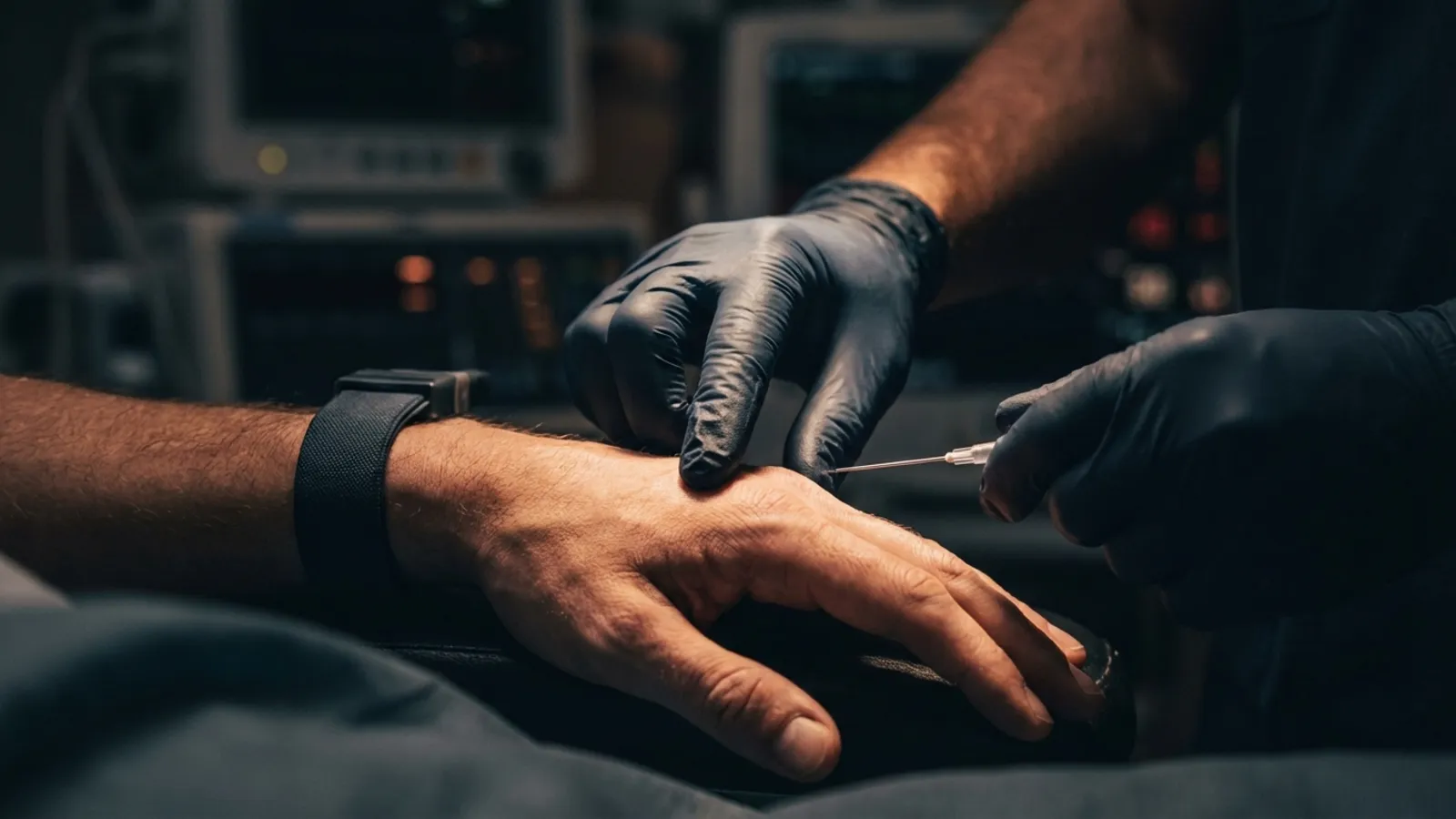
IV access in obese patients requires a shift from visual vein identification to systematic palpation, longer catheters, alternative site selection, and warming techniques. Excess adipose tissue hides peripheral veins from sight, but palpation, proper equipment, and ultrasound guidance restore reliable access even in patients with a BMI above 40.
You walk into the room, apply the tourniquet, and see nothing. No familiar blue lines under the skin. No reassuring vein popping up on the forearm. Just smooth, uninterrupted tissue from wrist to shoulder. If your stomach drops in that moment, you are not alone. Bariatric IV access is one of the most common difficult-access scenarios in clinical practice, and most IV training barely covers it.
According to a study published in the Journal of Infusion Nursing, patients with a BMI over 30 experience difficult IV access at rates two to three times higher than patients of normal weight. The challenge is not that obese patients lack adequate veins. The challenge is that standard visual assessment stops working, and providers who rely on sight over touch run out of options fast.
The mental shift: from sight to touch
Before adjusting your technique, adjust your expectations. Obese patient access is a different game, and the providers who handle it well have made a specific mental shift. They stopped looking for veins and started feeling for them.
That shift matters more than any single technical tip. When visual cues disappear, your nervous system registers "I can't find the vein" as a threat. Heart rate climbs. Hands get less steady. Palpation sensitivity drops right when you need it most. Understanding the psychology of IV insertion is the starting point for any difficult-access scenario, and bariatric access is no exception.
The fix is deliberate calm. Slow your breathing before you pick up the catheter. Remind yourself that the vein is there. You just need your fingertips, not your eyes, to find it. Providers who practice this mental reset before bariatric access attempts report fewer failed sticks and less performance anxiety on subsequent patients.
Palpation techniques for deep veins
Palpation is the primary skill for IV access in obese patients. Developing tactile sensitivity takes practice, but the technique itself is straightforward.
Step 1: Apply a tourniquet and wait. Give venous filling a full 60 seconds. Rushed tourniquet application is one of the most common reasons providers miss palpable veins in obese patients. The extra time lets deeper veins distend enough to become detectable under your fingertips.
Step 2: Palpate systematically. Start at the antecubital fossa and work distally along the forearm. Use the pads of your index and middle fingers with light, rolling pressure. You are feeling for a soft, compressible, tubular structure that bounces back when you release pressure.
Step 3: Distinguish vein from tendon and artery. Tendons feel firm and cord-like. They do not compress. Arteries pulse. Veins compress under pressure and refill when you release. If you feel a bouncy, non-pulsatile tube, you have found your target.
Step 4: Mark the spot. Once you identify a palpable vein, press a thumbnail indent into the skin directly over it. This gives you a visible reference point so you do not lose your target during site preparation.
Step 5: Palpate after prepping. Alcohol prep can change the feel of the skin. Re-palpate through the prepped area to confirm your vein location before you pick up the catheter.
Practice palpating on every patient, even the ones with visible veins. Over months, your fingertips develop the sensitivity to detect veins at increasing depths. That skill pays off the day you need it on a patient with a BMI of 45 and zero visible access.
Site selection: where to look when you cannot see
Not all sites are equally useful in obese patients. Subcutaneous fat distribution varies by body region, and some areas retain palpable veins even at high BMI.
| Site | Advantages | Best for | Catheter length |
|---|---|---|---|
| Antecubital fossa | Larger, deeper veins often palpable | First-line when hand/forearm veins are absent | 1.75 - 2 inches |
| Volar wrist | Less adipose tissue than dorsal hand | Patients with heavy forearm tissue | Standard 1.25 inches |
| Cephalic vein (deltopectoral groove) | Often visible even in very obese patients | BMI 40+ when extremity sites fail | 1.75 - 2 inches |
| Posterior forearm | Less fat than anterior surface | Alternative when anterior sites are exhausted | 1.25 - 1.75 inches |
| Dorsal hand | May have less tissue than forearm | Younger obese patients with less hand adiposity | Standard 1.25 inches |
The cephalic vein in the deltopectoral groove, the depression between the shoulder and chest muscles, deserves special attention. According to the New York School of Regional Anesthesia (NYSORA), this vein is often visible through the skin in obese patients even when all extremity veins are buried. It is an underused site that experienced providers learn to check early in their assessment.
Equipment adjustments for deeper veins
Standard peripheral IV catheters measure 1 to 1.25 inches. In obese patients, the vein may sit 1.5 to 2 inches below the skin surface. A standard catheter that successfully punctures the vein may not thread far enough to seat securely. The catheter enters the vein but lacks the length to stabilize, leading to infiltration within hours.
Use longer catheters. Catheters measuring 1.75 to 2.5 inches provide the extra length needed to traverse deeper subcutaneous tissue and seat properly within the vein. A study in the Annals of Emergency Medicine found that longer catheters placed in obese patients had significantly higher survival rates compared to standard-length catheters at the same sites.
Try the double tourniquet technique. Place two tourniquets on the upper arm, spaced 4 to 6 inches apart. This traps blood in a shorter segment and creates more venous distension in that zone. The increased pressure makes deeper veins more palpable.
Warm the site for 60 to 90 seconds. Heat causes vasodilation, expanding vein diameter and improving palpability. Use a warm pack, a warm moist towel, or have the patient submerge their hand in warm water. Do not skip the wait. Thirty seconds of warming is not enough. Ninety seconds of patient warming followed by a single successful stick beats three rushed attempts on cold, constricted veins.
Consider vein transillumination. Near-infrared vein finder devices project vein maps onto the skin surface. While not a replacement for palpation skill, they provide a visual reference that can confirm what your fingers detect. Studies from UMass Medical Center showed that vein illumination devices improved first-attempt success rates in obese patients by up to 30%.
When to reach for ultrasound
Ultrasound-guided peripheral IV (UGPIV) access is the most reliable method for obese patients when traditional palpation fails. Ultrasound lets you visualize veins in real time, measure their depth, confirm adequate diameter, and guide the catheter into the vessel under direct observation.
Use ultrasound when any of these apply:
- Two traditional attempts have failed on different sites
- No veins are palpable at any standard peripheral site
- The patient has a history of difficult access documented in their chart
- Clinical urgency requires first-attempt success
A study published in the Western Journal of Emergency Medicine found that ultrasound-guided IV placement achieved a 97% success rate in patients with difficult access, compared to 33% for traditional techniques after two failed attempts.
If UGPIV is not yet in your skill set, that is a gap worth closing. Ultrasound-guided vascular access is covered in VeinCraft Academy's Level 2: The Craft curriculum, where you learn probe technique, vessel identification, and real-time guided cannulation on live patients. For more on when ultrasound makes clinical sense, see our guide on ultrasound-guided IV training.
Securing the line in adipose tissue
Getting the catheter in is half the battle. Keeping it in is the other half. Obese patients present unique challenges for line security because adipose tissue moves. When the patient shifts position, deeper tissue layers shift with them, and a catheter that was well-seated can migrate or kink.
Secure aggressively. Use a transparent dressing with a bordered adhesive rather than tape alone. Add a stabilization device (like a StatLock) if available. The goal is zero catheter movement relative to the skin.
Monitor frequently. Check the insertion site at least every two hours for signs of infiltration: swelling, coolness, pain at the site, or slowed infusion rate. Infiltration happens faster in adipose tissue because the catheter has less margin for displacement before it exits the vein wall.
Document the depth. Note how deep the vein was (in centimeters from the skin surface if ultrasound was used) and the catheter length inserted. This helps the next provider if the line needs to be replaced.
How training changes your approach to bariatric access
The difference between a provider who dreads obese patients and one who handles them routinely is not talent. It is preparation. Structured training in palpation, equipment selection, alternative sites, and the mental game turns bariatric IV access from a coin flip into a repeatable process.
VeinCraft Academy's Level 2: The Craft covers bariatric and difficult-access patients as a core curriculum module. You practice deep-vein palpation, longer catheter placement, and ultrasound-guided cannulation on live patients under individualized instruction. Class sizes cap at 10 students with a 10:1 student-to-instructor ratio, so you get real coaching, not a lecture.
Level 2 builds on the psychology-first foundation from Level 1: The Method, where you learn CNS management under clinical pressure before you ever touch a catheter. The combination of mental preparation and advanced technique is what turns anxiety into competence.
At $299 for Level 2 (or $449 for the complete Master the Craft bundle), VeinCraft Academy is priced below every competitor in the market. Ready to become the provider your unit calls for the hard stick? Explore enrollment options.
What is the best IV site for obese patients?
The antecubital fossa is the most reliable first-line site for obese patients because the median cubital and cephalic veins remain palpable at higher BMIs than hand or forearm veins. When antecubital access is not available, the cephalic vein in the deltopectoral groove (between the shoulder and chest) is often visible even in patients with a BMI above 40. The volar wrist and posterior forearm are secondary options with less overlying adipose tissue than the anterior forearm.
What gauge catheter works best for obese patients?
An 18- or 20-gauge catheter in a longer length (1.75 to 2.5 inches) is typically the best choice for obese patients. The larger gauge provides stability during insertion through deeper tissue, and the extra length ensures the catheter seats properly within the vein. Standard 1.25-inch catheters often fail to reach or adequately seat in veins buried under thick subcutaneous tissue, leading to early infiltration or dislodgement.
How does ultrasound help with IV access in obese patients?
Ultrasound allows real-time visualization of veins that are too deep to palpate or see. The probe shows vein location, depth, and diameter, letting you choose an appropriate catheter length and insertion angle before you puncture the skin. Studies show ultrasound-guided IV placement achieves success rates above 90% in patients with difficult access, compared to 30-40% for repeated blind attempts. Ultrasound also reduces the number of needle sticks, which matters for patient comfort and trust.
How many IV attempts should you make before escalating?
Two attempts on different sites is the accepted clinical threshold for peripheral IV access before escalating. After two failed attempts, success rates on subsequent traditional attempts drop significantly while patient discomfort and tissue trauma increase. Escalation options include ultrasound-guided IV placement, a more experienced colleague, or vascular access team consultation. Knowing when to escalate is clinical maturity, not weakness.
VeinCraft Academy is a mastery-focused IV cannulation training program for healthcare professionals. All instruction is delivered by credentialed clinicians with active field experience. VeinCraft Academy is a RevivaGo Company.