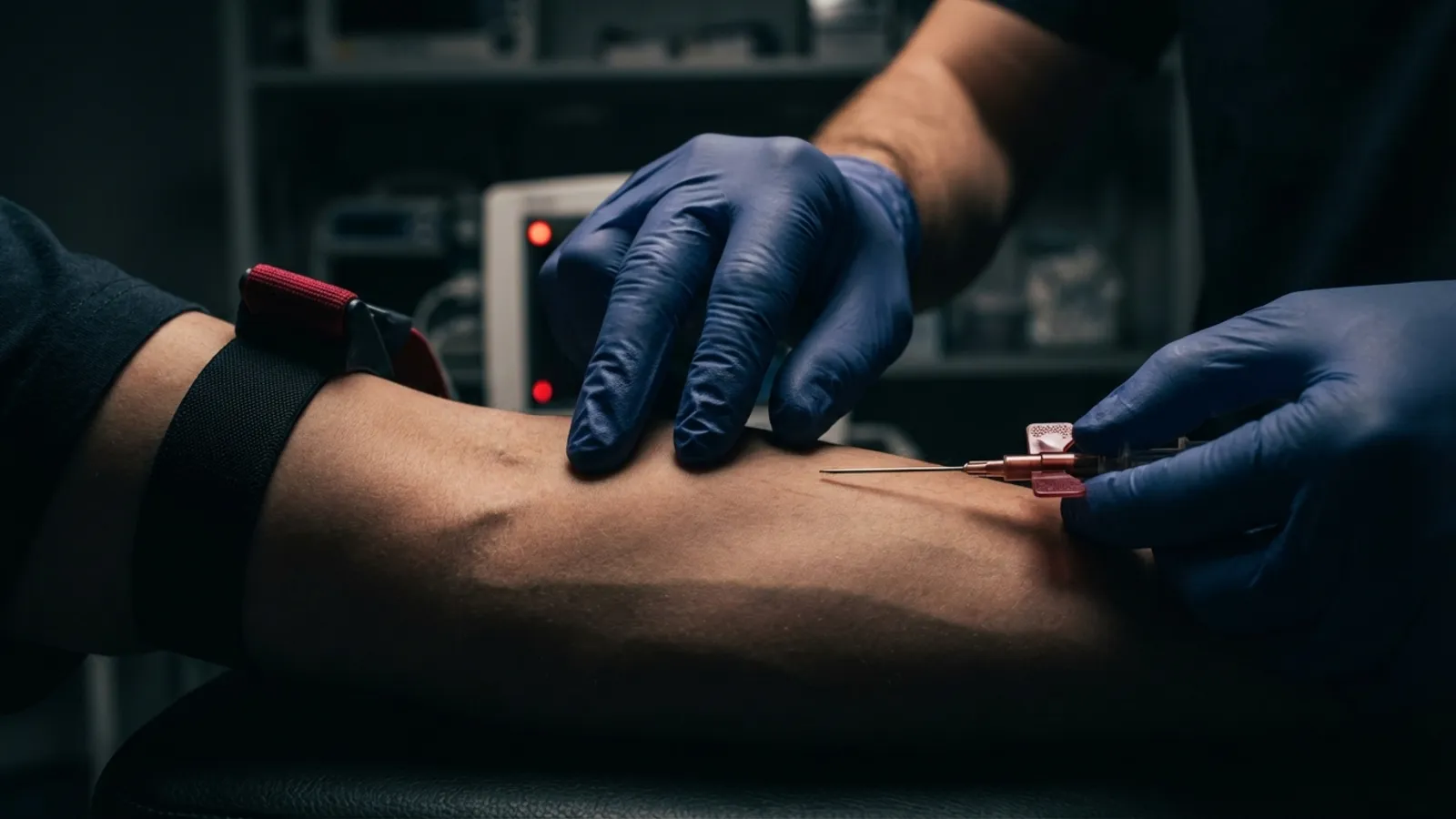
Dehydrated patient IV access requires a specific sequence of vein enhancement steps, catheter adjustments, and clinical judgment that differs from standard cannulation. The core protocol is warming the site for 60 to 90 seconds, gravity-dependent arm positioning, a double tourniquet if needed, a smaller-gauge catheter at a flatter insertion angle, and a fluid challenge when clinically appropriate. Providers who follow this stack consistently report fewer blown veins and higher first-attempt success in the population where it matters most.
You walk into the room and the patient is the textbook picture of volume depletion. Dry lips. Sunken eyes. A nursing assistant has already tried twice. Now it is your turn, and the tourniquet reveals nothing. No bounce. No fill. The veins you would bet on in a well-hydrated patient have gone into hiding, and the charting clock is ticking.
This is one of the most common hard sticks in clinical practice, and it is also one of the most avoidable sources of repeated failed attempts. Most providers approach dehydrated veins the same way they approach healthy ones, and then wonder why the catheter hubs up against a collapsing wall or why the vein rolls away at the first point of contact. The technique is fixable. The providers who master it become the ones their unit calls when nothing else is working.
Why dehydrated veins are harder
Before you adjust your technique, it helps to understand exactly what is happening inside the vessel. Dehydration reduces circulating blood volume. Less volume means lower venous pressure. Lower pressure means veins that should look plump and distended instead look flat, thread-like, and soft to the touch. When you apply a tourniquet, the amount of venous filling you get is proportional to what is available to fill, and in a patient who has been vomiting for eighteen hours there is not much to work with.
The problem does not stop at visibility. A flat vein is a fragile vein. The wall is less supported by internal pressure, so it collapses against the catheter tip instead of letting the bevel through. The vein also rolls more easily because the surrounding connective tissue has nothing firm to anchor against. You get the classic double failure pattern: you think you are in, you advance the catheter, and the vessel either blows or you find yourself chasing a moving target under the skin.
According to a clinical review published in the Journal of Infusion Nursing, volume-depleted patients experience failed first-attempt peripheral IV placement at rates nearly double those of normovolemic patients. The providers who close that gap are not relying on luck. They are running a different playbook.
How to recognize a dehydrated patient before you pick up the tourniquet
Assessment happens in the first thirty seconds of walking into the room, not after your first failed stick. The earlier you recognize volume depletion, the earlier you can set up for success instead of rushing through a standard approach and missing.
Skin turgor check. Pinch the skin on the back of the hand or over the clavicle. In a well-hydrated patient, the skin snaps back immediately. In a dehydrated patient, it tents and returns slowly. This is one of the fastest bedside assessments in nursing and it tells you exactly what to expect from the veins.
Capillary refill. Press the nail bed for three seconds and release. Return to baseline color in under two seconds suggests adequate perfusion. Delayed refill suggests compromised peripheral circulation, which goes hand in hand with dehydrated peripheral veins.
Vital sign patterns. Orthostatic blood pressure changes, tachycardia at rest, and dry mucous membranes are the classic triad. The patient's trend on the flowsheet often tells the story faster than a physical exam. If heart rate is climbing and blood pressure is drifting down, expect flat veins.
Lab markers if available. A BUN-to-creatinine ratio above 20, elevated hematocrit, or a rising sodium value point toward volume depletion. You will not always have fresh labs before you need to place the line, but when they are available they confirm what your hands are about to tell you.
The goal of this assessment is not to document for the chart. It is to prepare your nervous system. When you expect difficult access before you reach for a tourniquet, you slow down, set up your equipment differently, and avoid the rushed attempts that cost you sticks and the patient's trust.
The vein enhancement stack
This is the core technique sequence for dehydrated patient IV access. Each step multiplies the effect of the next. Skipping steps is where most failed attempts originate.
Step 1: Warm the site for 60 to 90 seconds. Heat causes vasodilation, which expands the vessel diameter and increases palpability. Use a commercial warm pack, a warm moist towel, or have the patient place their hand in a basin of warm water. Thirty seconds is not enough. Rush the warming and you rush the stick.
Step 2: Position the arm below heart level. Gravity pulls blood into the peripheral vessels. Have the patient dangle their arm off the side of the bed or rest it on a low surface for at least 30 to 60 seconds before tourniquet application. Combined with warming, this is the cheapest and most underused intervention in IV access.
Step 3: Apply the tourniquet and wait a full 60 seconds. Do not rush this. A rushed tourniquet is the single most common reason providers miss palpable veins in dehydrated patients. Use a proper venous tourniquet, place it four to six inches proximal to the intended site, and let the vein respond.
Step 4: Consider a double tourniquet. Place a second tourniquet four to six inches proximal to the first. The double tourniquet traps blood in a shorter segment of the extremity and creates additional venous distension in the target area. This technique is especially useful when a single tourniquet produces only partial filling.
Step 5: Palpate, do not just look. Dehydrated veins often disappear visually long before they become unpalpable. Use the pads of your index and middle fingers with light rolling pressure. You are feeling for a soft, compressible, bouncy tube. If you find it, mark the spot with a thumbnail indent before you prep.
Step 6: Reassess after prepping. Alcohol prep cools the skin briefly and can change the feel of the tissue. Re-palpate through the prepped area to confirm your target before committing to an insertion angle.
Providers who run this stack consistently report that a surprising number of "impossible" veins become accessible. The key is treating each step as required, not optional.
Fluid challenge: when a small bolus changes the next stick
If you have clinical permission and the patient already has IV access from another provider (even a 24-gauge hand IV that is barely working), consider whether a small volume bolus before the definitive stick would change your odds. A 250 to 500 mL bolus of isotonic crystalloid over 15 to 30 minutes can meaningfully improve venous filling in mildly to moderately volume-depleted patients. In a busy shift it feels slow. In the math of total attempts, it saves you time and protects the patient from repeated sticks.
The fluid challenge is not always appropriate. Patients with heart failure, renal insufficiency, or fluid restrictions need different decisions. But in the dehydrated elderly patient who came in for gastroenteritis, a small bolus through whatever line you can place first is a standard clinical intervention that directly improves access for the larger line you need later. Talk to the provider, make the plan, and sequence the work. This is what experienced teams do.
Catheter selection and insertion angle for flat veins
Equipment matters more in dehydrated patients than in healthy ones. The standard instinct of "bigger is better" works against you here. A flat, collapsing vein cannot accommodate a large-gauge catheter without trauma.
| Factor | Dehydrated vein approach | Why |
|---|---|---|
| Gauge | 22g or 20g, rarely 18g | Smaller bevel traumatizes thin walls less; adequate for crystalloid infusion |
| Length | Standard 1.25 inches for most sites | Longer catheters are for depth, not for thin-walled veins |
| Insertion angle | 10 to 15 degrees (flatter than standard) | Reduces risk of puncturing through the back wall of a collapsed vessel |
| Tourniquet release timing | Release immediately after flash | Releases pressure on the fragile vein before advancing the catheter |
| Advance speed | Slow and deliberate | Fast advance increases the chance of blowing a soft vein |
Bottom line: Go one gauge smaller than you think, come in flatter than your standard angle, and advance like you are defusing something. A 22-gauge that flows is infinitely better than an 18-gauge that blew.
Notice that this is the opposite of the guidance for bariatric access, where you often want longer catheters and a larger gauge. Population-specific technique is the whole game. For more on how to adapt your approach, see our guide to IV access in obese patients and the broader discussion of difficult veins and rolling veins.
When to bypass peripheral access
There is a point at which continuing to attempt peripheral access on a dehydrated patient is a disservice to the patient and to your own learning curve. Two failed attempts on two different sites is the widely accepted clinical threshold. After that, escalation options include ultrasound-guided peripheral access, external jugular access if it is within your scope, or intraosseous access in a true emergency.
Ultrasound-guided peripheral IV (UGPIV). This is the most reliable escalation pathway for dehydrated patients because ultrasound lets you see veins that are no longer palpable. A study in the Western Journal of Emergency Medicine reported UGPIV success rates near 97% in patients with documented difficult access, compared to 33% for continued blind attempts. If ultrasound-guided access is not yet in your skill set, ultrasound-guided IV training is one of the highest-value skill additions you can make.
External jugular access. Within scope for many RNs and most paramedics, the EJ is a reliable last-resort peripheral site when arm and hand veins are exhausted. It is often visible even in significantly dehydrated patients because of its anatomical position and its tendency to distend with Valsalva or Trendelenburg positioning.
Intraosseous access. In the true emergency where peripheral access has failed and resuscitation is immediate, IO access is a proven bridge to central access. It is not a routine tool, but knowing when to reach for it is part of clinical maturity.
Calling for help earlier is not a failure. It is triage. The provider who runs three more unsuccessful attempts before escalating has cost the patient time, comfort, and trust.
The psychology of the stick when the first target fails
Dehydrated access exposes every mental weakness in the provider. Your first attempt fails. The patient winces. You feel your heart rate climb. Your hands get less steady right when you need them most. The next attempt is measurably worse than the first because your central nervous system has already decided that this stick is a threat.
This is not weakness. It is physiology, and it is trainable. The psychology of IV insertion is the foundation of the VeinCraft Academy curriculum for a reason. Before technique, before equipment, before anatomy, providers need to manage their own CNS response under clinical pressure. The bear at the river analogy matters here: calm until the precise moment of action, explosive only when the conditions are right.
Concretely, that means a deliberate three-breath reset between failed attempts. It means verbalizing the plan out loud to reduce tunnel vision. It means giving yourself permission to escalate rather than chasing a sunk-cost stick. The providers who walk into a dehydrated patient's room and handle it routinely have trained these responses, not just the hand skills.
For nurses who recognize IV insertion anxiety as a real obstacle rather than a personal flaw, the path forward is structured training, not more shifts hoping exposure will fix it.
How VeinCraft Academy trains for dehydrated patient IV access
Dehydrated patient IV access is a core scenario in the VeinCraft Academy Level 2: The Craft curriculum. Students practice the full vein enhancement stack, run the protocol on simulated and live patients, and progress through difficult access scenarios under the observation of credentialed clinical instructors with active field experience.
All VeinCraft Academy classes cap at ten students with a 10:1 student-to-instructor ratio. You do not learn this skill by watching a lecture. You learn it by running the stack, missing, getting coached, running it again, and doing it on a real patient with an instructor at your shoulder. Mastery-based progression means you advance when you can demonstrate competence under observation, not when the clock runs out.
Level 2 builds on the foundation taught in Level 1: The Method, where students learn CNS management and technique basics before advancing to difficult access and ultrasound-guided cannulation. At $299 for Level 2 or $449 for the complete Master the Craft bundle, VeinCraft is priced below every competitor in the market.
Ready to make dehydrated patient IV access a routine stick instead of a coin flip? Explore enrollment and reserve a seat in the next cohort.
What are the signs a patient is too dehydrated for easy IV access?
The quickest bedside signs are poor skin turgor (tenting on pinch), delayed capillary refill over two seconds, dry mucous membranes, tachycardia at rest, and veins that fail to distend under a properly applied tourniquet. Lab markers like a BUN-to-creatinine ratio above 20 and elevated hematocrit confirm the clinical picture. When any of these are present, plan for difficult access before reaching for the tourniquet rather than starting with a standard approach and adjusting after the first miss.
Should you give fluids before starting a new IV on a dehydrated patient?
If the patient already has any working IV access, even a small-gauge line, a 250 to 500 mL bolus of isotonic crystalloid over 15 to 30 minutes can meaningfully improve venous filling for a subsequent larger-gauge placement. This is a routine intervention in many clinical settings, but it is not appropriate for every patient. Discuss the plan with the provider, confirm there are no contraindications like heart failure or fluid restriction, and sequence the fluid challenge before the definitive stick.
What gauge catheter is best for a dehydrated patient?
A 22-gauge or 20-gauge catheter is typically the better choice for dehydrated patients than an 18-gauge. Smaller gauges traumatize the thin, flat vein wall less during insertion and are still adequate for crystalloid infusion. A flowing 22-gauge beats a blown 18-gauge every time. Reserve 18-gauge placements for patients with clearly distensible veins who need large-volume or rapid infusion.
How long should you warm a site before IV insertion on a dehydrated patient?
Warm the intended site for 60 to 90 seconds. Thirty seconds is not enough to produce meaningful vasodilation. Use a commercial warm pack, a warm moist towel, or have the patient place their hand in a basin of warm water. Combined with gravity-dependent arm positioning and a patient tourniquet application, the warming step is one of the highest-yield interventions for improving venous filling in volume-depleted patients.
How many attempts should you make on a dehydrated patient before escalating?
Two attempts on two different sites is the accepted clinical threshold for peripheral IV access before escalating. After two failed attempts, subsequent blind-palpation success rates drop sharply while patient discomfort and tissue trauma rise. Escalation options include ultrasound-guided peripheral IV placement, external jugular access if within scope, or intraosseous access in a true emergency. Knowing when to call for help is clinical maturity, not weakness.
VeinCraft Academy is a mastery-focused IV cannulation training program for healthcare professionals. All instruction is delivered by credentialed clinicians with active field experience. VeinCraft Academy is a RevivaGo Company.